To cherish what remains of the Earth and to foster its renewal is our only legitimate hope of survival.
—Wendell Berry
National Park Service U. S. Department of Interior Golden Gate National Recreation Area
At Muir Beach, a complex network of freshwater wetlands, lagoon, and dunes defines the meeting place of Redwood Creek and the Pacific Ocean. Here, across a broad floodplain, intertwined natural systems perform an intricate seasonal and biological dance.
Redwood Creek drains an 8.9-square-mile watershed that extends from the ridgetops of Mt. Tamalpais through the old-growth forest of Muir Woods National Monument to the ocean. Largely undeveloped, the watershed functions as an essentially intact unit. Within this compact territory, a highly diverse range of habitats, many of them irreplaceable to their inhabitants, can be found.
Redwood Creek watershed is part of the Golden Gate Biosphere Reserve as well as one of North America’s biodiversity “hotspots.” These ecologi-cally critical areas represent some of the planet’s richest and most threatened reservoirs of plant and animal life.
The watershed is home to several of the West Coast’s most imperiled species, among them, coho salmon, steelhead trout, and the California red- legged frog. Habitat restoration has helped its red- legged frog population, but coho salmon are still in a highly precarious position. When salmon return to their native spawning grounds in upper Redwood Creek, they bring deep-ocean nutrients to the redwood forest. Without the salmon, a key piece of the age-old cycle of the redwood forest is gone and an important connection is lost.
EXPERIENCE YOUR AMERICA™
www.nps.gov/goga
For more than 10,000 years, the Coast Miwok lived in roughly 600 small family communities along the shoreline. Stewards of the land, they managed the local watersheds where creek and ocean resources were most abundant, including the Muir Beach floodplain. Here, they hunted, fished, and harvested many of the native plants for food, medicine, and other traditional uses. In developing traditional ecological knowledge, land- tending principles, and alignment of cultural customs with the seasons, they fostered a harmonious relationship with the natural world.
In the late 1700s, European settlement forced the Coast Miwok off their land and abruptly shifted their way of life forever.
Descendants of the Coast Miwok, members of what is known today as the Federated Indians of Graton Rancheria, continue to participate in research, education, cultural revitalization, and preservation of sacred sites.
Beginning in the mid-19th century, much of the watershed’s land was leased to Portuguese dairymen, who had emigrated from the Azores on whaling ships. By the 1880s, Marin County was California’s largest producer of fresh milk and butter. After World War II, the ranches declined, and most were incorporated into the California State Park system in the 1960s.
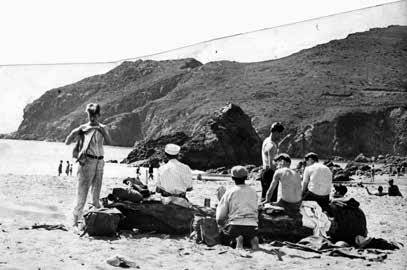
Get-together at a local dairy ranch. (photos from George Kristian Lindholdt)
Muir Beach—known as Big Lagoon Beach until the late 1930s—has always been a popular place for recreation. Early-day beachgoers picnicked, camped, fished for salmon and trout, and hiked here. Others came to dine and dance at the Old Tavern, built in the early 1920s, or stay in one of the summer cottages.
Weekend visitors catch a few fish (photos from George Kristian Lindholdt)
EXPERIENCE YOUR AMERICA™
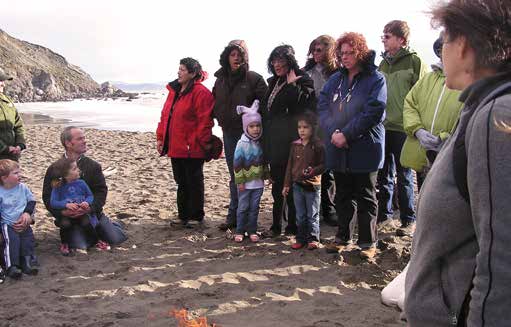
Left, Top & Bottom images: Traditional prayer led by a representative of the Coast Miwok at the annual Welcome Back Salmon ceremony at Muir Beach.
www.nps.gov/goga
During the 20th century, human use changed the natural landscape of the wetland and creek habitat at Muir Beach. Farming, cattle and dairy ranching, road construction, and beachfront development collectively confined the creek, cut it off from its floodplain, caused it to fill with sediment, and diminished habitats.
Click the link for more information.
Lend a hand in the ongoing effort to restore native plant communities and manage invasive species at Muir Beach and other parklands.
www.parksconservancy.org
Learn what you can do to help protect the ocean.
www.thankyouocean.org www.bluefront.org
5gyres.org
Get involved in the campaign to improve air quality in the San Francisco Bay Area.
www.sparetheair.org
In collaboration with public agencies and nonprofit partners, the National Park Service implemented a multi-year, large-scale restoration plan. This work has freed the creek to meander naturally and reconnect with its wetland system, expanded the lagoon, created frog- breeding habitat, and enhanced sand dunes, setting the stage for the site’s return to ecological integrity.
www.nps.gov/goga
Muir Beach is halfway between Stinson Beach and the Marin Headlands, where Shoreline Highway (Hwy. 1) meets Muir Woods Road. The Coastal, Redwood Creek, and Dias Ridge Trails connect with Muir Beach.
EXPERIENCE YOUR AMERICA™
www.nps.gov/goga