
Key Management Interoperability Protocol Specification Version 1.4
OASIS Standard
22 November 2017
Specification URIs
This version:
http://docs.oasis-open.org/kmip/spec/v1.4/os/kmip-spec-v1.4-os.docx (Authoritative)
http://docs.oasis-open.org/kmip/spec/v1.4/os/kmip-spec-v1.4-os.html
http://docs.oasis-open.org/kmip/spec/v1.4/os/kmip-spec-v1.4-os.pdf
Previous version:
http://docs.oasis-open.org/kmip/spec/v1.4/cs01/kmip-spec-v1.4-cs01.docx (Authoritative)
http://docs.oasis-open.org/kmip/spec/v1.4/cs01/kmip-spec-v1.4-cs01.html
http://docs.oasis-open.org/kmip/spec/v1.4/cs01/kmip-spec-v1.4-cs01.pdf
Latest version:
http://docs.oasis-open.org/kmip/spec/v1.4/kmip-spec-v1.4.docx (Authoritative)
http://docs.oasis-open.org/kmip/spec/v1.4/kmip-spec-v1.4.html
http://docs.oasis-open.org/kmip/spec/v1.4/kmip-spec-v1.4.pdf
Technical Committee:
OASIS Key Management Interoperability Protocol (KMIP) TC
Chairs:
Judith Furlong (Judith.Furlong@dell.com), Dell
Tony Cox (tony.cox@cryptsoft.com), Cryptsoft Pty Ltd.
Editor:
Tony Cox (tony.cox@cryptsoft.com), Cryptsoft Pty Ltd.
<w:bookmarkStart w:id="0" w:name="RelatedWork"/>Related work<w:bookmarkEnd w:id="0"/>:
This specification replaces or supersedes:
Key Management Interoperability Protocol Specification Version 1.0. Edited by Robert Haas and Indra Fitzgerald. 01 October 2010. OASIS Standard. http://docs.oasis-open.org/kmip/spec/v1.0/os/kmip-spec-1.0-os.html.
Key Management Interoperability Protocol Specification Version 1.1. Edited by Robert Haas and Indra Fitzgerald. 24 January 2013. OASIS Standard. http://docs.oasis-open.org/kmip/spec/v1.1/os/kmip-spec-v1.1-os.html.
Key Management Interoperability Protocol Specification Version 1.2. Edited by Kiran Thota and Kelley Burgin. 19 May 2015. OASIS Standard. http://docs.oasis-open.org/kmip/spec/v1.2/os/kmip-spec-v1.2-os.html.
Key Management Interoperability Protocol Specification Version 1.3. Edited by Kiran Thota and Tony Cox. 27 December 2016. OASIS Standard. http://docs.oasis-open.org/kmip/spec/v1.3/os/kmip-spec-v1.3-os.html.
This specification is related to:
Key Management Interoperability Protocol Profiles Version 1.4. Edited by Tim Hudson and Robert Lockhart. Latest version: http://docs.oasis-open.org/kmip/profiles/v1.4/kmip-profiles-v1.4.html.
Key Management Interoperability Protocol Test Cases Version 1.4. Edited by Tim Hudson and Mark Joseph. Latest version: http://docs.oasis-open.org/kmip/testcases/v1.4/kmip-testcases-v1.4.html.
Key Management Interoperability Protocol Usage Guide Version 1.4. Edited by Judith Furlong. Latest version: http://docs.oasis-open.org/kmip/ug/v1.4/kmip-ug-v1.4.html.
Abstract:
This document is intended for developers and architects who wish to design systems and applications that interoperate using the Key Management Interoperability Protocol Specification.
Status:
This document was last revised or approved by the Members of OASIS on the above date. The level of approval is also listed above. Check the “Latest version” location noted above for possible later revisions of this document. Any other numbered Versions and other technical work produced by the Technical Committee (TC) are listed at https://www.oasis-open.org/committees/tc_home.php?wg_abbrev=kmip#technical.
TC members should send comments on this specification to the TC’s email list. Others should send comments to the TC’s public comment list, after subscribing to it by following the instructions at the “Send A Comment” button on the TC’s web page at https://www.oasis-open.org/committees/kmip/.
This OASIS Standard is provided under the RF on RAND Terms Mode of the OASIS IPR Policy, the mode chosen when the Technical Committee was established. For information on whether any patents have been disclosed that may be essential to implementing this specification, and any offers of patent licensing terms, please refer to the Intellectual Property Rights section of the TC’s web page (https://www.oasis-open.org/committees/kmip/ipr.php).
Note that any machine-readable content (Computer Language Definitions) declared Normative for this Work Product is provided in separate plain text files. In the event of a discrepancy between any such plain text file and display content in the Work Product's prose narrative document(s), the content in the separate plain text file prevails.
Citation format:
When referencing this specification the following citation format should be used:
[kmip-spec-v1.4]
Key Management Interoperability Protocol Specification Version 1.4. Edited by Tony Cox. 22 November 2017. OASIS Standard. http://docs.oasis-open.org/kmip/spec/v1.4/os/kmip-spec-v1.4-os.html. Latest version: http://docs.oasis-open.org/kmip/spec/v1.4/kmip-spec-v1.4.html.
Notices
Copyright © OASIS Open 2017. All Rights Reserved.
All capitalized terms in the following text have the meanings assigned to them in the OASIS Intellectual Property Rights Policy (the "OASIS IPR Policy"). The full Policy may be found at the OASIS website.
This document and translations of it may be copied and furnished to others, and derivative works that comment on or otherwise explain it or assist in its implementation may be prepared, copied, published, and distributed, in whole or in part, without restriction of any kind, provided that the above copyright notice and this section are included on all such copies and derivative works. However, this document itself may not be modified in any way, including by removing the copyright notice or references to OASIS, except as needed for the purpose of developing any document or deliverable produced by an OASIS Technical Committee (in which case the rules applicable to copyrights, as set forth in the OASIS IPR Policy, must be followed) or as required to translate it into languages other than English.
The limited permissions granted above are perpetual and will not be revoked by OASIS or its successors or assigns.
This document and the information contained herein is provided on an "AS IS" basis and OASIS DISCLAIMS ALL WARRANTIES, EXPRESS OR IMPLIED, INCLUDING BUT NOT LIMITED TO ANY WARRANTY THAT THE USE OF THE INFORMATION HEREIN WILL NOT INFRINGE ANY OWNERSHIP RIGHTS OR ANY IMPLIED WARRANTIES OF MERCHANTABILITY OR FITNESS FOR A PARTICULAR PURPOSE.
OASIS requests that any OASIS Party or any other party that believes it has patent claims that would necessarily be infringed by implementations of this OASIS Committee Specification or OASIS Standard, to notify OASIS TC Administrator and provide an indication of its willingness to grant patent licenses to such patent claims in a manner consistent with the IPR Mode of the OASIS Technical Committee that produced this specification.
OASIS invites any party to contact the OASIS TC Administrator if it is aware of a claim of ownership of any patent claims that would necessarily be infringed by implementations of this specification by a patent holder that is not willing to provide a license to such patent claims in a manner consistent with the IPR Mode of the OASIS Technical Committee that produced this specification. OASIS may include such claims on its website, but disclaims any obligation to do so.
OASIS takes no position regarding the validity or scope of any intellectual property or other rights that might be claimed to pertain to the implementation or use of the technology described in this document or the extent to which any license under such rights might or might not be available; neither does it represent that it has made any effort to identify any such rights. Information on OASIS' procedures with respect to rights in any document or deliverable produced by an OASIS Technical Committee can be found on the OASIS website. Copies of claims of rights made available for publication and any assurances of licenses to be made available, or the result of an attempt made to obtain a general license or permission for the use of such proprietary rights by implementers or users of this OASIS Committee Specification or OASIS Standard, can be obtained from the OASIS TC Administrator. OASIS makes no representation that any information or list of intellectual property rights will at any time be complete, or that any claims in such list are, in fact, Essential Claims.
The name "OASIS" is a trademark of OASIS, the owner and developer of this specification, and should be used only to refer to the organization and its official outputs. OASIS welcomes reference to, and implementation and use of, specifications, while reserving the right to enforce its marks against misleading uses. Please see https://www.oasis-open.org/policies-guidelines/trademark for above guidance.
Table of Contents
1.3 Non-Normative References 17
2.1.6 Key Wrapping Specification 25
2.1.7 Transparent Key Structures 26
2.1.7.1 Transparent Symmetric Key 27
2.1.7.2 Transparent DSA Private Key 27
2.1.7.3 Transparent DSA Public Key 28
2.1.7.4 Transparent RSA Private Key 28
2.1.7.5 Transparent RSA Public Key 29
2.1.7.6 Transparent DH Private Key 29
2.1.7.7 Transparent DH Public Key 29
2.1.7.8 Transparent ECDSA Private Key 29
2.1.7.9 Transparent ECDSA Public Key 30
2.1.7.10 Transparent ECDH Private Key 30
2.1.7.11 Transparent ECDH Public Key 30
2.1.7.12 Transparent ECMQV Private Key 31
2.1.7.13 Transparent ECMQV Public Key 31
2.1.7.14 Transparent EC Private Key 31
2.1.7.15 Transparent EC Public Key 32
2.1.8 Template-Attribute Structures 32
2.1.9 Extension Information 32
2.1.20 Validation Information 36
2.1.21 Capability Information 36
2.1.22 Authenticated Encryption Additional Data 37
2.1.23 Authenticated Encryption Tag 37
3.4 Cryptographic Algorithm 45
3.6 Cryptographic Parameters 46
3.7 Cryptographic Domain Parameters 49
3.10 X.509 Certificate Identifier 50
3.11 X.509 Certificate Subject 51
3.12 X.509 Certificate Issuer 52
3.13 Certificate Identifier 52
3.16 Digital Signature Algorithm 54
3.18.1 Operations outside of operation policy control 57
3.18.2 Default Operation Policy 57
3.18.2.1 Default Operation Policy for Secret Objects 57
3.18.2.2 Default Operation Policy for Certificates and Public Key Objects 58
3.18.2.3 Default Operation Policy for Template Objects 59
3.19 Cryptographic Usage Mask 60
3.29 Compromise Occurrence Date 69
3.36 Application Specific Information 73
3.43 Original Creation Date 77
3.44 Random Number Generator 78
4 Client-to-Server Operations 83
5 Server-to-Client Operations 136
6.7 Asynchronous Indicator 142
6.8 Asynchronous Correlation Value 142
6.13 Batch Error Continuation Option 144
6.17 Attestation Capable Indicator 146
6.18 Client Correlation Value 146
6.19 Server Correlation Value 146
9.1.1 TTLV Encoding Fields 151
9.1.3.2.1 Credential Type Enumeration 162
9.1.3.2.2 Key Compression Type Enumeration 163
9.1.3.2.3 Key Format Type Enumeration 163
9.1.3.2.4 Wrapping Method Enumeration 164
9.1.3.2.5 Recommended Curve Enumeration 164
9.1.3.2.6 Certificate Type Enumeration 166
9.1.3.2.7 Digital Signature Algorithm Enumeration 167
9.1.3.2.8 Split Key Method Enumeration 168
9.1.3.2.9 Secret Data Type Enumeration 168
9.1.3.2.10 Opaque Data Type Enumeration 168
9.1.3.2.11 Name Type Enumeration 168
9.1.3.2.12 Object Type Enumeration 169
9.1.3.2.13 Cryptographic Algorithm Enumeration 170
9.1.3.2.14 Block Cipher Mode Enumeration 171
9.1.3.2.15 Padding Method Enumeration 172
9.1.3.2.16 Hashing Algorithm Enumeration 172
9.1.3.2.17 Key Role Type Enumeration 173
9.1.3.2.18 State Enumeration 174
9.1.3.2.19 Revocation Reason Code Enumeration 174
9.1.3.2.20 Link Type Enumeration 174
9.1.3.2.21 Derivation Method Enumeration 175
9.1.3.2.22 Certificate Request Type Enumeration 175
9.1.3.2.23 Validity Indicator Enumeration 176
9.1.3.2.24 Query Function Enumeration 176
9.1.3.2.25 Cancellation Result Enumeration 176
9.1.3.2.26 Put Function Enumeration 177
9.1.3.2.27 Operation Enumeration 178
9.1.3.2.28 Result Status Enumeration 179
9.1.3.2.29 Result Reason Enumeration 180
9.1.3.2.30 Batch Error Continuation Option Enumeration 181
9.1.3.2.31 Usage Limits Unit Enumeration 181
9.1.3.2.32 Encoding Option Enumeration 181
9.1.3.2.33 Object Group Member Enumeration 181
9.1.3.2.34 Alternative Name Type Enumeration 181
9.1.3.2.35 Key Value Location Type Enumeration 182
9.1.3.2.36 Attestation Type Enumeration 182
9.1.3.2.37 RNG Algorithm Enumeration 182
9.1.3.2.38 DRBG Algorithm Enumeration 183
9.1.3.2.39 FIPS186 Variation Enumeration 183
9.1.3.2.40 Validation Authority Type Enumeration 183
9.1.3.2.41 Validation Type Enumeration 184
9.1.3.2.42 Profile Name Enumeration 184
9.1.3.2.43 Unwrap Mode Enumeration 188
9.1.3.2.44 Destroy Action Enumeration 190
9.1.3.2.45 Shredding Algorithm Enumeration 190
9.1.3.2.46 RNG Mode Enumeration 190
9.1.3.2.47 Client Registration Method Enumeration 190
9.1.3.2.48 Key Wrap Type Enumeration 190
9.1.3.2.49 Mask Generator Enumeration 191
9.1.3.3.1 Cryptographic Usage Mask 191
9.1.3.3.2 Storage Status Mask 192
11.19 Get Usage Allocation 207
12 KMIP Server and Client Implementation Conformance 217
12.1 KMIP Server Implementation Conformance 217
12.2 KMIP Client Implementation Conformance 217
Appendix A. Acknowledgments 218
Appendix B. Attribute Cross-Reference 219
Appendix C. Tag Cross-Reference 221
Appendix D. Operations and Object Cross-Reference 227
Appendix F. List of Figures and Tables 233
Appendix G. Revision History 242
This document is intended as a specification of the protocol used for the communication between clients and servers to perform certain management operations on objects stored and maintained by a key management system. These objects are referred to as Managed Objects in this specification. They include symmetric and asymmetric cryptographic keys, digital certificates, and templates used to simplify the creation of objects and control their use. Managed Objects are managed with operations that include the ability to generate cryptographic keys, register objects with the key management system, obtain objects from the system, destroy objects from the system, and search for objects maintained by the system. Managed Objects also have associated attributes, which are named values stored by the key management system and are obtained from the system via operations. Certain attributes are added, modified, or deleted by operations.
The protocol specified in this document includes several certificate-related functions for which there are a number of existing protocols – namely Validate (e.g., SCVP or XKMS), Certify (e.g., CMP [RFC4210], CMC [RFC5272][RFC6402], SCEP) and Re-certify (e.g., CMP [RFC4210], CMC [RFC5272][RFC6402], SCEP). The protocol does not attempt to define a comprehensive certificate management protocol, such as would be needed for a certification authority. However, it does include functions that are needed to allow a key server to provide a proxy for certificate management functions.
In addition to the normative definitions for managed objects, operations and attributes, this specification also includes normative definitions for the following aspects of the protocol:
• The expected behavior of the server and client as a result of operations,
• Message contents and formats,
• Message encoding (including enumerations), and
• Error handling.
This specification is complemented by several other documents. The KMIP Usage Guide[KMIP-UG] provides illustrative information on using the protocol. The KMIP Profiles Specification [KMIP-Prof] provides a selected set of base level conformance profiles and authentication suites; additional KMIP Profiles define specific sets of KMIP functionality for conformance purposes. The KMIP Test Specification [KMIP-TC] provides samples of protocol messages corresponding to a set of defined test cases.
This specification defines the KMIP protocol version major 1 and minor 2 (see 6.1).
This OASIS Standard is provided under the RF on RAND Terms Mode of the OASIS IPR Policy, the mode chosen when the Technical Committee was established.
For information on whether any patents have been disclosed that may be essential to implementing this specification, and any offers of patent licensing terms, please refer to the Intellectual Property Rights section of the TC’s web page (https://www.oasis-open.org/committees/kmip/ipr.php).
The key words “MUST”, “MUST NOT”, “REQUIRED”, “SHALL”, “SHALL NOT”, “SHOULD”, “SHOULD NOT”, “RECOMMENDED”, “MAY”, and “OPTIONAL” in this document are to be interpreted as described in [RFC2119].
For acronyms used in this document, see Appendix E. For definitions not found in this document, see [SP800-57-1].
| Term | Definition |
|---|---|
| Archive | To place information not accessed frequently into long-term storage. |
Asymmetric key pair (key pair) | A public key and its corresponding private key; a key pair is used with a public key algorithm. |
| Authentication | A process that establishes the origin of information, or determines an entity’s identity. |
| Authentication code | A cryptographic checksum based on a security function. |
| Authorization | Access privileges that are granted to an entity; conveying an “official” sanction to perform a security function or activity. |
| Certificate length | The length (in bytes) of an X.509 public key certificate. |
| Certification authority | The entity in a Public Key Infrastructure (PKI) that is responsible for issuing certificates, and exacting compliance to a PKI policy. |
| Ciphertext | Data in its encrypted form. |
| Compromise | The unauthorized disclosure, modification, substitution or use of sensitive data (e.g., keying material and other security-related information). |
| Confidentiality | The property that sensitive information is not disclosed to unauthorized entities. |
| Cryptographic algorithm | A well-defined computational procedure that takes variable inputs, including a cryptographic key and produces an output. |
| Cryptographic key (key) | A parameter used in conjunction with a cryptographic algorithm that determines its operation in such a way that an entity with knowledge of the key can reproduce or reverse the operation, while an entity without knowledge of the key cannot. Examples include: 1. The transformation of plaintext data into ciphertext data, 2. The transformation of ciphertext data into plaintext data, 3. The computation of a digital signature from data, 4. The verification of a digital signature, 5. The computation of an authentication code from data, and 6. The verification of an authentication code from data and a received authentication code. |
| Decryption | The process of changing ciphertext into plaintext using a cryptographic algorithm and key. |
| Digest (or hash) | The result of applying a hashing algorithm to information. |
| Digital signature (signature) | The result of a cryptographic transformation of data that, when properly implemented with supporting infrastructure and policy, provides the services of: 1. origin authentication 2. data integrity, and 3. signer non-repudiation. |
| Digital Signature Algorithm | A cryptographic algorithm used for digital signature. |
| Encryption | The process of changing plaintext into ciphertext using a cryptographic algorithm and key. |
| Hashing algorithm (or hash algorithm, hash function) | An algorithm that maps a bit string of arbitrary length to a fixed length bit string. Approved hashing algorithms satisfy the following properties: 1. (One-way) It is computationally infeasible to find any input that maps to any pre-specified output, and 2. (Collision resistant) It is computationally infeasible to find any two distinct inputs that map to the same output. |
| Integrity | The property that sensitive data has not been modified or deleted in an unauthorized and undetected manner. |
| Key derivation (derivation) | A function in the lifecycle of keying material; the process by which one or more keys are derived from: 1) Either a shared secret from a key agreement computation or a pre-shared cryptographic key, and 2) Other information. |
| Key management | The activities involving the handling of cryptographic keys and other related security parameters (e.g., IVs and passwords) during the entire life cycle of the keys, including their generation, storage, establishment, entry and output, and destruction. |
| Key wrapping (wrapping) | A method of encrypting and/or MACing/signing keys. |
| Message Authentication Code (MAC) | A cryptographic checksum on data that uses a symmetric key to detect both accidental and intentional modifications of data. |
| PGP Key | A RFC 4880-compliant container of cryptographic keys and associated metadata. Usually text-based (in PGP-parlance, ASCII-armored). |
| Private key | A cryptographic key used with a public key cryptographic algorithm that is uniquely associated with an entity and is not made public. The private key is associated with a public key. Depending on the algorithm, the private key MAY be used to: 1. Compute the corresponding public key, 2. Compute a digital signature that can be verified by the corresponding public key, 3. Decrypt data that was encrypted by the corresponding public key, or 4. Compute a piece of common shared data, together with other information. |
| Profile | A specification of objects, attributes, operations, message elements and authentication methods to be used in specific contexts of key management server and client interactions (see [KMIP-Prof]). |
| Public key | A cryptographic key used with a public key cryptographic algorithm that is uniquely associated with an entity and that MAY be made public. The public key is associated with a private key. The public key MAY be known by anyone and, depending on the algorithm, MAY be used to: 1. Verify a digital signature that is signed by the corresponding private key, 2. Encrypt data that can be decrypted by the corresponding private key, or 3. Compute a piece of shared data. |
| Public key certificate (certificate) | A set of data that uniquely identifies an entity, contains the entity's public key and possibly other information, and is digitally signed by a trusted party, thereby binding the public key to the entity. |
| Public key cryptographic algorithm | A cryptographic algorithm that uses two related keys, a public key and a private key. The two keys have the property that determining the private key from the public key is computationally infeasible. |
| Public Key Infrastructure | A framework that is established to issue, maintain and revoke public key certificates. |
| Recover | To retrieve information that was archived to long-term storage. |
| Split Key | A process by which a cryptographic key is split into n multiple key components, individually providing no knowledge of the original key, which can be subsequently combined to recreate the original cryptographic key. If knowledge of k (where k is less than or equal to n) components is necessary to construct the original key, then knowledge of any k-1 key components provides no information about the original key other than, possibly, its length. |
| Symmetric key | A single cryptographic key that is used with a secret (symmetric) key algorithm. |
| Symmetric key algorithm | A cryptographic algorithm that uses the same secret (symmetric) key for an operation and its inverse (e.g., encryption and decryption). |
| X.509 certificate | The ISO/ITU-T X.509 standard defined two types of certificates – the X.509 public key certificate, and the X.509 attribute certificate. Most commonly (including this document), an X.509 certificate refers to the X.509 public key certificate. |
| X.509 public key certificate | The public key for a user (or device) and a name for the user (or device), together with some other information, rendered un-forgeable by the digital signature of the certification authority that issued the certificate, encoded in the format defined in the ISO/ITU-T X.509 standard. |
[CHACHA] D. J. Bernstein. ChaCha, a variant of Salsa20.https://cr.yp.to/chacha/chacha-20080128.pdf
[ECC-Brainpool]ECC Brainpool Standard Curves and Curve Generation v. 1.0.19.10.2005, http://www.ecc-brainpool.org/download/Domain-parameters.pdf.
<w:bookmarkStart w:id="27" w:name="FIPS180_4"/>[FIPS180-4]<w:bookmarkEnd w:id="27"/>Secure Hash Standard (SHS), FIPS PUB 186-4, March 2012,http://csrc.nist.gov/publications/fips/fips18-4/fips-180-4.pdf.
[FIPS186-4]Digital Signature Standard (DSS), FIPS PUB 186-4, July 2013,http://nvlpubs.nist.gov/nistpubs/FIPS/NIST.FIPS.186-4.pdf.
[FIPS197]Advanced Encryption Standard, FIPS PUB 197, November 2001,http://csrc.nist.gov/publications/fips/fips197/fips-197.pdf.
[FIPS198-1]The Keyed-Hash Message Authentication Code (HMAC), FIPS PUB 198-1, July 2008, http://csrc.nist.gov/publications/fips/fips198-1/FIPS-198-1_final.pdf.
[FIPS202] SHA-3 Standard: Permutation-Based Hash and Extendable-Output Functions, August 2015.http://nvlpubs.nist.gov/nistpubs/FIPS/NIST.FIPS.202.pdf
[IEEE1003-1]IEEE Std 1003.1, Standard for information technology - portable operating system interface (POSIX). Shell and utilities, 2004.
[ISO16609] ISO, Banking -- Requirements for message authentication using symmetric techniques, ISO 16609, 2012.
[ISO9797-1] ISO/IEC, Information technology -- Security techniques -- Message Authentication Codes (MACs) -- Part 1: Mechanisms using a block cipher, ISO/IEC 9797-1, 2011.
<w:bookmarkStart w:id="33" w:name="_Toc242537236"/><w:bookmarkEnd w:id="33"/>[KMIP-Prof]Key Management Interoperability Protocol Profiles Version 1.4. Edited by Tim Hudson and Robert Lockhart. Latest version: http://docs.oasis-open.org/kmip/profiles/v1.4/kmip-profiles-v1.4.html.
[PKCS#1]RSA Laboratories, PKCS #1 v2.1: RSA Cryptography Standard, June 14, 2002, http://www.preserveitall.org/emc-plus/rsa-labs/standards-initiatives/pkcs-rsa-cryptography-standard.htm.
[PKCS#5]RSALaboratories, PKCS #5 v2.1: Password-Based Cryptography Standard, October 5, 2006, http://www.preserveitall.org/emc-plus/rsa-labs/standards-initiatives/pkcs-5-password-based-cryptography-standard.htm.
[PKCS#8] RSA Laboratories, PKCS#8 v1.2: Private-Key Information Syntax Standard, November 1, 1993, http://www.preserveitall.org/emc-plus/rsa-labs/standards-initiatives/pkcs-8-private-key-information-syntax-stand.htm.
[PKCS#10] RSA Laboratories, PKCS #10 v1.7: Certification Request Syntax Standard, May 26, 2000, http://www.preserveitall.org/emc-plus/rsa-labs/standards-initiatives/pkcs10-certification-request-syntax-standard.htm.
<w:bookmarkStart w:id="37" w:name="RFC1319"/>[POLY1305] Daniel J. Bernstein. The Poly1305-AES Message-Authentication Code. In Henri Gilbert and Helena Handschuh, editors, Fast Software Encryption: 12th International Workshop, FSE 2005, Paris, France, February 21-23, 2005, Revised Selected Papers, volume 3557 of Lecture Notes in Computer Science, pages 32–49. Springer, 2005.
[RFC1319]<w:bookmarkEnd w:id="37"/>B. Kaliski, The MD2 Message-Digest Algorithm, IETF RFC 1319, Apr 1992,http://www.ietf.org/rfc/rfc1319.txt.
[RFC1320]R. Rivest, The MD4 Message-Digest Algorithm, IETF RFC 1320, April 1992, http://www.ietf.org/rfc/rfc1320.txt.
[RFC1321]R. Rivest, The MD5 Message-Digest Algorithm, IETF RFC 1321, April 1992,http://www.ietf.org/rfc/rfc1321.txt.
[RFC1421]J. Linn, Privacy Enhancement for Internet Electronic Mail:Part I: Message Encryption and Authentication Procedures, IETF RFC 1421, February 1993,http://www.ietf.org/rfc/rfc1421.txt.
[RFC1424] B.Kaliski, Privacy Enhancement for Internet Electronic Mail: Part IV: Key Certification and Related Services, IETF RFC 1424, Feb 1993, http://www.ietf.org/rfc/rfc1424.txt.
[RFC2104]H. Krawczyk, M. Bellare, R. Canetti, HMAC: Keyed-Hashing for Message Authentication, IETF RFC 2104, February 1997,http://www.ietf.org/rfc/rfc2104.txt.
[RFC2119] Bradner, S., “Key words for use in RFCs to Indicate Requirement Levels”, BCP 14, RFC 2119, March 1997. http://www.ietf.org/rfc/rfc2119.txt.
[RFC2898]B. Kaliski, PKCS #5: Password-Based Cryptography Specification Version 2.0, IETF RFC 2898, September 2000,http://www.ietf.org/rfc/rfc2898.txt.
[RFC2986] M. Nystrom and B. Kaliski, PKCS #10: Certification Request Syntax Specification Version 1.7, IETF RFC2986, November 2000, http://www.rfc-editor.org/rfc/rfc2986.txt.
[RFC3447]J. Jonsson, B. Kaliski, Public-Key Cryptography Standards (PKCS) #1: RSA Cryptography Specifications Version 2.1, IETF RFC 3447, Feb 2003,http://www.ietf.org/rfc/rfc3447.txt.
[RFC3629]F. Yergeau, UTF-8, a transformation format of ISO 10646, IETF RFC 3629, November 2003,http://www.ietf.org/rfc/rfc3629.txt.
[RFC3686]R. Housley, Using Advanced Encryption Standard (AES) Counter Mode with IPsec Encapsulating Security Payload (ESP), IETF RFC 3686, January 2004, http://www.ietf.org/rfc/rfc3686.txt.
[RFC4210]C. Adams, S. Farrell, T. Kause and T. Mononen, Internet X.509 Public Key Infrastructure Certificate Management Protocol (CMP), IETF RFC 4210, September 2005, http://www.ietf.org/rfc/rfc4210.txt.
[RFC4211]J. Schaad, Internet X.509 Public Key Infrastructure Certificate Request Message Format (CRMF), IETF RFC 4211, September 2005,http://www.ietf.org/rfc/rfc4211.txt.
[RFC4880]J. Callas, L. Donnerhacke, H. Finney, D. Shaw, and R. Thayer, OpenPGP Message Format, IETF RFC 4880, November 2007, http://www.ietf.org/rfc/rfc4880.txt.
[RFC4949] R. Shirey, Internet Security Glossary, Version 2, IETF RFC 4949, August 2007, http://www.ietf.org/rfc/rfc4949.txt.
[RFC5958] S. Turner, Asymmetric Key Packages, IETF RFC5958, August 2010, https://tools.ietf.org/rfc/rfc5958.txt
[RFC5272]J. Schaad and M. Meyers, Certificate Management over CMS (CMC), IETF RFC 5272, June 2008, http://www.ietf.org/rfc/rfc5272.txt.
[RFC5280]D. Cooper, S. Santesson, S. Farrell, S. Boeyen, R. Housley, W. Polk, Internet X.509 Public Key Infrastructure Certificate, IETF RFC 5280, May 2008,http://www.ietf.org/rfc/rfc5280.txt.
[RFC5639]M. Lochter, J. Merkle, Elliptic Curve Cryptography (ECC) Brainpool Standard Curves and Curve Generation, IETF RFC 5639, March 2010,http://www.ietf.org/rfc/rfc5639.txt.
[RFC6402] J. Schaad, Certificate Management over CMS (CMC) Updates, IETF RFC6402, November 2011, http://www.rfc-editor.org/rfc/rfc6402.txt.<w:bookmarkStart w:id="55" w:name="RFC6818"/>
[RFC6818]<w:bookmarkEnd w:id="55"/> P. Yee, Updates to the Internet X.509 Public Key Infrastructure Certificate and Certificate Revocation List (CRL) Profile, IETF RFC6818, January 2013, http://www.rfc-editor.org/rfc/rfc6818.txt.
[SEC2]SEC 2: Recommended Elliptic Curve Domain Parameters,http://www.secg.org/SEC2-Ver-1.0.pdf.
[SP800-38A]M. Dworkin, Recommendation for Block Cipher Modes of Operation – Methods and Techniques, NIST Special Publication 800-38A, December 2001,http://nvlpubs.nist.gov/nistpubs/Legacy/SP/nistspecialpublication800-38a.pdf
[SP800-38B]M. Dworkin, Recommendation for Block Cipher Modes of Operation: The CMAC Mode for Authentication, NIST Special Publication 800-38B, May 2005, updated June 2016, http://nvlpubs.nist.gov/nistpubs/Legacy/SP/nistspecialpublication800-38b.pdf
[SP800-38C]M. Dworkin, Recommendation for Block Cipher Modes of Operation: the CCM Mode for Authentication and Confidentiality, NIST Special Publication 800-38C, May 2004, updated July 2007 http://nvlpubs.nist.gov/nistpubs/Legacy/SP/nistspecialpublication800-38c.pdf
[SP800-38D]M. Dworkin, Recommendation for Block Cipher Modes of Operation: Galois/Counter Mode (GCM) and GMAC, NIST Special Publication 800-38D, Nov 2007, http://nvlpubs.nist.gov/nistpubs/Legacy/SP/nistspecialpublication800-38d.pdf.
[SP800-38E]M. Dworkin, Recommendation for Block Cipher Modes of Operation: The XTS-AES Mode for Confidentiality on Block-Oriented Storage Devices, NIST Special Publication 800-38E, January 2010, http://nvlpubs.nist.gov/nistpubs/Legacy/SP/nistspecialpublication800-38e.pdf.
[SP800-56A]E. Barker, L. Chen, A. Roginsky and M. Smid, Recommendation for Pair-Wise Key Establishment Schemes Using Discrete Logarithm Cryptography, NIST Special Publication 800-56A Revision 2, May 2013,http://nvlpubs.nist.gov/nistpubs/SpecialPublications/NIST.SP.800-56Ar2.pdf.
[SP800-57-1]E. Barker, W. Barker, W. Burr, W. Polk, and M. Smid, Recommendations for Key Management - Part 1: General (Revision 3), NIST Special Publication 800-57 Part 1 Revision 3, July 2012, http://csrc.nist.gov/publications/nistpubs/800-57/sp800-57_part1_rev3_general.pdf.
[SP800-108]L. Chen, Recommendation for Key Derivation Using Pseudorandom Functions (Revised), NIST Special Publication 800-108, Oct 2009, http://nvlpubs.nist.gov/nistpubs/Legacy/SP/nistspecialpublication800-108.pdf.
[X.509] International Telecommunication Union (ITU)–T, X.509: Information technology – Open systems interconnection – The Directory: Public-key and attribute certificate frameworks, November 2008, http://www.itu.int/rec/recommendation.asp?lang=en&parent=T-REC-X.509-200811-1.
[X9.24-1] ANSI, X9.24 - Retail Financial Services Symmetric Key Management - Part 1: Using Symmetric Techniques, 2009.
[X9.31] ANSI, X9.31: Digital Signatures Using Reversible Public Key Cryptography for the Financial Services Industry (rDSA), September 1998.
[X9.42]ANSI, X9.42: Public Key Cryptography for the Financial Services Industry: Agreement of Symmetric Keys Using Discrete Logarithm Cryptography, 2003.
[X9.62]ANSI, X9.62: Public Key Cryptography for the Financial Services Industry, The Elliptic Curve Digital Signature Algorithm (ECDSA), 2005.
[X9.63]ANSI, X9.63: Public Key Cryptography for the Financial Services Industry, Key Agreement and Key Transport Using Elliptic Curve Cryptography, 2011.
[X9.102] ANSI, X9.102: Symmetric Key Cryptography for the Financial Services Industry - Wrapping of Keys and Associated Data, 2008.
[X9 TR-31]ANSI, X9 TR-31: Interoperable Secure Key Exchange Key Block Specification for Symmetric Algorithms, 2010.
[ISO/IEC 9945-2]The Open Group, Regular Expressions, The Single UNIX Specification version 2, 1997,ISO/IEC 9945-2:1993, http://www.opengroup.org/onlinepubs/007908799/xbd/re.html.
[KMIP-UG]Key Management Interoperability Protocol Usage Guide Version 1.4. Edited by Judith Furlong. Latest version: http://docs.oasis-open.org/kmip/ug/v1.4/kmip-ug-v1.4.html.
[KMIP-TC]Key Management Interoperability Protocol Test Cases Version 1.4. Edited by Tim Hudson and Mark Joseph. Latest version: http://docs.oasis-open.org/kmip/testcases/v1.4/kmip-testcases-v1.4.html.
[RFC6151] S. Turner and L. Chen, Updated Security Considerations for the MD5 Message-Digest and the HMAC-MD5 Algorithms, IETF RFC6151, March 2011, http://www.rfc-editor.org/rfc/rfc6151.txt.
[w1979]A. Shamir, How to share a secret, Communications of the ACM, vol. 22, no. 11, pp. 612-613, November 1979.
[RFC7292] K. Moriarty, M. Nystrom, S. Parkinson, A. Rusch, M. Scott. PKCS #12: Personal Information Exchange Syntax v1.1, July 2014, https://tools.ietf.org/html/rfc7292
The following subsections describe the objects that are passed between the clients and servers of the key management system. Some of these object types, called Base Objects, are used only in the protocol itself, and are not considered Managed Objects. Key management systems MAY choose to support a subset of the Managed Objects. The object descriptions refer to the primitive data types of which they are composed. These primitive data types are (see Section 9.1.1.4):
Integer
Long Integer
Big Integer
Enumeration – choices from a predefined list of values
Boolean
Text String – string of characters representing human-readable text
Byte String – sequence of unencoded byte values
Date-Time – date and time, with a granularity of one second
Interval – a length of time expressed in seconds
Structures are composed of ordered lists of primitive data types or sub-structures.
<w:bookmarkStart w:id="91" w:name="_Toc287332011"/>These objects are used within the messages of the protocol, but are not objects managed by the key management system. They are components of Managed Objects.
An Attribute object is a structure (see Table 2) used for sending and receiving Managed Object attributes. The Attribute Name is a text-string that is used to identify the attribute. The Attribute Index is an index number assigned by the key management server. The Attribute Index is used to identify the particular instance. Attribute Indices SHALL start with 0. The Attribute Index of an attribute SHALL NOT change when other instances are added or deleted. Single-instance Attributes (attributes which an object MAY only have at most one instance thereof) SHALL have an Attribute Index of 0. The Attribute Value is either a primitive data type or structured object, depending on the attribute.
When an Attribute structure is used to specify or return a particular instance of an Attribute and the Attribute Index is not specified it SHALL be assumed to be 0.
| Object | Encoding | REQUIRED |
| Attribute | Structure | |
| Attribute Name | Text String | Yes |
| Attribute Index | Integer | No |
| Attribute Value | Varies, depending on attribute. See Section 3 | Yes, except for the Notify operation (see Section 5.1) |
A Credential is a structure (see Table 3) used for client identification purposes and is not managed by the key management system (e.g., user id/password pairs, Kerberos tokens, etc.). It MAY be used for authentication purposes as indicated in [KMIP-Prof].
| Object | Encoding | REQUIRED |
| Credential | Structure | |
| Credential Type | Enumeration, see 9.1.3.2.1 | Yes |
| Credential Value | Varies based on Credential Type. | Yes |
If the Credential Type in the Credential is Username and Password, then Credential Value is a structure as shown in Table 4. The Username field identifies the client, and the Password field is a secret that authenticates the client.
| Object | Encoding | REQUIRED |
| Credential Value | Structure | |
| Username | Text String | Yes |
| Password | Text String | No |
If the Credential Type in the Credential is Device, then Credential Value is a structure as shown in Table 5. One or a combination of the Device Serial Number, Network Identifier, Machine Identifier, and Media Identifier SHALL be unique. Server implementations MAY enforce policies on uniqueness for individual fields. A shared secret or password MAY also be used to authenticate the client. The client SHALL provide at least one field.
| Object | Encoding | REQUIRED |
| Credential Value | Structure | |
| Device Serial Number | Text String | No |
| Password | Text String | No |
| Device Identifier | Text String | No |
| Network Identifier | Text String | No |
| Machine Identifier | Text String | No |
| Media Identifier | Text String | No |
If the Credential Type in the Credential is Attestation, then Credential Value is a structure as shown in Table 6. The Nonce Value is obtained from the key management server in a Nonce Object. The Attestation Credential Object can contain a measurement from the client or an assertion from a third party if the server is not capable or willing to verify the attestation data from the client. Neither type of attestation data (Attestation Measurement or Attestation Assertion) is necessary to allow the server to accept either. However, the client SHALL provide attestation data in either the Attestation Measurement or Attestation Assertion fields.
| Object | Encoding | REQUIRED |
| Credential Value | Structure | |
| Nonce | Structure, see 2.1.14 | Yes |
| Attestation Type | Enumeration, see 9.1.3.2.36 | Yes |
| Attestation Measurement | Byte String | No |
| Attestation Assertion | Byte String | No |
A Key Block object is a structure (see Table 7) used to encapsulate all of the information that is closely associated with a cryptographic key. It contains a Key Value of one of the following Key Format Types:
Raw – This is a key that contains only cryptographic key material, encoded as a string of bytes.
Opaque – This is an encoded key for which the encoding is unknown to the key management system. It is encoded as a string of bytes.
PKCS1 – This is an encoded private key, expressed as a DER-encoded ASN.1 PKCS#1 object.
PKCS8 – This is an encoded private key, expressed as a DER-encoded ASN.1 PKCS#8 object, supporting both the RSAPrivateKey syntax and EncryptedPrivateKey.
X.509 – This is an encoded object, expressed as a DER-encoded ASN.1 X.509 object.
ECPrivateKey – This is an ASN.1 encoded elliptic curve private key.
Several Transparent Key types – These are algorithm-specific structures containing defined values for the various key types, as defined in Section 2.1.7.
Extensions – These are vendor-specific extensions to allow for proprietary or legacy key formats.
The Key Block MAY contain the Key Compression Type, which indicates the format of the elliptic curve public key. By default, the public key is uncompressed.
The Key Block also has the Cryptographic Algorithm and the Cryptographic Length of the key contained in the Key Value field. Some example values are:
RSA keys are typically 1024, 2048 or 3072 bits in length.
3DES keys are typically from 112 to 192 bits (depending upon key length and the presence of parity bits).
AES keys are 128, 192 or 256 bits in length.
The Key Block SHALL contain a Key Wrapping Data structure if the key in the Key Value field is wrapped (i.e., encrypted, or MACed/signed, or both).
| Object | Encoding | REQUIRED |
| Key Block | Structure | |
| Key Format Type | Enumeration, see 9.1.3.2.3 | Yes |
| Key Compression Type | Enumeration, see 9.1.3.2.2 | No |
| Key Value | Byte String: for wrapped Key Value; Structure: for plaintext Key Value, see 2.1.4 | No |
| Cryptographic Algorithm | Enumeration, see 9.1.3.2.13 | Yes. MAY be omitted only if this information is available from the Key Value. Does not apply to Secret Data (see Section 2.2.7) or Opaque Objects (see Section 2.2.8). If present, the Cryptographic Length SHALL also be present. |
| Cryptographic Length | Integer | Yes. MAY be omitted only if this information is available from the Key Value. Does not apply to Secret Data (see Section 2.2.7) or Opaque Objects (see Section 2.2.8). If present, the Cryptographic Algorithm SHALL also be present. |
| Key Wrapping Data | Structure, see 2.1.5 | No. SHALL only be present if the key is wrapped. |
The Key Value is used only inside a Key Block and is either a Byte String or a structure (see Table 8):
The Key Value structure contains the key material, either as a byte string or as a Transparent Key structure (see Section 2.1.7), and OPTIONAL attribute information that is associated and encapsulated with the key material. This attribute information differs from the attributes associated with Managed Objects, and is obtained via the Get Attributes operation, only by the fact that it is encapsulated with (and possibly wrapped with) the key material itself.
The Key Value Byte String is either the wrapped TTLV-encoded (see Section 9.1) Key Value structure, or the wrapped un-encoded value of the Byte String Key Material field.
| Object | Encoding | REQUIRED |
| Key Value | Structure | |
| Key Material | Byte String: for Raw, Opaque, PKCS1, PKCS8, ECPrivateKey, or Extension Key Format types; Structure: for Transparent, or Extension Key Format Types | Yes |
| Attribute | Attribute Object, see Section 2.1.1 | No. MAY be repeated |
The Key Block MAY also supply OPTIONAL information about a cryptographic key wrapping mechanism used to wrap the Key Value. This consists of a Key Wrapping Data structure (see Table 9). It is only used inside a Key Block.
This structure contains fields for:
A Wrapping Method, which indicates the method used to wrap the Key Value.
Encryption Key Information, which contains the Unique Identifier (see 3.1) value of the encryption key and associated cryptographic parameters.
MAC/Signature Key Information, which contains the Unique Identifier value of the MAC/signature key and associated cryptographic parameters.
A MAC/Signature, which contains a MAC or signature of the Key Value.
An IV/Counter/Nonce, if REQUIRED by the wrapping method.
An Encoding Option, specifying the encoding of the Key Material within the Key Value structure of the Key Block that has been wrapped. If No Encoding is specified, then the Key Value structure SHALL NOT contain any attributes.
If wrapping is used, then the whole Key Value structure is wrapped unless otherwise specified by the Wrapping Method. The algorithms used for wrapping are given by the Cryptographic Algorithm attributes of the encryption key and/or MAC/signature key; the block-cipher mode, padding method, and hashing algorithm used for wrapping are given by the Cryptographic Parameters in the Encryption Key Information and/or MAC/Signature Key Information, or, if not present, from the Cryptographic Parameters attribute of the respective key(s). Either the Encryption Key Information or the MAC/Signature Key Information (or both) in the Key Wrapping Data structure SHALL be specified.
The following wrapping methods are currently defined:
Encrypt only (i.e., encryption using a symmetric key or public key, or authenticated encryption algorithms that use a single key).
MAC/sign only (i.e., either MACing the Key Value with a symmetric key, or signing the Key Value with a private key).
Encrypt then MAC/sign.
MAC/sign then encrypt.
TR-31.
Extensions.
The following encoding options are currently defined:
No Encoding (i.e., the wrapped un-encoded value of the Byte String Key Material field in the Key Value structure).
TTLV Encoding (i.e., the wrapped TTLV-encoded Key Value structure).
| Object | Encoding | REQUIRED |
| Key Wrapping Data | Structure | |
| Wrapping Method | Enumeration, see 9.1.3.2.4 | Yes |
| Encryption Key Information | Structure, see below | No. Corresponds to the key that was used to encrypt the Key Value. |
| MAC/Signature Key Information | Structure, see below | No. Corresponds to the symmetric key used to MAC the Key Value or the private key used to sign the Key Value |
| MAC/Signature | Byte String | No |
| IV/Counter/Nonce | Byte String | No |
| Encoding Option | Enumeration, see 9.1.3.2.32 | No. Specifies the encoding of the Key Value Byte String. If not present, the wrapped Key Value structure SHALL be TTLV encoded. |
The structures of theEncryption Key Information (see Table 10) and the MAC/Signature Key Information (see Table 11) are as follows:
| Object | Encoding | REQUIRED |
| Encryption Key Information | Structure | |
| Unique Identifier | Text string, see 3.1 | Yes |
| Cryptographic Parameters | Structure, see 3.6 | No |
| Object | Encoding | REQUIRED |
| MAC/Signature Key Information | Structure | |
| Unique Identifier | Text string, see 3.1 | Yes. It SHALL be either the Unique Identifier of the Symmetric Key used to MAC, or of the Private Key (or its corresponding Public Key) used to sign. |
| Cryptographic Parameters | Structure, see 3.6 | No |
This is a separate structure (see Table 12) that is defined for operations that provide the option to return wrapped keys. The Key Wrapping Specification SHALL be included inside the operation request if clients request the server to return a wrapped key. If Cryptographic Parameters are specified in the Encryption Key Information and/or the MAC/Signature Key Information of the Key Wrapping Specification, then the server SHALL verify that they match one of the instances of the Cryptographic Parameters attribute of the corresponding key. If Cryptographic Parameters are omitted, then the server SHALL use the Cryptographic Parameters attribute with the lowest Attribute Index of the corresponding key. If the corresponding key does not have any Cryptographic Parameters attribute, or if no match is found, then an error is returned.
This structure contains:
A Wrapping Method that indicates the method used to wrap the Key Value.
Encryption Key Information with the Unique Identifier value of the encryption key and associated cryptographic parameters.
MAC/Signature Key Information with the Unique Identifier value of the MAC/signature key and associated cryptographic parameters.
Zero or more Attribute Names to indicate the attributes to be wrapped with the key material.
An Encoding Option, specifying the encoding of the Key Value before wrapping. If No Encoding is specified, then the Key Value SHALL NOT contain any attributes
| Object | Encoding | REQUIRED |
| Key Wrapping Specification | Structure | |
| Wrapping Method | Enumeration, see 9.1.3.2.4 | Yes |
| Encryption Key Information | Structure, see 2.1.5 | No, SHALL be present if MAC/Signature Key Information is omitted |
| MAC/Signature Key Information | Structure, see 2.1.5 | No, SHALL be present if Encryption Key Information is omitted |
| Attribute Name | Text String | No, MAY be repeated |
| Encoding Option | Enumeration, see 9.1.3.2.32 | No. If Encoding Option is not present, the wrapped Key Value SHALL be TTLV encoded. |
Transparent Key structures describe the necessary parameters to obtain the key material. They are used in the Key Value structure. The mapping to the parameters specified in other standards is shown in Table 13.
| Object | Description | Mapping |
|---|---|---|
| P | For DSA and DH, the (large) prime field order. For RSA, a prime factor of the modulus. | p in [FIPS186-4], [X9.42], [SP800-56A] p in [PKCS#1], [FIPS186-4] |
| Q | For DSA and DH, the (small) prime multiplicative subgroup order. For RSA, a prime factor of the modulus. | q in [FIPS186-4], [X9.42], [SP800-56A] q in [PKCS#1], [FIPS186-4] |
| G | The generator of the subgroup of order Q. | g in [FIPS186-4], [X9.42], [SP800-56A] |
| X | DSA or DH private key. | x in [FIPS186-4] x, xu, xv in [X9.42], [SP800-56A] for static private keys r, ru, rv in [X9.42], [SP800-56A] for ephemeral private keys |
| Y | DSA or DH public key. | y in [FIPS186-4] y, yu, yv in [X9.42], [SP800-56A] for static public keys t, tu, tv in [X9.42], [SP800-56A] for ephemeral public keys |
| J | DH cofactor integer, where P = JQ + 1. | j in [X9.42] |
| Modulus | RSA modulus PQ, where P and Q are distinct primes. | n in [PKCS#1], [FIPS186-4] |
| Private Exponent | RSA private exponent. | d in [PKCS#1], [FIPS186-4] |
| Public Exponent | RSA public exponent. | e in [PKCS#1], [FIPS186-4] |
| Prime Exponent P | RSA private exponent for the prime factor P in the CRT format, i.e., Private Exponent (mod (P-1)). | dP in [PKCS#1], [FIPS186-4] |
| Prime Exponent Q | RSA private exponent for the prime factor Q in the CRT format, i.e., Private Exponent (mod (Q-1)). | dQ in [PKCS#1], [FIPS186-4] |
| CRT Coefficient | The (first) CRT coefficient, i.e., Q-1 mod P. | qInv in [PKCS#1], [FIPS186-4] |
| Recommended Curve | NIST Recommended Curves (e.g., P-192). | See Appendix D of [FIPS186-4] |
| D | Elliptic curve private key. | d; de,U,de,V (ephemeral private keys); ds,U,ds,V (static private keys) in [X9.62], [FIPS186-4] |
| Q String | Elliptic curve public key. | Q; Qe,U,Qe,V (ephemeral public keys); Qs,U,Qs,V (static public keys) in [X9.62], [FIPS186-4] |
If the Key Format Type in the Key Block is Transparent Symmetric Key, then Key Material is a structure as shown in Table 14.
| Object | Encoding | REQUIRED |
| Key Material | Structure | |
| Key | Byte String | Yes |
If the Key Format Type in the Key Block is Transparent DSA Private Key, then Key Material is a structure as shown in Table 15.
| Object | Encoding | REQUIRED |
| Key Material | Structure | |
| P | Big Integer | Yes |
| Q | Big Integer | Yes |
| G | Big Integer | Yes |
| X | Big Integer | Yes |
If the Key Format Type in the Key Block is Transparent DSA Public Key, then Key Material is a structure as shown in Table 16.
| Object | Encoding | REQUIRED |
| Key Material | Structure | |
| P | Big Integer | Yes |
| Q | Big Integer | Yes |
| G | Big Integer | Yes |
| Y | Big Integer | Yes |
If the Key Format Type in the Key Block is Transparent RSA Private Key, then Key Material is a structure as shown in Table 17.
| Object | Encoding | REQUIRED |
| Key Material | Structure | |
| Modulus | Big Integer | Yes |
| Private Exponent | Big Integer | No |
| Public Exponent | Big Integer | No |
| P | Big Integer | No |
| Q | Big Integer | No |
| Prime Exponent P | Big Integer | No |
| Prime Exponent Q | Big Integer | No |
| CRT Coefficient | Big Integer | No |
One of the following SHALL be present (refer to [PKCS#1]):
Private Exponent<w:bookmarkStart w:id="318" w:name="DDE_LINK4"/><w:bookmarkEnd w:id="318"/>,
P and Q (the first two prime factors of Modulus), or
Prime Exponent P and Prime Exponent Q.
If the Key Format Type in the Key Block is Transparent RSA Public Key, then Key Material is a structure as shown in Table 18.
| Object | Encoding | REQUIRED |
| Key Material | Structure | |
| Modulus | Big Integer | Yes |
| Public Exponent | Big Integer | Yes |
If the Key Format Type in the Key Block is Transparent DH Private Key, then Key Material is a structure as shown in Table 19.
| Object | Encoding | REQUIRED |
| Key Material | Structure | |
| P | Big Integer | Yes |
| Q | Big Integer | No |
| G | Big Integer | Yes |
| J | Big Integer | No |
| X | Big Integer | Yes |
If the Key Format Type in the Key Block is Transparent DH Public Key, then Key Material is a structure as shown in Table 20.
| Object | Encoding | REQUIRED |
| Key Material | Structure | |
| P | Big Integer | Yes |
| Q | Big Integer | No |
| G | Big Integer | Yes |
| J | Big Integer | No |
| Y | Big Integer | Yes |
The Transparent ECDSA Private Key structure is deprecated as of version 1.3 of this specification and MAY be removed from subsequent versions of the specification. The Transparent EC Private Key structure SHOULD be used as a replacement.
If the Key Format Type in the Key Block is Transparent ECDSA Private Key, then Key Material is a structure as shown in Table 21.
| Object | Encoding | REQUIRED |
| Key Material | Structure | |
| Recommended Curve | Enumeration, see 9.1.3.2.5 | Yes |
| D | Big Integer | Yes |
The Transparent ECDSA Public Key structure is deprecated as of version 1.3 of this specification and MAY be removed from subsequent versions of the specification. The Transparent EC Public Key structure SHOULD be used as a replacement.
If the Key Format Type in the Key Block is Transparent ECDSA Public Key, then Key Material is a structure as shown in Table 22.
| Object | Encoding | REQUIRED |
| Key Material | Structure | |
| Recommended Curve | Enumeration, see 9.1.3.2.5 | Yes |
| Q String | Byte String | Yes |
The Transparent ECDH Private Key structure is deprecated as of version 1.3 of this specification and MAY be removed from subsequent versions of the specification. The Transparent EC Private Key structure SHOULD be used as a replacement.
If the Key Format Type in the Key Block is Transparent ECDH Private Key, then Key Material is a structure as shown in Table 23.
| Object | Encoding | REQUIRED |
| Key Material | Structure | |
| Recommended Curve | Enumeration, see 9.1.3.2.5 | Yes |
| D | Big Integer | Yes |
The Transparent ECDH Public Key structure is deprecated as of version 1.3 of this specification and MAY be removed from subsequent versions of the specification. The Transparent EC Public Key structure SHOULD be used as a replacement.
If the Key Format Type in the Key Block is Transparent ECDH Public Key, then Key Material is a structure as shown in Table 24.
| Object | Encoding | REQUIRED |
| Key Material | Structure | |
| Recommended Curve | Enumeration, see 9.1.3.2.5 | Yes |
| Q String | Byte String | Yes |
The Transparent ECMQV Private Key structure is deprecated as of version 1.3 of this specification and MAY be removed from subsequent versions of the specification. The Transparent EC Private Key structure SHOULD be used as a replacement.
If the Key Format Type in the Key Block is Transparent ECMQV Private Key, then Key Material is a structure as shown in Table 25.
| Object | Encoding | REQUIRED |
| Key Material | Structure | |
| Recommended Curve | Enumeration, see 9.1.3.2.5 | Yes |
| D | Big Integer | Yes |
The Transparent ECMQV Public Key structure is deprecated as of version 1.3 of this specification and MAY be removed from subsequent versions of the specification. The Transparent EC Public Key structure SHOULD be used as a replacement.
If the Key Format Type in the Key Block is Transparent ECMQV Public Key, then Key Material is a structure as shown in Table 26.
| Object | Encoding | REQUIRED |
| Key Material | Structure | |
| Recommended Curve | Enumeration, see 9.1.3.2.5 | Yes |
| Q String | Byte String | Yes |
If the Key Format Type in the Key Block is Transparent EC Private Key, then Key Material is a structure as shown in Table 27.
| Object | Encoding | REQUIRED |
| Key Material | Structure | |
| Recommended Curve | Enumeration, see 9.1.3.2.5 | Yes |
| D | Big Integer | Yes |
If the Key Format Type in the Key Block is Transparent EC Public Key, then Key Material is a structure as shown in Table 28.
| Object | Encoding | REQUIRED |
| Key Material | Structure | |
| Recommended Curve | Enumeration, see 9.1.3.2.5 | Yes |
| Q String | Byte String | Yes |
The Template Managed Object is deprecated as of version 1.3 of this specification and MAY be removed from subsequent versions of the specification. Individual Attributes SHOULD be used in operations which currently support use of a Name within a Template-Attribute to reference a Template.
These structures are used in various operations to provide the desired attribute values and/or template names in the request and to return the actual attribute values in the response.
The Template-Attribute, Common Template-Attribute, Private Key Template-Attribute, and Public Key Template-Attribute structures are defined identically as follows:
| Object | Encoding | REQUIRED |
Template-Attribute, Common Template-Attribute, Private Key Template-Attribute, Public Key Template-Attribute | Structure | |
| Name | Structure, see 3.2 | No, MAY be repeated. (deprecated) |
| Attribute | Attribute Object, see 2.1.1 | No, MAY be repeated |
Name is the Name attribute of the Template object defined in Section 2.2.6.<w:bookmarkEnd w:id="482"/>
An Extension Information object is a structure (see Table 30) describing Objects with Item Tag values in the Extensions range. The Extension Name is a Text String that is used to name the Object (first column of Table 288). The Extension Tag is the Item Tag Value of the Object (see Table 288). The Extension Type is the Item Type Value of the Object (see Table 286).
| Object | Encoding | REQUIRED |
| Extension Information | Structure | |
| Extension Name | Text String | Yes |
| Extension Tag | Integer | No |
| Extension Type | Integer | No |
The Data object is used in requests and responses in cryptographic operations that pass data between the client and the server.
| Object | Encoding |
| Data | Byte String |
The Data Length is used in requests in cryptographic operations to indicate the amount of data expected in a response.
| Object | Encoding |
| Data Length | Integer |
The Signature Data is used in requests and responses in cryptographic operations that pass signature data between the client and the server.
| Object | Encoding |
| Signature Data | Byte String |
The MAC Data is used in requests and responses in cryptographic operations that pass MAC data between the client and the server.
| Object | Encoding |
| MAC Data | Byte String |
A Nonce object is a structure (see Table 35) used by the server to send a random value to the client. The Nonce Identifier is assigned by the server and used to identify the Nonce object. The Nonce Value consists of the random data created by the server.
| Object | Encoding | REQUIRED |
| Nonce | Structure | |
| Nonce ID | Byte String | Yes |
| Nonce Value | Byte String | Yes |
The Correlation Value is used in requests and responses in cryptographic operations that support multi-part (streaming) operations. This is generated by the server and returned in the first response to an operation that is being performed across multiple requests. Note: the server decides which operations are supported for multi-part usage. A server-generated correlation value SHALL be specified in any subsequent cryptographic operations that pertain to the original operation.
| Object | Encoding |
| Correlation Value | Byte String |
The Init Indicator is used in requests in cryptographic operations that support multi-part (streaming) operations. This is provided in the first request with a value of True to an operation that is being performed across multiple requests.
| Object | Encoding |
| Init Indicator | Boolean |
The Final Indicator is used in requests in cryptographic operations that support multi-part (streaming) operations. This is provided in the final (last) request with a value of True to an operation that is being performed across multiple requests.
| Object | Encoding |
| Final Indicator | Boolean |
The RNG Parameters base object is a structure that contains a mandatory RNG Algorithm and a set of OPTIONAL fields that describe a Random Number Generator. Specific fields pertain only to certain types of RNGs.
The RNG Algorithm SHALL be specified and if the algorithm implemented is unknown or the implementation does not want to provide the specific details of the RNG Algorithm then the Unspecified enumeration SHALL be used.
If the cryptographic building blocks used within the RNG are known they MAY be specified in combination of the remaining fields within the RNG Parameters structure.
| Object | Encoding | REQUIRED |
| RNG Parameters | Structure | |
| RNG Algorithm | Enumeration, see 9.1.3.2.37 | Yes |
| Cryptographic Algorithm | Enumeration, see 9.1.3.2.13 | No |
| Cryptographic Length | Integer | No |
| Hashing Algorithm | Enumeration, see 9.1.3.2.16 | No |
| DRBG Algorithm | Enumeration, see 9.1.3.2.38 | No |
| Recommended Curve | Enumeration, see 9.1.3.2.5 | No |
| FIPS186 Variation | Enumeration, see 9.1.3.2.39 | No |
| Prediction Resistance | Boolean | No |
The Profile Information base object is a structure that contains details of the supported profiles. Specific fields MAY pertain only to certain types of profiles.
| Object | Encoding | REQUIRED |
| Profile Information | Structure | |
| Profile Name | Enumeration, see 9.1.3.2.42 | Yes |
| Server URI | Text String | No |
| Server Port | Integer | No |
The Validation Information base object is a structure that contains details of a formal validation. Specific fields MAY pertain only to certain types of validations.
| Object | Encoding | REQUIRED |
| Validation Information | Structure | |
| Validation Authority Type | Enumeration, see 9.1.3.2.40 | Yes |
| Validation Authority Country | Text String | No |
| Validation Authority URI | Text String | No |
| Validation Version Major | Integer | Yes |
| Validation Version Minor | Integer | No |
| Validation Type | Enumeration, see 0 | Yes |
| Validation Level | Integer | Yes |
| Validation Certificate Identifier | Text String | No |
| Validation Certificate URI | Text String | No |
| Validation Vendor URI | Text String | No |
| Validation Profile | Text String (MAY be repeated) | No |
The Validation Authority along with the Validation Version Major, Validation Type and Validation Level SHALL be provided to uniquely identify a validation for a given validation authority. If the Validation Certificate URI is not provided the server SHOULD include a Validation Vendor URI from which information related to the validation is available.
The Validation Authority Country is the two letter ISO country code.
The Capability Information base object is a structure that contains details of the supported capabilities.
| Object | Encoding | REQUIRED |
| Capability Information | Structure | |
| Streaming Capability | Boolean | No |
| Asynchronous Capability | Boolean | No |
| Attestation Capability | Boolean | No |
| Batch Undo Capability | Boolean | No |
| Batch Continue Capability | Boolean | No |
| Unwrap Mode | Enumeration, see 9.1.3.2.43 | No |
| Destroy Action | Enumeration, see 9.1.3.2.44 | No |
| Shredding Algorithm | Enumeration, see 9.1.3.2.45 | No |
| RNG Mode | Enumeration, see 9.1.3.2.46 | No |
The Authenticated Encryption Additional Data object is used in authenticated encryption and decryption operations that require the optional additional data to be provided by the client.
| Object | Encoding | REQUIRED |
| Authenticated Encryption Additional Data | Byte String | No |
The Authenticated Encryption Tag object is used to validate the integrity of the data encrypted and decrypted in Authenticated Encryption modes. It is an output from the encryption process and an input to the decryption process. See [SP800-38D].
| Object | Encoding | REQUIRED |
| Authenticated Encryption Tag | Byte String | No |
Managed Objects are objects that are the subjects of key management operations, which are described in Sections 4 and 5. Managed Cryptographic Objects are the subset of Managed Objects that contain cryptographic material (e.g., certificates, keys, and secret data).
A Managed Cryptographic Object that is a digital certificate. It is a DER-encoded X.509 public key certificate. The PGP certificate type is deprecated as of version 1.2 of this specification and MAY be removed from subsequent versions of the specification. The PGP Key object (see section 2.2.9) SHOULD be used instead.
| Object | Encoding | REQUIRED |
| Certificate | Structure | |
| Certificate Type | Enumeration, see 9.1.3.2.6 | Yes |
| Certificate Value | Byte String | Yes |
A Managed Cryptographic Object that is a symmetric key.
| Object | Encoding | REQUIRED |
| Symmetric Key | Structure | |
| Key Block | Structure, see 2.1.3 | Yes |
A Managed Cryptographic Object that is the public portion of an asymmetric key pair. This is only a public key, not a certificate.
| Object | Encoding | REQUIRED |
| Public Key | Structure | |
| Key Block | Structure, see 2.1.3 | Yes |
A Managed Cryptographic Object that is the private portion of an asymmetric key pair.
| Object | Encoding | REQUIRED |
| Private Key | Structure | |
| Key Block | Structure, see 2.1.3 | Yes |
A Managed Cryptographic Object that is a Split Key. A split key is a secret, usually a symmetric key or a private key that has been split into a number of parts, each of which MAY then be distributed to several key holders, for additional security. The Split Key Parts field indicates the total number of parts, and the Split Key Threshold field indicates the minimum number of parts needed to reconstruct the entire key. The Key Part Identifier indicates which key part is contained in the cryptographic object, and SHALL be at least 1 and SHALL be less than or equal to Split Key Parts.
| Object | Encoding | REQUIRED |
| Split Key | Structure | |
| Split Key Parts | Integer | Yes |
| Key Part Identifier | Integer | Yes |
| Split Key Threshold | Integer | Yes |
| Split Key Method | Enumeration, see 9.1.3.2.8 | Yes |
| Prime Field Size | Big Integer | No, REQUIRED only if Split Key Method is Polynomial Sharing Prime Field. |
| Key Block | Structure, see 2.1.3 | Yes |
There are three Split Key Methods for secret sharing: the first one is based on XOR, and the other two are based on polynomial secret sharing, according to [w1979].
Let L be the minimum number of bits needed to represent all values of the secret.
When the Split Key Method is XOR, then the Key Material in the Key Value of the Key Block is of length L bits. The number of split keys is Split Key Parts (identical to Split Key Threshold), and the secret is reconstructed by XORing all of the parts.
When the Split Key Method is Polynomial Sharing Prime Field, then secret sharing is performed in the field GF(Prime Field Size), represented as integers, where Prime Field Size is a prime bigger than 2L.
When the Split Key Method is Polynomial Sharing GF(216), then secret sharing is performed in the field GF(216). The Key Material in the Key Value of the Key Block is a bit string of length L, and when L is bigger than 216, then secret sharing is applied piecewise in pieces of 16 bits each. The Key Material in the Key Value of the Key Block is the concatenation of the corresponding shares of all pieces of the secret.
Secret sharing is performed in the field GF(216), which is represented as an algebraic extension of GF(28):
GF(216) ≈ GF(28) [y]/(y2+y+m), where m is defined later.
An element of this field then consists of a linear combination uy + v, where u and v are elements of the smaller field GF(28).
The representation of field elements and the notation in this section rely on [FIPS197], Sections 3 and 4. The field GF(28) is as described in [FIPS197],
GF(28) ≈ GF(2) [x]/(x8+x4+x3+x+1).
An element of GF(28) is represented as a byte. Addition and subtraction in GF(28) is performed as a bit-wise XOR of the bytes. Multiplication and inversion are more complex (see [FIPS197] Section 4.1 and 4.2 for details).
An element of GF(216) is represented as a pair of bytes (u, v). The element m is given by
m = x5+x4+x3+x,
which is represented by the byte 0x3A (or {3A} in notation according to [FIPS197]).
Addition and subtraction in GF(216) both correspond to simply XORing the bytes. The product of two elements ry + s and uy + v is given by
(ry + s) (uy + v) = ((r + s)(u + v) + sv)y + (ru + svm).
The inverse of an element uy + v is given by
(uy + v)-1 = ud-1y + (u + v)d-1, where d = (u + v)v + mu2.
The Template Managed Object is deprecated as of version 1.3 of this specification and MAY be removed from subsequent versions of the specification. Individual Attributes SHOULD be used in operations which currently support use of a Template.
A Template is a named Managed Object containing the client-settable attributes of a Managed Cryptographic Object. A Template is used to specify the attributes of a new Managed Cryptographic Object invarious operations. Attributes associated with a Managed Object MAY also be specified in the Template-Attribute structures in the operations in Section 4.
Attributes specified in a Template apply to any object created that reference the Template by name using the Name object in any of the Template-Attribute structures in Section 2.1.7.14.
The name of a Template (as it is for any Managed Object) is specified as an Attribute in the Template-Attribute structure in the Register operation where the Attribute Name is "Name" and the Attribute Value is the name of the Template Managed Object.
| Object | Encoding | REQUIRED |
| Template | Structure | |
| Attribute | Attribute Object, see 2.1.1 | Yes. MAY be repeated. |
A Managed Cryptographic Object containing a shared secret value that is not a key or certificate (e.g., a password). The Key Block of the Secret Data object contains a Key Value of the Secret Data Type. The Key Value MAY be wrapped.
| Object | Encoding | REQUIRED |
| Secret Data | Structure | |
| Secret Data Type | Enumeration, see 9.1.3.2.9 | Yes |
| Key Block | Structure, see 2.1.3 | Yes |
A Managed Object that the key management server is possibly not able to interpret. The context information for this object MAY be stored and retrieved using Custom Attributes.
| Object | Encoding | REQUIRED |
| Opaque Object | Structure | |
| Opaque Data Type | Enumeration, see 9.1.3.2.10 | Yes |
| Opaque Data Value | Byte String | Yes |
A Managed Cryptographic Object that is a text-based representation of a PGP key. The Key Block field, indicated below, will contain the ASCII-armored export of a PGP key in the format as specified in RFC 4880. It MAY contain only a public key block, or both a public and private key block. Two different versions of PGP keys, version 3 and version 4, MAY be stored in this Managed Cryptographic Object.
KMIP implementers SHOULD treat the Key Block field as an opaque blob. PGP-aware KMIP clients SHOULD take on the responsibility of decomposing the Key Block into other Managed Cryptographic Objects (Public Keys, Private Keys, etc.).
| Object | Encoding | REQUIRED |
| PGP Key | Structure | |
| PGP Key Version | Integer | Yes |
| Key Block | Structure, see 2.1.3 | Yes |
The following subsections describe the attributes that are associated with Managed Objects. Attributes that an object MAY have multiple instances of are referred to as multi-instance attributes. All instances of an attribute SHOULD have a different value. Similarly, attributes which an object SHALL only have at most one instance of are referred to as single-instance attributes. Attributes are able to be obtained by a client from the server using the Get Attribute operation. Some attributes are able to be set by the Add Attribute operation or updated by the Modify Attribute operation, and some are able to be deleted by the Delete Attribute operation if they no longer apply to the Managed Object. Read-only attributes are attributes that SHALL NOT be modified by either server or client, and that SHALL NOT be deleted by a client.
When attributes are returned by the server (e.g., via a Get Attributes operation), the attribute value returned MAY differ for different clients (e.g., the Cryptographic Usage Mask value MAY be different for different clients, depending on the policy of the server).
The first table in each subsection contains the attribute name in the first row. This name is the canonical name used when managing attributes using the Get Attributes, Get Attribute List, Add Attribute, Modify Attribute, and Delete Attribute operations.
A server SHALL NOT delete attributes without receiving a request from a client until the object is destroyed. After an object is destroyed, the server MAY retain all, some or none of the object attributes, depending on the object type and server policy.
The second table in each subsection lists certain attribute characteristics (e.g., “SHALL always have a value”): Table 54 below explains the meaning of each characteristic that MAY appear in those tables. The server policy MAY further restrict these attribute characteristics.
| SHALL always have a value | All Managed Objects that are of the Object Types for which this attribute applies, SHALL always have this attribute set once the object has been created or registered, up until the object has been destroyed. |
| Initially set by | Who is permitted to initially set the value of the attribute (if the attribute has never been set, or if all the attribute values have been deleted)? |
| Modifiable by server | Is the server allowed to change an existing value of the attribute without receiving a request from a client? |
| Modifiable by client | Is the client able to change an existing value of the attribute value once it has been set? |
| Deletable by client | Is the client able to delete an instance of the attribute? |
| Multiple instances permitted | Are multiple instances of the attribute permitted? |
| When implicitly set | Which operations MAY cause this attribute to be set even if the attribute is not specified in the operation request itself? |
| Applies to Object Types | Which Managed Objects MAY have this attribute set? |
The Unique Identifier is generated by the key management system to uniquely identify a Managed Object. It is only REQUIRED to be unique within the identifier space managed by a single key management system, however this identifier SHOULD be globally unique in order to allow for a key management domain export of such objects. This attribute SHALL be assigned by the key management system at creation or registration time, and then SHALL NOT be changed or deleted before the object is destroyed.
| Object | Encoding | |
| Unique Identifier | Text String |
| SHALL always have a value | Yes |
| Initially set by | Server |
| Modifiable by server | No |
| Modifiable by client | No |
| Deletable by client | No |
| Multiple instances permitted | No |
| When implicitly set | Create, Create Key Pair, Register, Derive Key, Certify, Re-certify, Re-key, Re-key Key Pair |
| Applies to Object Types | All Objects |
The Name attribute is a structure (see Table 57) used to identify and locate an object. This attribute is assigned by the client, and the Name Value is intended to be in a form that humans are able to interpret. The key management system MAY specify rules by which the client creates valid names. Clients are informed of such rules by a mechanism that is not specified by this standard. Names SHALL be unique within a given key management domain, but are NOT REQUIRED to be globally unique.
| Object | Encoding | REQUIRED |
| Name | Structure | |
| Name Value | Text String | Yes |
| Name Type | Enumeration, see 9.1.3.2.11 | Yes |
| SHALL always have a value | No |
| Initially set by | Client |
| Modifiable by server | Yes |
| Modifiable by client | Yes |
| Deletable by client | Yes |
| Multiple instances permitted | Yes |
| When implicitly set | Re-key, Re-key Key Pair, Re-certify |
| Applies to Object Types | All Objects |
The Object Type of a Managed Object (e.g., public key, private key, symmetric key, etc.) SHALL be set by the server when the object is created or registered and then SHALL NOT be changed or deleted before the object is destroyed.
| Object | Encoding |
| Object Type | Enumeration, see 9.1.3.2.12 |
| SHALL always have a value | Yes |
| Initially set by | Server |
| Modifiable by server | No |
| Modifiable by client | No |
| Deletable by client | No |
| Multiple instances permitted | No |
| When implicitly set | Create, Create Key Pair, Register, Derive Key, Certify, Re-certify, Re-key, Re-key Key Pair |
| Applies to Object Types | All Objects |
The Cryptographic Algorithm of an object. The Cryptographic Algorithm of a Certificate object identifies the algorithm for the public key contained within the Certificate. The digital signature algorithm used to sign the Certificate is identified in the Digital Signature Algorithm attribute defined in Section 3.16. This attribute SHALL be set by the server when the object is created or registered and then SHALL NOT be changed or deleted before the object is destroyed.
| Object | Encoding |
| Cryptographic Algorithm | Enumeration, see 9.1.3.2.13 |
| SHALL always have a value | Yes |
| Initially set by | Server |
| Modifiable by server | No |
| Modifiable by client | No |
| Deletable by client | No |
| Multiple instances permitted | No |
| When implicitly set | Certify, Create, Create Key Pair, Re-certify, Register, Derive Key, Re-key, Re-key Key Pair |
| Applies to Object Types | Keys, Certificates, Templates |
For keys, Cryptographic Length is the length in bits of the clear-text cryptographic key material of the Managed Cryptographic Object. For certificates, Cryptographic Length is the length in bits of the public key contained within the Certificate. This attribute SHALL be set by the server when the object is created or registered, and then SHALL NOT be changed or deleted before the object is destroyed.
| Object | Encoding |
| Cryptographic Length | Integer |
| SHALL always have a value | Yes |
| Initially set by | Server |
| Modifiable by server | No |
| Modifiable by client | No |
| Deletable by client | No |
| Multiple instances permitted | No |
| When implicitly set | Certify, Create, Create Key Pair, Re-certify, Register, Derive Key, Re-key, Re-key Key Pair |
| Applies to Object Types | Keys, Certificates, Templates |
The Cryptographic Parameters attribute is a structure (see Table 65) that contains a set of OPTIONAL fields that describe certain cryptographic parameters to be used when performing cryptographic operations using the object. Specific fields MAY pertain only to certain types of Managed Cryptographic Objects. The Cryptographic Parameters attribute of a Certificate object identifies the cryptographic parameters of the public key contained within the Certificate.
The Cryptographic Algorithm is also used to specify the parameters for cryptographic operations. For operations involving digital signatures, either the Digital Signature Algorithm can be specified or the Cryptographic Algorithm and Hashing Algorithm combination can be specified.
Random IV can be used to request that the KMIP server generate an appropriate IV for a cryptographic operation that uses an IV. The generated Random IV is returned in the response to the cryptographic operation.
IV Length is the length of the Initialization Vector in bits. This parameter SHALL be provided when the specified Block Cipher Mode supports variable IV lengths such as CTR or GCM.
Tag Length is the length of the authentication tag in bytes. This parameter SHALL be provided when the Block Cipher Mode is GCM or CCM.
The IV used with counter modes of operation (e.g., CTR and GCM) cannot repeat for a given cryptographic key. To prevent an IV/key reuse, the IV is often constructed of three parts: a fixed field, an invocation field, and a counter as described in [SP800-38A] and [SP800-38D]. The Fixed Field Length is the length of the fixed field portion of the IV in bits. The Invocation Field Length is the length of the invocation field portion of the IV in bits. The Counter Length is the length of the counter portion of the IV in bits.
Initial Counter Value is the starting counter value for CTR mode (for [RFC3686] it is 1).
| Object | Encoding | REQUIRED |
| Cryptographic Parameters | Structure | |
| Block Cipher Mode | Enumeration, see 9.1.3.2.14 | No |
| Padding Method | Enumeration, see 9.1.3.2.15 | No |
| Hashing Algorithm | Enumeration, see 9.1.3.2.16 | No |
| Key Role Type | Enumeration, see 9.1.3.2.17 | No |
| Digital Signature Algorithm | Enumeration, see 9.1.3.2.7 | No |
| Cryptographic Algorithm | Enumeration, see 9.1.3.2.13 | No |
| Random IV | Boolean | No |
| IV Length | Integer | No unless Block Cipher Mode supports variable IV lengths |
| Tag Length | Integer | No unless Block Cipher Mode is GCM |
| Fixed Field Length | Integer | No |
| Invocation Field Length | Integer | No |
| Counter Length | Integer | No |
| Initial Counter Value | Integer | No |
| Salt Length | Integer | No (if omitted, defaults to the block size of the Mask Generator Hashing Algorithm) |
| Mask Generator | Enumeration, see 9.1.3.2.49 | No (if omitted defaults to MGF1). |
| Mask Generator Hashing Algorithm | Enumeration, see 9.1.3.2.16 | No. (if omitted defaults to SHA-1). |
| P Source | Byte String | No (if omitted, defaults to an empty byte string for encoding input P in OAEP padding) |
| Trailer Field | Integer | No (if omitted, defaults to the standard one-byte trailer in PSS padding) |
| SHALL always have a value | No |
| Initially set by | Client |
| Modifiable by server | No |
| Modifiable by client | Yes |
| Deletable by client | Yes |
| Multiple instances permitted | Yes |
| When implicitly set | Re-key, Re-key Key Pair, Re-certify |
| Applies to Object Types | Keys, Certificates, Templates |
Key Role Type definitions match those defined in ANSI X9 TR-31 [X9 TR-31] and are defined in Table 67:
| BDK | Base Derivation Key (ANSI X9.24 DUKPT key derivation) |
| CVK | Card Verification Key (CVV/signature strip number validation) |
| DEK | Data Encryption Key (General Data Encryption) |
| MKAC | EMV/chip card Master Key: Application Cryptograms |
| MKSMC | EMV/chip card Master Key: Secure Messaging for Confidentiality |
| MKSMI | EMV/chip card Master Key: Secure Messaging for Integrity |
| MKDAC | EMV/chip card Master Key: Data Authentication Code |
| MKDN | EMV/chip card Master Key: Dynamic Numbers |
| MKCP | EMV/chip card Master Key: Card Personalization |
| MKOTH | EMV/chip card Master Key: Other |
| KEK | Key Encryption or Wrapping Key |
| MAC16609 | ISO16609 MAC Algorithm 1 |
| MAC97971 | ISO9797-1 MAC Algorithm 1 |
| MAC97972 | ISO9797-1 MAC Algorithm 2 |
| MAC97973 | ISO9797-1 MAC Algorithm 3 (Note this is commonly known as X9.19 Retail MAC) |
| MAC97974 | ISO9797-1 MAC Algorithm 4 |
| MAC97975 | ISO9797-1 MAC Algorithm 5 |
| ZPK | PIN Block Encryption Key |
| PVKIBM | PIN Verification Key, IBM 3624 Algorithm |
| PVKPVV | PIN Verification Key, VISA PVV Algorithm |
| PVKOTH | PIN Verification Key, Other Algorithm |
Accredited Standards Committee X9, Inc. - Financial Industry Standards (www.x9.org) contributed to Table 67. Key role names and descriptions are derived from material in the Accredited Standards Committee X9, Inc.'s Technical Report "TR-31 2010 Interoperable Secure Key Exchange Key Block Specification for Symmetric Algorithms" and used with the permission of Accredited Standards Committee X9, Inc. in an effort to improve interoperability between X9 standards and OASIS KMIP. The complete ANSI X9 TR-31 is available at www.x9.org.
The Cryptographic Domain Parameters attribute is a structure (see Table 68) that contains a set of OPTIONAL fields that MAY need to be specified in the Create Key Pair Request Payload. Specific fields MAY only pertain to certain types of Managed Cryptographic Objects.
The domain parameter Qlength correponds to the bit length of parameter Q (refer to [SEC2] and [SP800-56A]). Qlength applies to algorithms such as DSA and DH. The bit length of parameter P (refer to [SEC2] and [SP800-56A]) is specified separately by setting the Cryptographic Length attribute.
Recommended Curve is applicable to elliptic curve algorithms such as ECDSA, ECDH, and ECMQV.
| Object | Encoding | Required |
| Cryptographic Domain Parameters | Structure | Yes |
| Qlength | Integer | No |
| Recommended Curve | Enumeration, see 9.1.3.2.5 | No |
| Shall always have a value | No |
| Initially set by | Client |
| Modifiable by server | No |
| Modifiable by client | No |
| Deletable by client | No |
| Multiple instances permitted | No |
| When implicitly set | Re-key, Re-key Key Pair |
| Applies to Object Types | Asymmetric Keys, Templates |
The Certificate Type attribute is a type of certificate (e.g., X.509). The PGP certificate type is deprecated as of version 1.2 of this specification and MAY be removed from subsequent versions of the specification.
The Certificate Type value SHALL be set by the server when the certificate is created or registered and then SHALL NOT be changed or deleted before the object is destroyed.
| Object | Encoding | |
| Certificate Type | Enumeration, see 9.1.3.2.6 |
| SHALL always have a value | Yes |
| Initially set by | Server |
| Modifiable by server | No |
| Modifiable by client | No |
| Deletable by client | No |
| Multiple instances permitted | No |
| When implicitly set | Register, Certify, Re-certify |
| Applies to Object Types | Certificates |
The Certificate Length attribute is the length in bytes of the Certificate object. The Certificate Length SHALL be set by the server when the object is created or registered, and then SHALL NOT be changed or deleted before the object is destroyed.
| Object | Encoding |
| Certificate Length | Integer |
| SHALL always have a value | Yes |
| Initially set by | Server |
| Modifiable by server | No |
| Modifiable by client | No |
| Deletable by client | No |
| Multiple instances permitted | No |
| When implicitly set | Register, Certify, Re-certify |
| Applies to Object Types | Certificates |
The X.509 Certificate Identifier attribute is a structure (see Table 74) used to provide the identification of an X.509 public key certificate. The X.509 Certificate Identifier contains the Issuer Distinguished Name (i.e., from the Issuer field of the X.509 certificate) and the Certificate Serial Number (i.e., from the Serial Number field of the X.509 certificate). The X.509 Certificate Identifier SHALL be set by the server when the X.509 certificate is created or registered and then SHALL NOT be changed or deleted before the object is destroyed.
| Object | Encoding | REQUIRED |
| X.509 Certificate Identifier | Structure | |
| Issuer Distinguished Name | Byte String | Yes |
| Certificate Serial Number | Byte String | Yes |
| SHALL always have a value | Yes |
| Initially set by | Server |
| Modifiable by server | No |
| Modifiable by client | No |
| Deletable by client | No |
| Multiple instances permitted | No |
| When implicitly set | Register, Certify, Re-certify |
| Applies to Object Types | X.509 Certificates |
The X.509 Certificate Subject attribute is a structure (see Table 76) used to identify the subject of a X.509 certificate. The X.509 Certificate Subject contains the Subject Distinguished Name (i.e., from the Subject field of the X.509 certificate). It MAY include one or more alternative names (e.g., email address, IP address, DNS name) for the subject of the X.509 certificate (i.e., from the Subject Alternative Name extension within the X.509 certificate). The X.509 Certificate Subject SHALL be set by the server based on the information it extracts from the X.509 certificate that is created (as a result of a Certify or a Re-certify operation) or registered (as part of a Register operation) and SHALL NOT be changed or deleted before the object is destroyed.
If the Subject Alternative Name extension is included in the X.509 certificate and is marked critical within the X.509 certificate itself, then an X.509 certificate MAY be issued with the subject field left blank. Therefore an empty string is an acceptable value for the Subject Distinguished Name.
| Object | Encoding | REQUIRED |
| X.509 Certificate Subject | Structure | |
| Subject Distinguished Name | Byte String | Yes, but MAY be the empty string |
| Subject Alternative Name | Byte String | Yes, if the Subject Distinguished Name is an empty string. MAY be repeated |
| SHALL always have a value | Yes |
| Initially set by | Server |
| Modifiable by server | No |
| Modifiable by client | No |
| Deletable by client | No |
| Multiple instances permitted | No |
| When implicitly set | Register, Certify, Re-certify |
| Applies to Object Types | X.509 Certificates |
The X.509 Certificate Issuer attribute is a structure (see Table 82) used to identify the issuer of a X.509 certificate, containing the Issuer Distinguished Name (i.e., from the Issuer field of the X.509 certificate). It MAY include one or more alternative names (e.g., email address, IP address, DNS name) for the issuer of the certificate (i.e., from the Issuer Alternative Name extension within the X.509 certificate). The server SHALL set these values based on the information it extracts from a X.509 certificate that is created as a result of a Certify or a Re-certify operation or is sent as part of a Register operation. These values SHALL NOT be changed or deleted before the object is destroyed.
| Object | Encoding | REQUIRED |
| X.509 Certificate Issuer | Structure | |
| Issuer Distinguished Name | Byte String | Yes |
| Issuer Alternative Name | Byte String | No, MAY be repeated |
| SHALL always have a value | Yes |
| Initially set by | Server |
| Modifiable by server | No |
| Modifiable by client | No |
| Deletable by client | No |
| Multiple instances permitted | No |
| When implicitly set | Register, Certify, Re-certify |
| Applies to Object Types | X.509 Certificates |
This attribute is deprecated as of version 1.1 of this specification and MAY be removed from subsequent versions of this specification. The X.509 Certificate Identifier attribute (see Section 3.10) SHOULD be used instead.
The Certificate Identifier attribute is a structure (see Table 80) used to provide the identification of a certificate. For X.509 certificates, it contains the Issuer Distinguished Name (i.e., from the Issuer field of the certificate) and the Certificate Serial Number (i.e., from the Serial Number field of the certificate). For PGP certificates, the Issuer contains the OpenPGP Key ID of the key issuing the signature (the signature that represents the certificate). The Certificate Identifier SHALL be set by the server when the certificate is created or registered and then SHALL NOT be changed or deleted before the object is destroyed.
| Object | Encoding | REQUIRED |
| Certificate Identifier | Structure | |
| Issuer | Text String | Yes |
| Serial Number | Text String | Yes (for X.509 certificates) / No (for PGP certificates since they do not contain a serial number) |
| SHALL always have a value | Yes |
| Initially set by | Server |
| Modifiable by server | No |
| Modifiable by client | No |
| Deletable by client | No |
| Multiple instances permitted | No |
| When implicitly set | Register, Certify, Re-certify |
| Applies to Object Types | Certificates |
This attribute is deprecated as of version 1.1 of this specification and MAY be removed from subsequent versions of this specification. The X.509 Certificate Subject attribute (see Section 3.11) SHOULD be used instead.
The Certificate Subject attribute is a structure (see Table 82) used to identify the subject of a certificate. For X.509 certificates, it contains the Subject Distinguished Name (i.e., from the Subject field of the certificate). It MAY include one or more alternative names (e.g., email address, IP address, DNS name) for the subject of the certificate (i.e., from the Subject Alternative Name extension within the certificate). For PGP certificates, the Certificate Subject Distinguished Name contains the content of the first User ID packet in the PGP certificate (that is, the first User ID packet after the Public-Key packet in the transferable public key that forms the PGP certificate). These values SHALL be set by the server based on the information it extracts from the certificate that is created (as a result of a Certify or a Re-certify operation) or registered (as part of a Register operation) and SHALL NOT be changed or deleted before the object is destroyed.
If the Subject Alternative Name extension is included in the certificate and is marked CRITICAL (i.e., within the certificate itself), then it is possible to issue an X.509 certificate where the subject field is left blank. Therefore an empty string is an acceptable value for the Certificate Subject Distinguished Name.
| Object | Encoding | REQUIRED |
| Certificate Subject | Structure | |
| Certificate Subject Distinguished Name | Text String | Yes, but MAY be the empty string |
| Certificate Subject Alternative Name | Text String | No, MAY be repeated |
| SHALL always have a value | Yes |
| Initially set by | Server |
| Modifiable by server | No |
| Modifiable by client | No |
| Deletable by client | No |
| Multiple instances permitted | No |
| When implicitly set | Register, Certify, Re-certify |
| Applies to Object Types | Certificates |
This attribute is deprecated as of version 1.1 of this specification and MAY be removed from subsequent versions of this specification. The X.509 Certificate Issuer attribute (see Section 3.12) SHOULD be used instead.
The Certificate Issuer attribute is a structure (see Table 85) used to identify the issuer of a certificate, containing the Issuer Distinguished Name (i.e., from the Issuer field of the certificate). It MAY include one or more alternative names (e.g., email address, IP address, DNS name) for the issuer of the certificate (i.e., from the Issuer Alternative Name extension within the certificate). The server SHALL set these values based on the information it extracts from a certificate that is created as a result of a Certify or a Re-certify operation or is sent as part of a Register operation. These values SHALL NOT be changed or deleted before the object is destroyed.
| Object | Encoding | REQUIRED |
| Certificate Issuer | Structure | |
| Certificate Issuer Distinguished Name | Text String | Yes |
| Certificate Issuer Alternative Name | Text String | No, MAY be repeated |
| SHALL always have a value | Yes |
| Initially set by | Server |
| Modifiable by server | No |
| Modifiable by client | No |
| Deletable by client | No |
| Multiple instances permitted | No |
| When implicitly set | Register, Certify, Re-certify |
| Applies to Object Types | Certificates |
The Digital Signature Algorithm attribute identifies the digital signature algorithm associated with a digitally signed object (e.g., Certificate). This attribute SHALL be set by the server when the object is created or registered and then SHALL NOT be changed or deleted before the object is destroyed.
| Object | Encoding |
| Digital Signature Algorithm | Enumeration, see 9.1.3.2.7 |
| SHALL always have a value | Yes |
| Initially set by | Server |
| Modifiable by server | No |
| Modifiable by client | No |
| Deletable by client | No |
| Multiple instances permitted | Yes for PGP keys. No for X.509 certificates. |
| When implicitly set | Certify, Re-certify, Register |
| Applies to Object Types | Certificates, PGP keys |
The Digest attribute is a structure (see Table 88) that contains the digest value of the key or secret data (i.e., digest of the Key Material), certificate (i.e., digest of the Certificate Value), or opaque object (i.e., digest of the Opaque Data Value). If the Key Material is a Byte String, then the Digest Value SHALL be calculated on this Byte String. If the Key Material is a structure, then the Digest Value SHALL be calculated on the TTLV-encoded (see Section 9.1) Key Material structure. The Key Format Type field in the Digest attribute indicates the format of the Managed Object from which the Digest Value was calculated. Multiple digests MAY be calculated using different algorithms listed in Section 9.1.3.2.16 and/or key format types listed in Section 9.1.3.2.3. If this attribute exists, then it SHALL have a mandatory attribute instance computed with the SHA-256 hashing algorithm. For objects registered by a client, the server SHALL compute the digest of the mandatory attribute instance using the Key Format Type of the registered object. In all other cases, the server MAY use any Key Format Type when computing the digest of the mandatory attribute instance, provided it is able to serve the object to clients in that same format. The digest(s) are static and SHALL be set by the server when the object is created or registered, provided that the server has access to the Key Material or the Digest Value (possibly obtained via out-of-band mechanisms).
| Object | Encoding | REQUIRED |
| Digest | Structure | |
| Hashing Algorithm | Enumeration, see 9.1.3.2.16 | Yes |
| Digest Value | Byte String | Yes, if the server has access to the Digest Value or the Key Material (for keys and secret data), the Certificate Value (for certificates) or the Opaque Data Value (for opaque objects). |
| Key Format Type | Enumeration, see 9.1.3.2.3 | Yes, if the Managed Object is a key or secret data object. |
| SHALL always have a value | Yes, if the server has access to the Digest Value or the Key Material (for keys and secret data), the Certificate Value (for certificates) or the Opaque Data Value (for opaque objects). |
| Initially set by | Server |
| Modifiable by server | No |
| Modifiable by client | No |
| Deletable by client | No |
| Multiple instances permitted | Yes |
| When implicitly set | Create, Create Key Pair, Register, Derive Key, Certify, Re-certify, Re-key, Re-key Key Pair |
| Applies to Object Types | All Cryptographic Objects, Opaque Objects |
The Operation Policy Name Attribute is deprecated as of version 1.3 of this specification and MAY be removed from subsequent versions of the specification.
An operation policy controls what entities MAY perform which key management operations on the object. The content of the Operation Policy Name attribute is the name of a policy object known to the key management system and, therefore, is server dependent. The named policy objects are created and managed using mechanisms outside the scope of the protocol. The policies determine what entities MAY perform specified operations on the object, and which of the object’s attributes MAY be modified or deleted. The Operation Policy Name attribute SHOULD be set when operations that result in a new Managed Object on the server are executed. It is set either explicitly or via some default set by the server, which then applies the named policy to all subsequent operations on the object.
| Object | Encoding |
| Operation Policy Name | Text String |
| SHALL always have a value | No |
| Initially set by | Server or Client |
| Modifiable by server | Yes |
| Modifiable by client | No |
| Deletable by client | No |
| Multiple instances permitted | No |
| When implicitly set | Create, Create Key Pair, Register, Derive Key, Certify, Re-certify, Re-key, Re-key Key Pair |
| Applies to Object Types | All Objects |
Some of the operations SHOULD be allowed for any client at any time, without respect to operation policy. These operations are:
Create
Create Key Pair
Register
Certify
Re-certify
Validate
Query
Cancel
Poll
A key management system implementation MAY implement a named operation policy, which is used for objects when the Operation Policy attribute is not specified by the Client in operations that result in a new Managed Object on the server, or in a template specified in these operations. This policy is named default. It specifies the following rules for operations on objects created or registered with this policy, depending on the object type.
This policy applies to Symmetric Keys, Private Keys, Split Keys, Secret Data, and Opaque Objects.
The Default Operation Policy for Template Objects is deprecated as of version 1.3 of this specification and MAY be removed from subsequent versions of the specification.
| Default Operation Policy for Secret Objects | |
| Operation | Policy |
| Re-key | Allowed to owner only |
| Re-key Key Pair | Allowed to owner only |
| Derive Key | Allowed to owner only |
| Locate | Allowed to owner only |
| Check | Allowed to owner only |
| Get | Allowed to owner only |
| Get Attributes | Allowed to owner only |
| Get Attribute List | Allowed to owner only |
| Add Attribute | Allowed to owner only |
| Modify Attribute | Allowed to owner only |
| Delete Attribute | Allowed to owner only |
| Obtain Lease | Allowed to owner only |
| Get Usage Allocation | Allowed to owner only |
| Activate | Allowed to owner only |
| Revoke | Allowed to owner only |
| Destroy | Allowed to owner only |
| Archive | Allowed to owner only |
| Recover | Allowed to owner only |
This policy applies to Certificates and Public Keys.
The Default Operation Policy for Template Objects is deprecated as of version 1.3 of this specification and MAY be removed from subsequent versions of the specification.
| Default Operation Policy for Certificates and Public Key Objects | |
| Operation | Policy |
| Locate | Allowed to all |
| Check | Allowed to all |
| Get | Allowed to all |
| Get Attributes | Allowed to all |
| Get Attribute List | Allowed to all |
| Add Attribute | Allowed to owner only |
| Modify Attribute | Allowed to owner only |
| Delete Attribute | Allowed to owner only |
| Obtain Lease | Allowed to all |
| Activate | Allowed to owner only |
| Revoke | Allowed to owner only |
| Destroy | Allowed to owner only |
| Archive | Allowed to owner only |
| Recover | Allowed to owner only |
The Default Operation Policy for Template Objects is deprecated as of version 1.3 of this specification and MAY be removed from subsequent versions of the specification.
The operation policy specified as an attribute in the Register operation for a template object is the operation policy used for objects created using that template, and is not the policy used to control operations on the template itself. There is no mechanism to specify a policy used to control operations on template objects, so the default policy for template objects is always used for templates created by clients using the Register operation to create template objects.
| Default Operation Policy for Private Template Objects | |
| Operation | Policy |
| Locate | Allowed to owner only |
| Get | Allowed to owner only |
| Get Attributes | Allowed to owner only |
| Get Attribute List | Allowed to owner only |
| Add Attribute | Allowed to owner only |
| Modify Attribute | Allowed to owner only |
| Delete Attribute | Allowed to owner only |
| Destroy | Allowed to owner only |
| Any operation referencing the Template using a Template-Attribute | Allowed to owner only |
In addition to private template objects (which are controlled by the above policy, and which MAY be created by clients or the server), publicly known and usable templates MAY be created and managed by the server, with a default policy different from private template objects.
| Default Operation Policy for Public Template Objects | |
| Operation | Policy |
| Locate | Allowed to all |
| Get | Allowed to all |
| Get Attributes | Allowed to all |
| Get Attribute List | Allowed to all |
| Add Attribute | Disallowed to all |
| Modify Attribute | Disallowed to all |
| Delete Attribute | Disallowed to all |
| Destroy | Disallowed to all |
| Any operation referencing the Template using a Template-Attribute | Allowed to all |
The Cryptographic Usage Mask attribute defines the cryptographic usage of a key. This is a bit mask that indicates to the client which cryptographic functions MAY be performed using the key, and which ones SHALL NOT be performed.
Sign
Verify
Encrypt
Decrypt
Wrap Key
Unwrap Key
Export
MAC Generate
MAC Verify
Derive Key
Content Commitment
Key Agreement
Certificate Sign
CRL Sign
Generate Cryptogram
Validate Cryptogram
Translate Encrypt
Translate Decrypt
Translate Wrap
Translate Unwrap
This list takes into consideration values that MAY appear in the Key Usage extension in an X.509 certificate. However, the list does not consider the additional usages that MAY appear in the Extended Key Usage extension.
X.509 Key Usage values SHALL be mapped to Cryptographic Usage Mask values in the following manner:
| X.509 Key Usage to Cryptographic Usage Mask Mapping | |
| X.509 Key Usage Value | Cryptographic Usage Mask Value |
| digitalSignature | Sign or Verify |
| contentCommitment | Content Commitment (Non Repudiation) |
| keyEncipherment | Wrap Key or Unwrap Key |
| dataEncipherment | Encrypt or Decrypt |
| keyAgreement | Key Agreement |
| keyCertSign | Certificate Sign |
| cRLSign | CRL Sign |
| encipherOnly | Encrypt |
| decipherOnly | Decrypt |
| Object | Encoding |
| Cryptographic Usage Mask | Integer |
| SHALL always have a value | Yes |
| Initially set by | Server or Client |
| Modifiable by server | Yes |
| Modifiable by client | No |
| Deletable by client | No |
| Multiple instances permitted | No |
| When implicitly set | Create, Create Key Pair, Register, Derive Key, Certify, Re-certify, Re-key, Re-key Key Pair |
| Applies to Object Types | All Cryptographic Objects, Templates |
The Lease Time attribute defines a time interval for a Managed Cryptographic Object beyond which the client SHALL NOT use the object without obtaining another lease. This attribute always holds the initial length of time allowed for a lease, and not the actual remaining time. Once its lease expires, the client is only able to renew the lease by calling Obtain Lease. A server SHALL store in this attribute the maximum Lease Time it is able to serve and a client obtains the lease time (with Obtain Lease) that is less than or equal to the maximum Lease Time. This attribute is read-only for clients. It SHALL be modified by the server only.
| Object | Encoding |
| Lease Time | Interval |
| SHALL always have a value | No |
| Initially set by | Server |
| Modifiable by server | Yes |
| Modifiable by client | No |
| Deletable by client | No |
| Multiple instances permitted | No |
| When implicitly set | Create, Create Key Pair, Register, Derive Key, Certify, Re-certify, Re-key, Re-key Key Pair |
| Applies to Object Types | All Cryptographic Objects |
The Usage Limits attribute is a mechanism for limiting the usage of a Managed Cryptographic Object. It only applies to Managed Cryptographic Objects that are able to be used for applying cryptographic protection and it SHALL only reflect their usage for applying that protection (e.g., encryption, signing, etc.). This attribute does not necessarily exist for all Managed Cryptographic Objects, since some objects are able to be used without limit for cryptographically protecting data, depending on client/server policies. Usage for processing cryptographically protected data (e.g., decryption, verification, etc.) is not limited. The Usage Limits attribute has the three following fields:
Usage Limits Total – the total number of Usage Limits Units allowed to be protected. This is the total value for the entire life of the object and SHALL NOT be changed once the object begins to be used for applying cryptographic protection.
Usage Limits Count – the currently remaining number of Usage Limits Units allowed to be protected by the object.
Usage Limits Unit – The type of quantity for which this structure specifies a usage limit (e.g., byte, object).
When the attribute is initially set (usually during object creation or registration), the Usage Limits Count is set to the Usage Limits Total value allowed for the useful life of the object, and are decremented when the object is used. The server SHALL ignore the Usage Limits Count value if the attribute is specified in an operation that creates a new object. Changes made via the Modify Attribute operation reflect corrections to the Usage Limits Total value, but they SHALL NOT be changed once the Usage Limits Count value has changed by a Get Usage Allocation operation. The Usage Limits Count value SHALL NOT be set or modified by the client via the Add Attribute or Modify Attribute operations.
| Object | Encoding | REQUIRED |
| Usage Limits | Structure | |
| Usage Limits Total | Long Integer | Yes |
| Usage Limits Count | Long Integer | Yes |
| Usage Limits Unit | Enumeration, see 9.1.3.2.31 | Yes |
| SHALL always have a value | No |
| Initially set by | Server (Total, Count, and Unit) or Client (Total and/or Unit only) |
| Modifiable by server | Yes |
| Modifiable by client | Yes (Total and/or Unit only, as long as Get Usage Allocation has not been performed) |
| Deletable by client | Yes, as long as Get Usage Allocation has not been performed |
| Multiple instances permitted | No |
| When implicitly set | Create, Create Key Pair, Register, Derive Key, Re-key, Re-key Key Pair, Get Usage Allocation |
| Applies to Object Types | Keys, Templates |
<w:bookmarkStart w:id="1482" w:name="_Toc409729185"/><w:bookmarkStart w:id="1483" w:name="_Toc411623341"/><w:bookmarkStart w:id="1484" w:name="_Toc442284000"/><w:bookmarkStart w:id="1485" w:name="_Ref477422706"/><w:bookmarkStart w:id="1486" w:name="_Ref477422733"/>Figure 1: Cryptographic Object States and Transitions<w:bookmarkEnd w:id="1482"/><w:bookmarkEnd w:id="1483"/><w:bookmarkEnd w:id="1484"/><w:bookmarkEnd w:id="1485"/><w:bookmarkEnd w:id="1486"/>This attribute is an indication of the State of an object as known to the key management server. The State SHALL NOT be changed by using the Modify Attribute operation on this attribute. The State SHALL only be changed by the server as a part of other operations or other server processes. An object SHALL be in one of the following states at any given time. (Note: These states correspond to those described in [SP800-57-1]).
Pre-Active: The object exists and SHALL NOT be used for any cryptographic purpose.
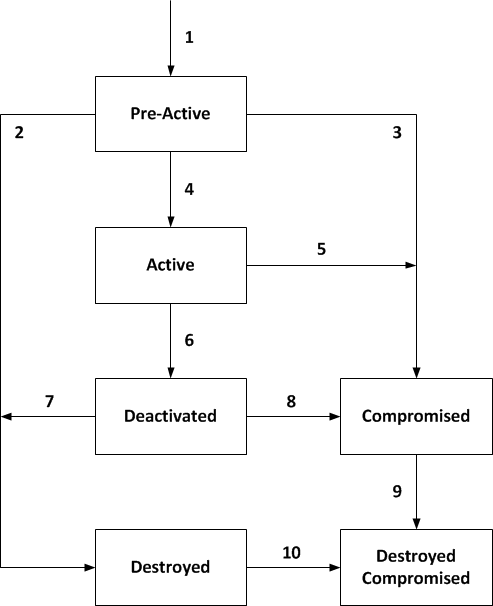 Active: The object SHALL be transitioned to the Active state prior to being used for any cryptographic purpose. The object SHALL only be used for all cryptographic purposes that are allowed by its Cryptographic Usage Mask attribute. If a Process Start Date (see 3.25) attribute is set, then the object SHALL NOT be used for cryptographic purposes prior to the Process Start Date. If a Protect Stop Date (see 3.26) attribute is set, then the object SHALL NOT be used for cryptographic purposes after the Process Stop Date.
Deactivated: The object SHALL NOT be used for applying cryptographic protection (e.g., encryption, signing, wrapping, MACing, deriving) . The object SHALL only be used for cryptographic purposes permitted by the Cryptographic Usage Mask attribute. The object SHOULD only be used to process cryptographically-protected information (e.g., decryption, signature verification, unwrapping, MAC verification under extraordinary circumstances and when special permission is granted.
Compromised: The object SHALL NOT be used for applying cryptographic protection (e.g., encryption, signing, wrapping, MACing, deriving). The object SHOULD only be used to process cryptographically-protected information (e.g., decryption, signature verification, unwrapping, MAC verification in a client that is trusted to use managed objects that have been compromised. The object SHALL only be used for cryptographic purposes permitted by the Cryptographic Usage Mask attribute.
Destroyed: The object SHALL NOT be used for any cryptographic purpose.
Destroyed Compromised: The object SHALL NOT be used for any cryptographic purpose; however its compromised status SHOULD be retained for audit or security purposes.
State transitions occur as follows:
The transition from a non-existent key to the Pre-Active state is caused by the creation of the object. When an object is created or registered, it automatically goes from non-existent to Pre-Active. If, however, the operation that creates or registers the object contains an Activation Date that has already occurred, then the state immediately transitions from Pre-Active to Active. In this case, the server SHALL set the Activation Date attribute to the value specified in the request, or fail the request attempting to create or register the object, depending on server policy. If the operation contains an Activation Date attribute that is in the future, or contains no Activation Date, then the Cryptographic Object is initialized in the key management system in the Pre-Active state.
The transition from Pre-Active to Destroyed is caused by a client issuing a Destroy operation. The server destroys the object when (and if) server policy dictates.
The transition from Pre-Active to Compromised is caused by a client issuing a Revoke operation with a Revocation Reason of Compromised.
The transition from Pre-Active to Active SHALL occur in one of three ways:
The Activation Date is reached,
A client successfully issues a Modify Attribute operation, modifying the Activation Date to a date in the past, or the current date, or
A client issues an Activate operation on the object. The server SHALL set the Activation Date to the time the Activate operation is received.
The transition from Active to Compromised is caused by a client issuing a Revoke operation with a Revocation Reason of Compromised.
The transition from Active to Deactivated SHALL occur in one of three ways:
The object's Deactivation Date is reached,
A client issues a Revoke operation, with a Revocation Reason other than Compromised, or
The client successfully issues a Modify Attribute operation, modifying the Deactivation Date to a date in the past, or the current date.
The transition from Deactivated to Destroyed is caused by a client issuing a Destroy operation, or by a server, both in accordance with server policy. The server destroys the object when (and if) server policy dictates.
The transition from Deactivated to Compromised is caused by a client issuing a Revoke operation with a Revocation Reason of Compromised.
The transition from Compromised to Destroyed Compromised is caused by a client issuing a Destroy operation, or by a server, both in accordance with server policy. The server destroys the object when (and if) server policy dictates.
The transition from Destroyed to Destroyed Compromised is caused by a client issuing a Revoke operation with a Revocation Reason of Compromised.
Only the transitions described above are permitted.
| Object | Encoding |
| State | Enumeration, see 9.1.3.2.18 |
| SHALL always have a value | Yes |
| Initially set by | Server |
| Modifiable by server | Yes |
| Modifiable by client | No, but only by the server in response to certain requests (see above) |
| Deletable by client | No |
| Multiple instances permitted | No |
| When implicitly set | Create, Create Key Pair, Register, Derive Key, Activate, Revoke, Destroy, Certify, Re-certify, Re-key, Re-key Key Pair |
| Applies to Object Types | All Cryptographic Objects |
The Initial Date attribute contains the date and time when the Managed Object was first created or registered at the server. This time corresponds to state transition 1 (see Section 3.22). This attribute SHALL be set by the server when the object is created or registered, and then SHALL NOT be changed or deleted before the object is destroyed. This attribute is also set for non-cryptographic objects (e.g., templates) when they are first registered with the server.
| Object | Encoding |
| Initial Date | Date-Time |
| SHALL always have a value | Yes |
| Initially set by | Server |
| Modifiable by server | No |
| Modifiable by client | No |
| Deletable by client | No |
| Multiple instances permitted | No |
| When implicitly set | Create, Create Key Pair, Register, Derive Key, Certify, Re-certify, Re-key, Re-key Key Pair |
| Applies to Object Types | All Objects |
The Activation Date attribute contains the date and time when the Managed Cryptographic Object MAY begin to be used. This time corresponds to state transition 4 (see Section 3.22). The object SHALL NOT be used for any cryptographic purpose before the Activation Date has been reached. Once the state transition from Pre-Active has occurred, then this attribute SHALL NOT be changed or deleted before the object is destroyed.
| Object | Encoding |
| Activation Date | Date-Time |
| SHALL always have a value | No |
| Initially set by | Server or Client |
| Modifiable by server | Yes, only while in Pre-Active state |
| Modifiable by client | Yes, only while in Pre-Active state |
| Deletable by client | No |
| Multiple instances permitted | No |
| When implicitly set | Create, Create Key Pair, Register, Derive Key, Activate Certify, Re-certify, Re-key, Re-key Key Pair |
| Applies to Object Types | All Cryptographic Objects, Templates |
The Process Start Date attribute is the date and time when a Managed Symmetric Key Object MAY begin to be used to process cryptographically protected information (e.g., decryption or unwrapping), depending on the value of its Cryptographic Usage Mask attribute. The object SHALL NOT be used for these cryptographic purposes before the Process Start Date has been reached. This value MAY be equal to or later than, but SHALL NOT precede, the Activation Date. Once the Process Start Date has occurred, then this attribute SHALL NOT be changed or deleted before the object is destroyed.
| Object | Encoding |
| Process Start Date | Date-Time |
| SHALL always have a value | No |
| Initially set by | Server or Client |
| Modifiable by server | Yes, only while in Pre-Active or Active state and as long as the Process Start Date has been not reached. |
| Modifiable by client | Yes, only while in Pre-Active or Active state and as long as the Process Start Date has been not reached. |
| Deletable by client | No |
| Multiple instances permitted | No |
| When implicitly set | Create, Register, Derive Key, Re-key |
| Applies to Object Types | Symmetric Keys, Split Keys of symmetric keys, Templates |
The Protect Stop Date attribute is the date and time after which a Managed Symmetric Key Object SHALL NOT be used for applying cryptographic protection (e.g., encryption or wrapping), depending on the value of its Cryptographic Usage Mask attribute. This value MAY be equal to or earlier than, but SHALL NOT be later than the Deactivation Date. Once the Protect Stop Date has occurred, then this attribute SHALL NOT be changed or deleted before the object is destroyed.
| Object | Encoding |
| Protect Stop Date | Date-Time |
| SHALL always have a value | No |
| Initially set by | Server or Client |
| Modifiable by server | Yes, only while in Pre-Active or Active state and as long as the Protect Stop Date has not been reached. |
| Modifiable by client | Yes, only while in Pre-Active or Active state and as long as the Protect Stop Date has not been reached. |
| Deletable by client | No |
| Multiple instances permitted | No |
| When implicitly set | Create, Register, Derive Key, Re-key |
| Applies to Object Types | Symmetric Keys, Split Keys of symmetric keys, Templates |
The Deactivation Date attribute is the date and time when the Managed Cryptographic Object SHALL NOT be used for any purpose, except for decryption, signature verification, or unwrapping, but only under extraordinary circumstances and only when special permission is granted. This time corresponds to state transition 6 (see Section 3.22). This attribute SHALL NOT be changed or deleted before the object is destroyed, unless the object is in the Pre-Active or Active state.
| Object | Encoding |
| Deactivation Date | Date-Time |
| SHALL always have a value | No |
| Initially set by | Server or Client |
| Modifiable by server | Yes, only while in Pre-Active or Active state |
| Modifiable by client | Yes, only while in Pre-Active or Active state |
| Deletable by client | No |
| Multiple instances permitted | No |
| When implicitly set | Create, Create Key Pair, Register, Derive Key, Revoke Certify, Re-certify, Re-key, Re-key Key Pair |
| Applies to Object Types | All Cryptographic Objects, Templates |
The Destroy Date attribute is the date and time when the Managed Object was destroyed. This time corresponds to state transitions 2, 7, or 9 (see Section 3.22). This value is set by the server when the object is destroyed due to the reception of a Destroy operation, or due to server policy or out-of-band administrative action.
| Object | Encoding |
| Destroy Date | Date-Time |
| SHALL always have a value | No |
| Initially set by | Server |
| Modifiable by server | No |
| Modifiable by client | No |
| Deletable by client | No |
| Multiple instances permitted | No |
| When implicitly set | Destroy |
| Applies to Object Types | All Cryptographic Objects, Opaque Objects |
The Compromise Occurrence Date attribute is the date and time when the Managed Cryptographic Object was first believed to be compromised. If it is not possible to estimate when the compromise occurred, then this value SHOULD be set to the Initial Date for the object.
| Object | Encoding |
| Compromise Occurrence Date | Date-Time |
| SHALL always have a value | No |
| Initially set by | Server |
| Modifiable by server | No |
| Modifiable by client | No |
| Deletable by client | No |
| Multiple instances permitted | No |
| When implicitly set | Revoke |
| Applies to Object Types | All Cryptographic Objects, Opaque Object |
The Compromise Date attribute contains the date and time when the Managed Cryptographic Object entered into the compromised state. This time corresponds to state transitions 3, 5, 8, or 10 (see Section 3.22). This time indicates when the key management system was made aware of the compromise, not necessarily when the compromise occurred. This attribute is set by the server when it receives a Revoke operation with a Revocation Reason of Compromised code, or due to server policy or out-of-band administrative action.
| Object | Encoding |
| Compromise Date | Date-Time |
| SHALL always have a value | No |
| Initially set by | Server |
| Modifiable by server | No |
| Modifiable by client | No |
| Deletable by client | No |
| Multiple instances permitted | No |
| When implicitly set | Revoke |
| Applies to Object Types | All Cryptographic Objects, Opaque Object |
The Revocation Reason attribute is a structure (see Table 121) used to indicate why the Managed Cryptographic Object was revoked (e.g., “compromised”, “expired”, “no longer used”, etc.). This attribute is only set by the server as a part of the Revoke Operation.
The Revocation Message is an OPTIONAL field that is used exclusively for audit trail/logging purposes and MAY contain additional information about why the object was revoked (e.g., “Laptop stolen”, or “Machine decommissioned”).
| Object | Encoding | REQUIRED |
| Revocation Reason | Structure | |
| Revocation Reason Code | Enumeration, see 9.1.3.2.19 | Yes |
| Revocation Message | Text String | No |
| SHALL always have a value | No |
| Initially set by | Server |
| Modifiable by server | Yes |
| Modifiable by client | No |
| Deletable by client | No |
| Multiple instances permitted | No |
| When implicitly set | Revoke |
| Applies to Object Types | All Cryptographic Objects, Opaque Object |
The Archive Date attribute is the date and time when the Managed Object was placed in archival storage. This value is set by the server as a part of the Archive operation. The server SHALL delete this attribute whenever a Recover operation is performed.
| Object | Encoding |
| Archive Date | Date-Time |
| SHALL always have a value | No |
| Initially set by | Server |
| Modifiable by server | No |
| Modifiable by client | No |
| Deletable by client | No |
| Multiple instances permitted | No |
| When implicitly set | Archive |
| Applies to Object Types | All Objects |
An object MAY be part of a group of objects. An object MAY belong to more than one group of objects. To assign an object to a group of objects, the object group name SHOULD be set into this attribute. “default” is a reserved Text String for Object Group.
| Object | Encoding |
| Object Group | Text String |
| SHALL always have a value | No |
| Initially set by | Client or Server |
| Modifiable by server | Yes |
| Modifiable by client | Yes |
| Deletable by client | Yes |
| Multiple instances permitted | Yes |
| When implicitly set | Create, Create Key Pair, Register, Derive Key, Certify, Re-certify, Re-key, Re-key Key Pair |
| Applies to Object Types | All Objects |
The Fresh attribute is a Boolean attribute that indicates that the object has not yet been served to a client. The Fresh attribute SHALL be set to True when a new object is created on the server. The server SHALL change the attribute value to False as soon as the object has been served to a client.
| Object | Encoding |
| Fresh | Boolean |
| SHALL always have a value | No |
| Initially set by | Client or Server |
| Modifiable by server | Yes |
| Modifiable by client | No |
| Deletable by client | No |
| Multiple instances permitted | No |
| When implicitly set | Create, Create Key Pair, Register, Derive Key, Certify, Re-certify, Re-key, Re-key Key Pair, Re-key Key Pair |
| Applies to Object Types | All Cryptographic Objects |
The Link attribute is a structure (see Table 129) used to create a link from one Managed Cryptographic Object to another, closely related target Managed Cryptographic Object. The link has a type, and the allowed types differ, depending on the Object Type of the Managed Cryptographic Object, as listed below. The Linked Object Identifier identifies the target Managed Cryptographic Object by its Unique Identifier. The link contains information about the association between the Managed Cryptographic Objects (e.g., the private key corresponding to a public key; the parent certificate for a certificate in a chain; or for a derived symmetric key, the base key from which it was derived).
Possible values of Link Type in accordance with the Object Type of the Managed Cryptographic Object are:
<w:bookmarkStart w:id="1798" w:name="DDE_LINK3"/>Private Key Link: For a Public Key object: the private key corresponding to the public key.
Public Key Link: For a Private Key object: the public key corresponding to the private key. For a Certificate object: the public key contained in the certificate.
Certificate Link: For Certificate objects: the parent certificate for a certificate in a certificate chain. For Public Key objects: the corresponding certificate(s), containing the same public key.
Derivation Base Object Link: For a derived Symmetric Key or Secret Data object: the object(s) from which the current symmetric key was derived.
Derived Key Link: the symmetric key(s) or Secret Data object(s) that were derived from the current object.
Replacement Object Link: For a Symmetric Key, an Asymmetric Private Key, or an Asymmetric Public Key object: the key that resulted from the re-key of the current key. For a Certificate object: the certificate that resulted from the re-certify. Note that there SHALL be only one such replacement object per Managed Object.
Replaced Object Link: For a Symmetric Key, an Asymmetric Private Key, or an Asymmetric Public Key object: the key that was re-keyed to obtain the current key. For a Certificate object: the certificate that was re-certified to obtain the current certificate.
Parent Link: For all object types: the owner, container or other parent object corresponding to the object.
Child Link: For all object types: the subordinate, derived or other child object corresponding to the object.
Previous Link: For all object types: the previous object to this object.
Next Link: For all object types: the next object to this object.
The Link attribute SHOULD be present for private keys and public keys for which a certificate chain is stored by the server, and for certificates in a certificate chain.
Note that it is possible for a Managed Object to have multiple instances of the Link attribute (e.g., a Private Key has links to the associated certificate, as well as the associated public key; a Certificate object has links to both the public key and to the certificate of the certification authority (CA) that signed the certificate).
It is also possible that a Managed Object does not have links to associated cryptographic objects. This MAY occur in cases where the associated key material is not available to the server or client (e.g., the registration of a CA Signer certificate with a server, where the corresponding private key is held in a different manner).
| Object | Encoding | REQUIRED |
| Link | Structure | |
| Link Type | Enumeration, see 9.1.3.2.20 | Yes |
| Linked Object Identifier, see 3.1 | Text String | Yes |
| SHALL always have a value | No |
| Initially set by | Client or Server |
| Modifiable by server | Yes |
| Modifiable by client | Yes |
| Deletable by client | Yes |
| Multiple instances permitted | Yes |
| When implicitly set | Create Key Pair, Derive Key, Certify, Re-certify, Re-key, Re-key Key Pair |
| Applies to Object Types | All Cryptographic Objects |
The Application Specific Information attribute is a structure (see Table 131) used to store data specific to the application(s) using the Managed Object. It consists of the following fields: an Application Namespace and Application Data specific to that application namespace.
Clients MAY request to set (i.e., using any of the operations that result in new Managed Object(s) on the server or adding/modifying the attribute of an existing Managed Object) an instance of this attribute with a particular Application Namespace while omitting Application Data. In that case, if the server supports this namespace (as indicated by the Query operation in Section 4.25), then it SHALL return a suitable Application Data value. If the server does not support this namespace, then an error SHALL be returned.
| Object | Encoding | REQUIRED |
| Application Specific Information | Structure | |
| Application Namespace | Text String | Yes |
| Application Data | Text String | No |
| SHALL always have a value | No |
| Initially set by | Client or Server (only if the Application Data is omitted, in the client request) |
| Modifiable by server | Yes (only if the Application Data is omitted in the client request) |
| Modifiable by client | Yes |
| Deletable by client | Yes |
| Multiple instances permitted | Yes |
| When implicitly set | Re-key, Re-key Key Pair, Re-certify |
| Applies to Object Types | All Objects |
The Contact Information attribute is OPTIONAL, and its content is used for contact purposes only. It is not used for policy enforcement. The attribute is set by the client or the server.
| Object | Encoding |
| Contact Information | Text String |
| SHALL always have a value | No |
| Initially set by | Client or Server |
| Modifiable by server | Yes |
| Modifiable by client | Yes |
| Deletable by client | Yes |
| Multiple instances permitted | No |
| When implicitly set | Create, Create Key Pair, Register, Derive Key, Certify, Re-certify, Re-key, Re-key Key Pair |
| Applies to Object Types | All Objects |
The Last Change Date attribute contains the date and time of the last change of the specified object.
| Object | Encoding |
| Last Change Date | Date-Time |
| SHALL always have a value | Yes |
| Initially set by | Server |
| Modifiable by server | Yes |
| Modifiable by client | No |
| Deletable by client | No |
| Multiple instances permitted | No |
| When implicitly set | Create, Create Key Pair, Register, Derive Key, Activate, Revoke, Destroy, Archive, Recover, Certify, Re-certify, Re-key, Re-key Key Pair, Add Attribute, Modify Attribute, Delete Attribute, Get Usage Allocation |
| Applies to Object Types | All Objects |
A Custom Attribute is a client- or server-defined attribute intended for vendor-specific purposes. It is created by the client and not interpreted by the server, or is created by the server and MAY be interpreted by the client. All custom attributes created by the client SHALL adhere to a naming scheme, where the name of the attribute SHALL have a prefix of 'x-'. All custom attributes created by the key management server SHALL adhere to a naming scheme where the name of the attribute SHALL have a prefix of 'y-'. The server SHALL NOT accept a client-created or modified attribute, where the name of the attribute has a prefix of ‘y-‘. The tag type Custom Attribute is not able to identify the particular attribute; hence such an attribute SHALL only appear in an Attribute Structure with its name as defined in Section 2.1.1.
| Object | Encoding | |
| Custom Attribute | Any data type or structure. If a structure, then the structure SHALL NOT include sub structures | The name of the attribute SHALL start with 'x-' or 'y-'. |
| SHALL always have a value | No |
| Initially set by | Client or Server |
| Modifiable by server | Yes, for server-created attributes |
| Modifiable by client | Yes, for client-created attributes |
| Deletable by client | Yes, for client-created attributes |
| Multiple instances permitted | Yes |
| When implicitly set | Create, Create Key Pair, Register, Derive Key, Activate, Revoke, Destroy, Certify, Re-certify, Re-key, Re-key Key Pair |
| Applies to Object Types | All Objects |
The Alternative Name attribute is used to identify and locate the object. This attribute is assigned by the client, and the Alternative Name Value is intended to be in a form that humans are able to interpret. The key management system MAY specify rules by which the client creates valid alternative names. Clients are informed of such rules by a mechanism that is not specified by this standard. Alternative Names MAY NOT be unique within a given key management domain.
| Object | Encoding | REQUIRED |
| Alternative Name | Structure | |
| Alternative Name Value | Text String | Yes |
| Alternative Name Type | Enumeration, see 9.1.3.2.34 | Yes |
| SHALL always have a value | No |
| Initially set by | Client |
| Modifiable by server | Yes (Only if no value present) |
| Modifiable by client | Yes |
| Deletable by client | Yes |
| Multiple instances permitted | Yes |
| Applies to Object Types | All Objects |
Key Value Present is an OPTIONAL attribute of the managed object created by the server. It SHALL NOT be specified by the client in a Register request. Key Value Present SHALL be created by the server if the Key Value is absent from the Key Block in a Register request. The value of Key Value Present SHALL NOT be modified by either the client or the server. Key Value Present attribute MAY be used as a part of the Locate operation. This attribute does not apply to Templates, Certificates, Public Keys or Opaque Objects.
| Object | Encoding | REQUIRED |
| Key Value Present | Boolean | No |
| SHALL always have a value | No |
| Initially set by | Server |
| Modifiable by server | No |
| Modifiable by client | No |
| Deletable by client | No |
| Multiple instances permitted | No |
| When implicitly set | During Register operation |
| Applies to Object Types | Symmetric Key, Private Key, Split Key, Secret Data |
Key Value Location is an OPTIONAL attribute of a managed object. It MAY be specified by the client when the Key Value is omitted from the Key Block in a Register request. Key Value Location is used to indicate the location of the Key Value absent from the object being registered. This attribute does not apply to Templates, Certificates, Public Keys or Opaque Objects.
| Object | Encoding | REQUIRED |
| Key Value Location | Structure | |
| Key Value Location Value | Text String | Yes |
| Key Value Location Type | Enumeration, see 9.1.3.2.35 | Yes |
| SHALL always have a value | No |
| Initially set by | Client |
| Modifiable by server | No |
| Modifiable by client | Yes |
| Deletable by client | Yes |
| Multiple instances permitted | Yes |
| When implicitly set | Never |
| Applies to Object Types | Symmetric Key, Private Key, Split Key, Secret Data |
The Original Creation Date attribute contains the date and time the object was originally created, which can be different from when the object is registered with a key management server.
It is OPTIONAL for an object being registered by a client. The Original Creation Date MAY be set by the client during a Register operation. If no Original Creation Date attribute was set by the client during a Register operation, it MAY do so at a later time through an Add Attribute operation for that object.
It is mandatory for an object created on the server as a result of a Create, Create Key Pair, Derive Key, Re-key, or Re-key Key Pair operation. In such cases the Original Creation Date SHALL be set by the server and SHALL be the same as the Initial Date attribute.
In all cases, once the Original Creation Date is set, it SHALL NOT be deleted or updated.
| Object | Encoding |
| Original Creation Date | Date-Time |
| SHALL always have a value | No |
| Initially set by | Client or Server (when object is generated by Server) |
| Modifiable by server | No |
| Modifiable by client | No |
| Deletable by client | No |
| Multiple instances permitted | No |
| When implicitly set | Create, Create Key Pair, Derive Key, Re-key, Re-key Key Pair |
| Applies to Object Types | All Objects |
The Random Number Generator attribute contains the details of the random number generator used during the creation of the managed cryptographic object.
It is OPTIONAL for a managed cryptographic object being registered by a client. The Random Number Generator MAY be set by the client during a Register operation. If no Random Number Generator attribute was set by the client during a Register operation, it MAY do so at a later time through an Add Attribute operation for that object.
It is mandatory for an object created on the server as a result of a Create, Create Key Pair, Derive Key, Re-key, or Re-key Key Pair operation. In such cases the Random Number Generator SHALL be set by the server depending on which random number generator was used. If the specific details of the random number generator are unknown then the RNG Algorithm within the RNG Parameters structure SHALL be set to Unspecified.
If one or more Random Number Generator attribute values are provided in the template attributes (either directly or via reference to templates which contain Random Number Generator attribute values) in a Create, Create Key Pair, Derive Key, Re-key, or Re-key Key Pair operation then the server SHALL use a random number generator that matches one of the Random Number Generator attributes. If the server does not support or is otherwise unable to use a matching random number generator then it SHALL fail the request.
The Random Number Generator attribute SHALL NOT be copied from the original object in a Re-key or Re-key Key Pair operation.
In all cases, once the Random Number Generator attribute is set, it SHALL NOT be deleted or updated.
| Object | Encoding |
| Random Number Generator | RNG Parameters (see 2.1.18) |
| SHALL always have a value | No |
| Initially set by | Client (when the object is generated by the Client and registered) or Server (when object is generated by Server) |
| Modifiable by server | No |
| Modifiable by client | No |
| Deletable by client | No |
| Multiple instances permitted | No |
| When implicitly set | Create, Create Key Pair, Derive Key, Re-key, Re-key Key Pair |
| Applies to Object Types | All Cryptographic Objects |
The PKCS#12 Friendly Name attribute is OPTIONAL. If supplied on a Register Private Key with Key Format Type PKCS#12, it informs the server of the alias/friendly name (see [RFC7292]) under which the private key and its associated certificate chain SHALL be found in the Key Material. If no such alias/friendly name is supplied, the server SHALL record the alias/friendly name (if any) it finds for the first Private Key in the Key Material.
When a Get with Key Format Type PKCS#12 is issued, this attribute informs the server what alias/friendly name the server SHALL use when encoding the response. If this attribute is absent for the object on which the Get is issued, the server SHOULD use an alias/friendly name of “alias”. Since the PKCS#12 Friendly Name is defined in ASN.1 with an EQUALITY MATCHING RULE of caseIgnoreMatch, clients and servers SHOULD utilize a lowercase text string.
| Object | Encoding |
| PKCS#12 Friendly Name | Text String |
| SHALL always have a value | No |
| Initially set by | Client or Server |
| Modifiable by server | No |
| Modifiable by client | Yes |
| Deletable by client | Yes |
| Multiple instances permitted | No |
| Applies to Object Types | Managed Cryptographic Objects |
The Description attribute is OPTIONAL, and its content is used for informational purposes only. It is not used for policy enforcement. The attribute is set by the client or the server.
| Object | Encoding |
| Description | Text String |
| SHALL always have a value | No |
| Initially set by | Client or Server |
| Modifiable by server | Yes |
| Modifiable by client | Yes |
| Deletable by client | Yes |
| Multiple instances permitted | No |
| Applies to Object Types | All Objects |
The Comment attribute is OPTIONAL, and its content is used for informational purposes only. It is not used for policy enforcement. The attribute is set by the client or the server.
| Object | Encoding |
| Description | Text String |
| SHALL always have a value | No |
| Initially set by | Client or Server |
| Modifiable by server | Yes |
| Modifiable by client | Yes |
| Deletable by client | Yes |
| Multiple instances permitted | No |
| Applies to Object Types | All Objects |
If True then the server SHALL prevent the object value being retrieved (via the Get operation) unless it is wrapped by another key. The server SHALL set the value to False if the value is not provided by the client.
| Object | Encoding |
| Sensitive | Boolean |
| SHALL always have a value | Yes |
| Initially set by | Client or Server |
| Modifiable by server | Yes |
| Modifiable by client | Yes |
| Deletable by client | No |
| Multiple instances permitted | No |
| When implicitly set | When object is created or registered |
| Applies to Object Types | All Objects |
The server SHALL set the value toTrue if the Sensitive attribute has always been True and the value to False if the Sensitive attribute has ever been set to False.
| Object | Encoding |
| Sensitive | Boolean |
| SHALL always have a value | Yes |
| Initially set by | Server |
| Modifiable by server | Yes |
| Modifiable by client | No |
| Deletable by client | No |
| Multiple instances permitted | No |
| When implicitly set | When Sensitive attribute is set or changed |
| Applies to Object Types | All Objects |
If False then the server SHALL prevent the object value being retrieved (via the Get operation). The server SHALL set the value to True if the value is not provided by the client.
| Object | Encoding |
| Extractable | Boolean |
| SHALL always have a value | Yes |
| Initially set by | Client or Server |
| Modifiable by server | Yes |
| Modifiable by client | Yes |
| Deletable by client | No |
| Multiple instances permitted | No |
| When implicitly set | When object is created or registered |
| Applies to Object Types | All Objects |
The server SHALL set the value to True if the Extractable attribute has always been False, and set the value to False if the Extractable attribute has ever been set to True.
| Object | Encoding |
| Never Extractable | Boolean |
| SHALL always have a value | Yes |
| Initially set by | Server |
| Modifiable by server | Yes |
| Modifiable by client | No |
| Deletable by client | No |
| Multiple instances permitted | No |
| When implicitly set | When Never Extractable attribute is set or changed |
| Applies to Object Types | All Objects |
The following subsections describe the operations that MAY be requested by a key management client. Not all clients have to be capable of issuing all operation requests; however any client that issues a specific request SHALL be capable of understanding the response to the request. All Object Management operations are issued in requests from clients to servers, and results obtained in responses from servers to clients. Multiple operations MAY be combined within a batch, resulting in a single request/response message pair.
A number of the operations whose descriptions follow are affected by a mechanism referred to as the ID Placeholder.
The key management server SHALL implement a temporary variable called the ID Placeholder. This value consists of a single Unique Identifier. It is a variable stored inside the server that is only valid and preserved during the execution of a batch of operations. Once the batch of operations has been completed, the ID Placeholder value SHALL be discarded and/or invalidated by the server, so that subsequent requests do not find this previous ID Placeholder available.
The ID Placeholder is obtained from the Unique Identifier returned in response to the Create, Create Pair, Register, Derive Key, Re-key, Re-key Key Pair, Certify, Re-Certify, Locate, and Recover operations. If any of these operations successfully completes and returns a Unique Identifier, then the server SHALL copy this Unique Identifier into the ID Placeholder variable, where it is held until the completion of the operations remaining in the batched request or until a subsequent operation in the batch causes the ID Placeholder to be replaced. If the Batch Error Continuation Option is set to Stop and the Batch Order Option is set to true, then subsequent operations in the batched request MAY make use of the ID Placeholder by omitting the Unique Identifier field from the request payloads for these operations.
Requests MAY contain attribute values to be assigned to the object. This information is specified with a Template-Attribute (see Section 2.1.8) that contains zero or more template names and zero or more individual attributes. If more than one template name is specified, and there is a conflict between the single-instance attributes in the templates, then the value in the last of the conflicting templates takes precedence. If there is a conflict between the single-instance attributes in the request and the single-instance attributes in a specified template, then the attribute values in the request take precedence. For multi-instance attributes, the union of attribute values is used when the attributes are specified more than once.
The Template Managed Object is deprecated as of version 1.3 of this specification and MAY be removed from subsequent versions of the specification. Individual Attributes SHOULD be used in operations which currently support use of a Name within a Template-Attribute to reference a Template.
Responses MAY contain attribute values that were not specified in the request, but have been implicitly set by the server. This information is specified with a Template-Attribute that contains one or more individual attributes.
For any operations that operate on Managed Objects already stored on the server, any archived object SHALL first be made available by a Recover operation (see Section 4.23) before they MAY be specified (i.e., as on-line objects).
Multi-part cryptographic operations (operations where a stream of data is provided across multiple requests from a client to a server) are optionally supported by those cryptographic operations that include the Correlation Value (see section 2.1.15), Init Indicator (see section 2.1.16) and Final Indicator (see section 2.1.17) request parameters.
For multi-part cryptographic operations the following sequence is performed
On the first request
Provide an Init Indicator with a value of True
Provide any other required parameters
Preserve the Correlation Value returned in the response for use in subsequent requests
Use the Data output (if any) from the response
On subsequent requests
Provide the Correlation Value from the response to the first request
Provide any other required parameters
Use the next block of Data output (if any) from the response
On the final request
Provide the Correlation Value from the response to the first request
Provide a Final Indicator with a value of True
Use the final block of Data output (if any) from the response
Single-part cryptographic operations (operations where a single input is provided and a single response returned) the following sequence is performed:
On each request
Do not provide an Init Indicator, Final Indicator or Correlation Value or provide an Init indicator and Final Indicator but no Correlation Value.
Provide any other required parameters
Use the Data output from the response
Data is always required in cryptographic operations except when either Init Indicator or Final Indicator is true.
This operation requests the server to generate a new symmetric key as a Managed Cryptographic Object. This operation is not used to create a Template object (see Register operation, Section 4.3).
The request contains information about the type of object being created, and some of the attributes to be assigned to the object (e.g., Cryptographic Algorithm, Cryptographic Length, etc.). This information MAY be specified by the names of Template objects that already exist.
The response contains the Unique Identifier of the created object. The server SHALL copy the Unique Identifier returned by this operation into the ID Placeholder variable.
| Request Payload | ||
| Object | REQUIRED | Description |
| Object Type, see 3.3 | Yes | Determines the type of object to be created. |
| Template-Attribute, see 2.1.8 | Yes | Specifies desired attributes using to be associated with the new object templates and/or individual attributes. The Template Managed Object is deprecated as of version 1.3 of this specification and MAY be removed from subsequent versions of the specification. Individual Attributes SHOULD be used in operations which currently support use of a Name within a Template-Attribute to reference a Template. |
| Response Payload | ||
| Object | REQUIRED | Description |
| Object Type, see 3.3 | Yes | Type of object created. |
| Unique Identifier, see 3.1 | Yes | The Unique Identifier of the newly created object. |
| Template-Attribute, see 2.1.8 | No | An OPTIONAL list of object attributes with values that were not specified in the request, but have been implicitly set by the key management server. The Template Managed Object is deprecated as of version 1.3 of this specification and MAY be removed from subsequent versions of the specification. Individual Attributes SHOULD be used in operations which currently support use of a Name within a Template-Attribute to reference a Template. |
Table 165 indicates which attributes SHALL be included in the Create request using the Template-Attribute object.
| Attribute | REQUIRED |
| Cryptographic Algorithm, see 3.4 | Yes |
| Cryptographic Usage Mask, see 3.19 | Yes |
This operation requests the server to generate a new public/private key pair and register the two corresponding new Managed Cryptographic Objects.
The request contains attributes to be assigned to the objects (e.g., Cryptographic Algorithm, Cryptographic Length, etc.). Attributes and Template Names MAY be specified for both keys at the same time by specifying a Common Template-Attribute object in the request. Attributes not common to both keys (e.g., Name, Cryptographic Usage Mask) MAY be specified using the Private Key Template-Attribute and Public Key Template-Attribute objects in the request, which take precedence over the Common Template-Attribute object.
The Template Managed Object is deprecated as of version 1.3 of this specification and MAY be removed from subsequent versions of the specification. Individual Attributes SHOULD be used in operations which currently support use of a Name within a Template-Attribute to reference a Template.
For the Private Key, the server SHALL create a Link attribute of Link Type Public Key pointing to the Public Key. For the Public Key, the server SHALL create a Link attribute of Link Type Private Key pointing to the Private Key. The response contains the Unique Identifiers of both created objects. The ID Placeholder value SHALL be set to the Unique Identifier of the Private Key.
| Request Payload | ||
| Object | REQUIRED | Description |
| Common Template-Attribute, see 2.1.8 | No | Specifies desired attributes in templates and/or as individual attributes to be associated with the new object that apply to both the Private and Public Key Objects. The Template Managed Object is deprecated as of version 1.3 of this specification and MAY be removed from subsequent versions of the specification. Individual Attributes SHOULD be used in operations which currently support use of a Name within a Template-Attribute to reference a Template. |
| Private Key Template-Attribute, see 2.1.8 | No | Specifies templates and/or attributes to be associated with the new object that apply to the Private Key Object. Order of precedence applies. The Template Managed Object is deprecated as of version 1.3 of this specification and MAY be removed from subsequent versions of the specification. Individual Attributes SHOULD be used in operations which currently support use of a Name within a Template-Attribute to reference a Template. |
| Public Key Template-Attribute, see 2.1.8 | No | Specifies templates and/or attributes to be associated with the new object that apply to the Public Key Object. Order of precedence applies. The Template Managed Object is deprecated as of version 1.3 of this specification and MAY be removed from subsequent versions of the specification. Individual Attributes SHOULD be used in operations which currently support use of a Name within a Template-Attribute to reference a Template. |
For multi-instance attributes, the union of the values found in the templates and attributes of the Common, Private, and Public Key Template-Attribute SHALL be used. For single-instance attributes, the order of precedence is as follows:
attributes specified explicitly in the Private and Public Key Template-Attribute, then
attributes specified via templates in the Private and Public Key Template-Attribute, then
attributes specified explicitly in the Common Template-Attribute, then
attributes specified via templates in the Common Template-Attribute.
If there are multiple templates in the Common, Private, or Public Key Template-Attribute, then the last value of the single-instance attribute that conflicts takes precedence.
| Response Payload | ||
| Object | REQUIRED | Description |
| Private Key Unique Identifier, see 3.1 | Yes | The Unique Identifier of the newly created Private Key object. |
| Public Key Unique Identifier, see 3.1 | Yes | The Unique Identifier of the newly created Public Key object. |
| Private Key Template-Attribute, see 2.1.8 | No | An OPTIONAL list of attributes, for the Private Key Object, with values that were not specified in the request, but have been implicitly set by the key management server. The Template Managed Object is deprecated as of version 1.3 of this specification and MAY be removed from subsequent versions of the specification. Individual Attributes SHOULD be used in operations which currently support use of a Name within a Template-Attribute to reference a Template. |
| Public Key Template-Attribute, see 2.1.8 | No | An OPTIONAL list of attributes, for the Public Key Object, with values that were not specified in the request, but have been implicitly set by the key management server. The Template Managed Object is deprecated as of version 1.3 of this specification and MAY be removed from subsequent versions of the specification. Individual Attributes SHOULD be used in operations which currently support use of a Name within a Template-Attribute to reference a Template. |
Table 168 indicates which attributes SHALL be included in the Create Key pair request using Template-Attribute objects, as well as which attributes SHALL have the same value for the Private and Public Key.
| Attribute | REQUIRED | SHALL contain the same value for both Private and Public Key |
| Cryptographic Algorithm, see 3.4 | Yes | Yes |
| Cryptographic Length, see 3.5 | No | Yes |
| Cryptographic Usage Mask, see 3.19 | Yes | No |
| Cryptographic Domain Parameters, see 3.7 | No | Yes |
| Cryptographic Parameters, see 3.6 | No | Yes |
Setting the same Cryptographic Length value for both private and public key does not imply that both keys are of equal length. For RSA, Cryptographic Length corresponds to the bit length of the Modulus. For DSA and DH algorithms, Cryptographic Length corresponds to the bit length of parameter P, and the bit length of Q is set separately in the Cryptographic Domain Parameters attribute. For ECDSA, ECDH, and ECMQV algorithms, Cryptographic Length corresponds to the bit length of parameter Q.
This operation requests the server to register a Managed Object that was created by the client or obtained by the client through some other means, allowing the server to manage the object. The arguments in the request are similar to those in the Create operation, but contain the object itself for storage by the server.
The request contains information about the type of object being registered and attributes to be assigned to the object (e.g., Cryptographic Algorithm, Cryptographic Length, etc.). This information SHALL be specified by the use of a Template-Attribute object.
The response contains the Unique Identifier assigned by the server to the registered object. The server SHALL copy the Unique Identifier returned by this operations into the ID Placeholder variable. The Initial Date attribute of the object SHALL be set to the current time.
| Request Payload | ||
| Object | REQUIRED | Description |
| Object Type, see 3.3 | Yes | Determines the type of object being registered. |
| Template-Attribute, see 2.1.8 | Yes | Specifies desired object attributes to be associated with the new object using templates and/or individual attributes. The Template Managed Object is deprecated as of version 1.3 of this specification and MAY be removed from subsequent versions of the specification. Individual Attributes SHOULD be used in operations which currently support use of a Name within a Template-Attribute to reference a Template. |
| Certificate, Symmetric Key, Private Key, Public Key, Split Key, Template Secret Data or Opaque Object, see 2.1.22 | Yes | The object being registered. The object and attributes MAY be wrapped. |
| Response Payload | ||
| Object | REQUIRED | Description |
| Unique Identifier, see 3.1 | Yes | The Unique Identifier of the newly registered object. |
| Template-Attribute, see 2.1.8 | No | An OPTIONAL list of object attributes with values that were not specified in the request, but have been implicitly set by the key management server. The Template Managed Object is deprecated as of version 1.3 of this specification and MAY be removed from subsequent versions of the specification. Individual Attributes SHOULD be used in operations which currently support use of a Name within a Template-Attribute to reference a Template. |
If a Managed Cryptographic Object is registered, then the following attributes SHALL be included in the Register request, either explicitly, or via specification of a template that contains the attribute.
| Attribute | REQUIRED |
| Cryptographic Algorithm, see 3.4 | Yes, MAY be omitted only if this information is encapsulated in the Key Block. Does not apply to Secret Data. If present, then Cryptographic Length below SHALL also be present. |
| Cryptographic Length, see 3.5 | Yes, MAY be omitted only if this information is encapsulated in the Key Block. Does not apply to Secret Data. If present, then Cryptographic Algorithm above SHALL also be present. |
| Certificate Length, see 3.9 | Yes. Only applies to Certificates. |
| Cryptographic Usage Mask, see 3.19 | Yes. |
| Digital Signature Algorithm, see 3.16 | Yes, MAY be omitted only if this information is encapsulated in the Certificate object. Only applies to Certificates. |
This request is used to generate a replacement key for an existing symmetric key. It is analogous to the Create operation, except that attributes of the replacement key are copied from the existing key, with the exception of the attributes listed in Random Number Generator 3.44.
As the replacement key takes over the name attribute of the existing key, Re-key SHOULD only be performed once on a given key.
The server SHALL copy the Unique Identifier of the replacement key returned by this operation into the ID Placeholder variable.
For the existing key, the server SHALL create a Link attribute of Link Type Replacement Object pointing to the replacement key. For the replacement key, the server SHALL create a Link attribute of Link Type Replaced Key pointing to the existing key.
An Offset MAY be used to indicate the difference between the Initialization Date and the Activation Date of the replacement key. If no Offset is specified, the Activation Date, Process Start Date, Protect Stop Date and Deactivation Date values are copied from the existing key. If Offset is set and dates exist for the existing key, then the dates of the replacement key SHALL be set based on the dates of the existing key as follows:
| Attribute in Existing Key | Attribute in Replacement Key |
| Initial Date (IT1) | Initial Date (IT2) > IT1 |
| Activation Date (AT1) | Activation Date (AT2) = IT2+ Offset |
| Process Start Date (CT1) | Process Start Date = CT1+(AT2- AT1) |
| Protect Stop Date (TT1) | Protect Stop Date = TT1+(AT2- AT1) |
| Deactivation Date (DT1) | Deactivation Date = DT1+(AT2- AT1) |
Attributes requiring special handling when creating the replacement key are:
| Attribute | Action |
| Initial Date, see 3.23 | Set to the current time |
| Destroy Date, see 3.28 | Not set |
| Compromise Occurrence Date, see 3.29 | Not set |
| Compromise Date, see 3.30 | Not set |
| Revocation Reason, see 3.31 | Not set |
| Unique Identifier, see 3.1 | New value generated |
| Usage Limits, see 3.21 | The Total value is copied from the existing key, and the Count value in the existing key is set to the Total value. |
| Name, see 3.2 | Set to the name(s) of the existing key; all name attributes are removed from the existing key. |
| State, see 3.22 | Set based on attributes values, such as dates, as shown in Table 172 |
| Digest, see 3.16 | Recomputed from the replacement key value |
| Link, see 3.35 | Set to point to the existing key as the replaced key |
| Last Change Date, see 3.38 | Set to current time |
| <w:bookmarkStart w:id="2145" w:name="_Ref242080899"/><w:bookmarkStart w:id="2146" w:name="_Toc236497790"/><w:bookmarkStart w:id="2147" w:name="_Toc310932833"/>Random Number Generator, see 3.44 | Set to the random number generator used for creating the new managed object. Not copied from the original object. |
| Request Payload | ||
| Object | REQUIRED | Description |
| Unique Identifier, see 3.1 | No | Determines the existing Symmetric Key being re-keyed. If omitted, then the ID Placeholder value is used by the server as the Unique Identifier. |
| Offset | No | An Interval object indicating the difference between the Initialization Date and the Activation Date of the replacement key to be created. |
| Template-Attribute, see 2.1.8 | No | Specifies desired object attributes using templates and/or individual attributes. The Template Managed Object is deprecated as of version 1.3 of this specification and MAY be removed from subsequent versions of the specification. Individual Attributes SHOULD be used in operations which currently support use of a Name within a Template-Attribute to reference a Template. |
| Response Payload | ||
| Object | REQUIRED | Description |
| Unique Identifier, see 3.1 | Yes | The Unique Identifier of the newly-created replacement Symmetric Key. |
| Template-Attribute, see 2.1.8 | No | An OPTIONAL list of object attributes with values that were not specified in the request, but have been implicitly set by the key management server. The Template Managed Object is deprecated as of version 1.3 of this specification and MAY be removed from subsequent versions of the specification. Individual Attributes SHOULD be used in operations which currently support use of a Name within a Template-Attribute to reference a Template. |
This request is used to generate a replacement key pair for an existing public/private key pair. It is analogous to the Create Key Pair operation, except that attributes of the replacement key pair are copied from the existing key pair, with the exception of the attributes listed in Random Number Generator 3.44
As the replacement of the key pair takes over the name attribute for the existing public/private key pair, Re-key Key Pair SHOULD only be performed once on a given key pair.
For both the existing public key and private key, the server SHALL create a Link attribute of Link Type Replacement Key pointing to the replacement public and private key, respectively. For both the replacement public and private key, the server SHALL create a Link attribute of Link Type Replaced Key pointing to the existing public and private key, respectively.
The server SHALL copy the Private Key Unique Identifier of the replacement private key returned by this operation into the ID Placeholder variable.
An Offset MAY be used to indicate the difference between the Initialization Date and the Activation Date of the replacement key pair. If no Offset is specified, the Activation Date and Deactivation Date values are copied from the existing key pair. If Offset is set and dates exist for the existing key pair, then the dates of the replacement key pair SHALL be set based on the dates of the existing key pair as follows
| Attribute in Existing Key Pair | Attribute in Replacement Key Pair |
| Initial Date (IT1) | Initial Date (IT2) > IT1 |
| Activation Date (AT1) | Activation Date (AT2) = IT2+ Offset |
| Deactivation Date (DT1) | Deactivation Date = DT1+(AT2- AT1) |
Attributes for the replacement key pair that are not copied from the existing key pair and which are handled in a specific way are:
| Attribute | Action |
| Private Key Unique Identifier, see 3.1 | New value generated |
| Public Key Unique Identifier, see 3.1 | New value generated |
| Name, see 3.2 | Set to the name(s) of the existing public/private keys; all name attributes of the existing public/private keys are removed. |
| Digest, see 3.17 | Recomputed for both replacement public and private keys from the new public and private key values |
| Usage Limits, see 3.21 | The Total Bytes/Total Objects value is copied from the existing key pair, while the Byte Count/Object Count values are set to the Total Bytes/Total Objects. |
| State, see 3.22 | Set based on attributes values, such as dates, as shown in Table 176. |
| Initial Date, see 3.23 | Set to the current time |
| Destroy Date, see 3.28 | Not set |
| Compromise Occurrence Date, see 3.29 | Not set |
| Compromise Date, see 3.30 | Not set |
| Revocation Reason, see 3.31 | Not set |
| Link, see 3.35 | Set to point to the existing public/private keys as the replaced public/private keys |
| Last Change Date, see 3.38 | Set to current time |
| <w:bookmarkStart w:id="2176" w:name="_Ref295838839"/><w:bookmarkStart w:id="2177" w:name="_Ref295838833"/><w:bookmarkStart w:id="2178" w:name="_Toc310932837"/>Random Number Generator, see 3.44 | Set to the random number generator used for creating the new managed object. Not copied from the original object. |
| Request Payload | ||
| Object | REQUIRED | Description |
| Private Key Unique Identifier, see 3.1 | No | Determines the existing Asymmetric key pair to be re-keyed. If omitted, then the ID Placeholder is substituted by the server. |
| Offset | No | An Interval object indicating the difference between the Initialization date and the Activation Date of the replacement key pair to be created. |
| Common Template-Attribute, see 2.1.8 | No | Specifies desired attributes in templates and/or as individual attributes that apply to both the Private and Public Key Objects. The Template Managed Object is deprecated as of version 1.3 of this specification and MAY be removed from subsequent versions of the specification. Individual Attributes SHOULD be used in operations which currently support use of a Name within a Template-Attribute to reference a Template. |
| Private Key Template-Attribute, see 2.1.8 | No | Specifies templates and/or attributes that apply to the Private Key Object. Order of precedence applies. The Template Managed Object is deprecated as of version 1.3 of this specification and MAY be removed from subsequent versions of the specification. Individual Attributes SHOULD be used in operations which currently support use of a Name within a Template-Attribute to reference a Template. |
| Public Key Template-Attribute, see 2.1.8 | No | Specifies templates and/or attributes that apply to the Public Key Object. Order of precedence applies. The Template Managed Object is deprecated as of version 1.3 of this specification and MAY be removed from subsequent versions of the specification. Individual Attributes SHOULD be used in operations which currently support use of a Name within a Template-Attribute to reference a Template. |
For multi-instance attributes, the union of the values found in the templates and attributes of the Common, Private, and Public Key Template-Attribute is used. For single-instance attributes, the order of precedence is as follows:
attributes specified explicitly in the Private and Public Key Template-Attribute, then
attributes specified via templates in the Private and Public Key Template-Attribute, then
attributes specified explicitly in the Common Template-Attribute, then
attributes specified via templates in the Common Template-Attribute.
If there are multiple templates in the Common, Private, or Public Key Template-Attribute, then the subsequent value of the single-instance attribute takes precedence.
| Response Payload | ||
| Object | REQUIRED | Description |
| Private Key Unique Identifier, see 3.1 | Yes | The Unique Identifier of the newly created replacement Private Key object. |
| Public Key Unique Identifier, see 3.1 | Yes | The Unique Identifier of the newly created replacement Public Key object. |
| Private Key Template-Attribute, see 2.1.8 | No | An OPTIONAL list of attributes, for the Private Key Object, with values that were not specified in the request, but have been implicitly set by the key management server. The Template Managed Object is deprecated as of version 1.3 of this specification and MAY be removed from subsequent versions of the specification. Individual Attributes SHOULD be used in operations which currently support use of a Name within a Template-Attribute to reference a Template. |
| Public Key Template-Attribute, see 2.1.8 | No | An OPTIONAL list of attributes, for the Public Key Object, with values that were not specified in the request, but have been implicitly set by the key management server. The Template Managed Object is deprecated as of version 1.3 of this specification and MAY be removed from subsequent versions of the specification. Individual Attributes SHOULD be used in operations which currently support use of a Name within a Template-Attribute to reference a Template. |
This request is used to derive a Symmetric Key or Secret Data object from keys or Secret Data objects that are already known to the key management system. The request SHALL only apply to Managed Cryptographic Objects that have the Derive Key bit set in the Cryptographic Usage Mask attribute of the specified Managed Object (i.e., are able to be used for key derivation). If the operation is issued for an object that does not have this bit set, then the server SHALL return an error. For all derivation methods, the client SHALL specify the desired length of the derived key or Secret Data object using the Cryptographic Length attribute. If a key is created, then the client SHALL specify both its Cryptographic Length and Cryptographic Algorithm. If the specified length exceeds the output of the derivation method, then the server SHALL return an error. Clients MAY derive multiple keys and IVs by requesting the creation of a Secret Data object and specifying a Cryptographic Length that is the total length of the derived object. If the specified length exceeds the output of the derivation method, then the server SHALL return an error.
The fields in the request specify the Unique Identifiers of the keys or Secret Data objects to be used for derivation (e.g., some derivation methods MAY use multiple keys or Secret Data objects to derive the result), the method to be used to perform the derivation, and any parameters needed by the specified method. The method is specified as an enumerated value. Currently defined derivation methods include:
PBKDF2 – This method is used to derive a symmetric key from a password or pass phrase. The PBKDF2 method is published in [PKCS#5] and [RFC2898].
HASH – This method derives a key by computing a hash over the derivation key or the derivation data.
HMAC – This method derives a key by computing an HMAC over the derivation data.
ENCRYPT – This method derives a key by encrypting the derivation data.
NIST800-108-C – This method derives a key by computing the KDF in Counter Mode as specified in [SP800-108].
NIST800-108-F – This method derives a key by computing the KDF in Feedback Mode as specified in [SP800-108].
NIST800-108-DPI – This method derives a key by computing the KDF in Double-Pipeline Iteration Mode as specified in [SP800-108].
Extensions.
The server SHALL perform the derivation function, and then register the derived object as a new Managed Object, returning the new Unique Identifier for the new object in the response. The server SHALL copy the Unique Identifier returned by this operation into the ID Placeholder variable.
For the keys or Secret Data objects from which the key or Secret Data object is derived, the server SHALL create a Link attribute of Link Type Derived Key pointing to the Symmetric Key or Secret Data object derived as a result of this operation. For the Symmetric Key or Secret Data object derived as a result of this operation, the server SHALL create a Link attribute of Link Type Derivation Base Object pointing to the keys or Secret Data objects from which the key or Secret Data object is derived.
| Request Payload | ||
| Object | REQUIRED | Description |
| Object Type, see 3.3 | Yes | Determines the type of object to be created. |
| Unique Identifier, see 3.1 | Yes. MAY be repeated | Determines the object or objects to be used to derive a new key. Note that the current value of the ID Placeholder SHALL NOT be used in place of a Unique Identifier in this operation. |
| Derivation Method, see 9.1.3.2.21 | Yes | An Enumeration object specifying the method to be used to derive the new key. |
| Derivation Parameters, see below | Yes | A Structure object containing the parameters needed by the specified derivation method. |
| Template-Attribute, see 2.1.8 | Yes | Specifies desired attributes to be associated with the new object using templates and/or individual attributes; the length and algorithm SHALL always be specified for the creation of a symmetric key. The Template Managed Object is deprecated as of version 1.3 of this specification and MAY be removed from subsequent versions of the specification. Individual Attributes SHOULD be used in operations which currently support use of a Name within a Template-Attribute to reference a Template. |
| Response Payload | ||
| Object | REQUIRED | Description |
| Unique Identifier, see 3.1 | Yes | The Unique Identifier of the newly derived key or Secret Data object. |
| Template-Attribute, see 2.1.8 | No | An OPTIONAL list of object attributes with values that were not specified in the request, but have been implicitly set by the key management server. The Template Managed Object is deprecated as of version 1.3 of this specification and MAY be removed from subsequent versions of the specification. Individual Attributes SHOULD be used in operations which currently support use of a Name within a Template-Attribute to reference a Template. |
The Derivation Parameters for all derivation methods consist of the following parameters, except PBKDF2, which takes two additional parameters.
| Object | Encoding | REQUIRED |
| Derivation Parameters | Structure | Yes. |
| Cryptographic Parameters, see 3.6 | Structure | Yes, except for HMAC derivation keys. |
| Initialization Vector | Byte String | No, depends on PRF and mode of operation: empty IV is assumed if not provided. |
| Derivation Data | Byte String | Yes, unless the Unique Identifier of a Secret Data object is provided. |
Cryptographic Parameters identify the Pseudorandom Function (PRF) or the mode of operation of the PRF (e.g., if a key is to be derived using the HASH derivation method, then clients are REQUIRED to indicate the hash algorithm inside Cryptographic Parameters; similarly, if a key is to be derived using AES in CBC mode, then clients are REQUIRED to indicate the Block Cipher Mode). The server SHALL verify that the specified mode matches one of the instances of Cryptographic Parameters set for the corresponding key. If Cryptographic Parameters are omitted, then the server SHALL select the Cryptographic Parameters with the lowest Attribute Index for the specified key. If the corresponding key does not have any Cryptographic Parameters attribute, or if no match is found, then an error is returned.
If a key is derived using HMAC, then the attributes of the derivation key provide enough information about the PRF, and the Cryptographic Parameters are ignored.
Derivation Data is either the data to be encrypted, hashed, or HMACed. For the NIST SP 800-108 methods [SP800-108], Derivation Data is Label||{0x00}||Context, where the all-zero byte is OPTIONAL.
Most derivation methods (e.g., Encrypt) REQUIRE a derivation key and the derivation data to be used. The HASH derivation method REQUIRES either a derivation key or derivation data. Derivation data MAY either be explicitly provided by the client with the Derivation Data field or implicitly provided by providing the Unique Identifier of a Secret Data object. If both are provided, then an error SHALL be returned.
The PBKDF2 derivation method takes two additional parameters:
| Object | Encoding | REQUIRED |
| Derivation Parameters | Structure | Yes. |
| Cryptographic Parameters, see 3.6 | Structure | No, depends on the PRF. |
| Initialization Vector | Byte String | No, depends on the PRF (if different than those defined in [PKCS#5]) and mode of operation: an empty IV is assumed if not provided. |
| Derivation Data | Byte String | Yes, unless the Unique Identifier of a Secret Data object is provided. |
| Salt | Byte String | Yes. |
| Iteration Count | Integer | Yes. |
This request is used to generate a Certificate object for a public key. This request supports the certification of a new public key, as well as the certification of a public key that has already been certified (i.e., certificate update). Only a single certificate SHALL be requested at a time. Server support for this operation is OPTIONAL. If the server does not support this operation, an error SHALL be returned.
The Certificate Request object MAY be omitted, in which case the public key for which a Certificate object is generated SHALL be specified by its Unique Identifier only. If the Certificate Request Type and the Certificate Request objects are omitted from the request, then the Certificate Type SHALL be specified using the Template-Attribute object.
The Certificate Request is passed as a Byte String, which allows multiple certificate request types for X.509 certificates (e.g., PKCS#10, PEM, etc.) to be submitted to the server.
The generated Certificate object whose Unique Identifier is returned MAY be obtained by the client via a Get operation in the same batch, using the ID Placeholder mechanism.
For the public key, the server SHALL create a Link attribute of Link Type Certificate pointing to the generated certificate. For the generated certificate, the server SHALL create a Link attribute of Link Type Public Key pointing to the Public Key.
The server SHALL copy the Unique Identifier of the generated certificate returned by this operation into the ID Placeholder variable.
If the information in the Certificate Request conflicts with the attributes specified in the Template-Attribute, then the information in the Certificate Request takes precedence.
| Request Payload | ||
| Object | REQUIRED | Description |
| Unique Identifier, see 3.1 | No | The Unique Identifier of the Public Key being certified. If omitted, then the ID Placeholder value is used by the server as the Unique Identifier. |
| Certificate Request Type, see 9.1.3.2.22 | No | An Enumeration object specifying the type of certificate request. It is REQUIRED if the Certificate Request is present. |
| Certificate Request | No | A Byte String object with the certificate request. |
| Template-Attribute, see 2.1.8 | No | Specifies desired object attributes using templates and/or individual attributes. The Template Managed Object is deprecated as of version 1.3 of this specification and MAY be removed from subsequent versions of the specification. Individual Attributes SHOULD be used in operations which currently support use of a Name within a Template-Attribute to reference a Template. |
| Response Payload | ||
| Object | REQUIRED | Description |
| Unique Identifier, see 3.1 | Yes | The Unique Identifier of the generated Certificate object. |
| Template-Attribute, see 2.1.8 | No | An OPTIONAL list of object attributes with values that were not specified in the request, but have been implicitly set by the key management server. The Template Managed Object is deprecated as of version 1.3 of this specification and MAY be removed from subsequent versions of the specification. Individual Attributes SHOULD be used in operations which currently support use of a Name within a Template-Attribute to reference a Template. |
This request is used to renew an existing certificate for the same key pair. Only a single certificate SHALL be renewed at a time. Server support for this operation is OPTIONAL. If the server does not support this operation, an error SHALL be returned.
The Certificate Request object MAY be omitted, in which case the public key for which a Certificate object is generated SHALL be specified by its Unique Identifier only. If the Certificate Request Type and the Certificate Request objects are omitted and the Certificate Type is not specified using the Template-Attribute object in the request, then the Certificate Type of the new certificate SHALL be the same as that of the existing certificate.
The Certificate Request is passed as a Byte String, which allows multiple certificate request types for X.509 certificates (e.g., PKCS#10, PEM, etc.) to be submitted to the server.
The server SHALL copy the Unique Identifier of the new certificate returned by this operation into the ID Placeholder variable.
If the information in the Certificate Request field in the request conflicts with the attributes specified in the Template-Attribute, then the information in the Certificate Request takes precedence.
As the new certificate takes over the name attribute of the existing certificate, Re-certify SHOULD only be performed once on a given (existing) certificate.
For the existing certificate, the server SHALL create a Link attribute of Link Type Replacement pointing to the new certificate. For the new certificate, the server SHALL create a Link attribute of Link Type Replaced pointing to the existing certificate. For the public key, the server SHALL change the Link attribute of Link Type Certificate to point to the new certificate.
An Offset MAY be used to indicate the difference between the Initialization Date and the Activation Date of the new certificate. If no Offset is specified, the Activation Date and Deactivation Date values are copied from the existing certificate. If Offset is set and dates exist for the existing certificate, then the dates of the new certificate SHALL be set based on the dates of the existing certificate as follows:
| Attribute in Existing Certificate | Attribute in New Certificate |
| Initial Date (IT1) | Initial Date (IT2) > IT1 |
| Activation Date (AT1) | Activation Date (AT2) = IT2+ Offset |
| Deactivation Date (DT1) | Deactivation Date = DT1+(AT2- AT1) |
Attributes that are not copied from the existing certificate and that are handled in a specific way for the new certificate are:
| Attribute | Action |
| Initial Date, see 3.23 | Set to current time. |
| Destroy Date, see 3.28 | Not set. |
| Revocation Reason, see 3.31 | Not set. |
| Unique Identifier, see 3.2 | New value generated. |
| Name, see 3.2 | Set to the name(s) of the existing certificate; all name attributes are removed from the existing certificate. |
| State, see 3.22 | Set based on attributes values, such as dates, as shown in Table 186. |
| Digest, see 3.16 | Recomputed from the new certificate value. |
| Link, see 3.35 | Set to point to the existing certificate as the replaced certificate. |
| Last Change Date, see 3.38 | Set to current time. |
| Request Payload | ||
| Object | REQUIRED | Description |
| Unique Identifier, see 3.1 | No | The Unique Identifier of the Certificate being renewed. If omitted, then the ID Placeholder value is used by the server as the Unique Identifier. |
| Certificate Request Type, see 9.1.3.2.22 | No | An Enumeration object specifying the type of certificate request. It is REQUIRED if the Certificate Request is present. |
| Certificate Request | No | A Byte String object with the certificate request. |
| Offset | No | An Interval object indicating the difference between the Initial Date of the new certificate and the Activation Date of the new certificate. |
| Template-Attribute, see 2.1.8 | No | Specifies desired object attributes using templates and/or individual attributes. The Template Managed Object is deprecated as of version 1.3 of this specification and MAY be removed from subsequent versions of the specification. Individual Attributes SHOULD be used in operations which currently support use of a Name within a Template-Attribute to reference a Template. |
| Response Payload | ||
| Object | REQUIRED | Description |
| Unique Identifier, see 3.1 | Yes | The Unique Identifier of the new certificate. |
| Template-Attribute, see 2.1.8 | No | An OPTIONAL list of object attributes with values that were not specified in the request, but have been implicitly set by the key management server. The Template Managed Object is deprecated as of version 1.3 of this specification and MAY be removed from subsequent versions of the specification. Individual Attributes SHOULD be used in operations which currently support use of a Name within a Template-Attribute to reference a Template. |
This operation requests that the server search for one or more Managed Objects, depending on the attributes specified in the request. All attributes are allowed to be used. However, Attribute Index values SHOULD NOT be specified in the request. Attribute Index values that are provided SHALL be ignored by the server. The request MAY contain a Maximum Items field, which specifies the maximum number of objects to be returned. If the Maximum Items field is omitted, then the server MAY return all objects matched, or MAY impose an internal maximum limit due to resource limitations.
The request MAY contain an Offset Items field, which specifies the number of objects to skip that satisfy the identification criteria specified in the request. An Offset Items field of 0 is the same as omitting the Offset Items field. If both Offset Items and Maximum Items are specified in the request, the server skips Offset Items objects and returns up to Maximum Items objects.
If more than one object satisfies the identification criteria specified in the request, then the response MAY contain Unique Identifiers for multiple Managed Objects. Returned objects SHALL match all of the attributes in the request. If no objects match, then an empty response payload is returned. If no attribute is specified in the request, any object SHALL be deemed to match the Locate request. The response MAY include Located Items which is the count of all objects that satisfy the identification criteria.
The server returns a list of Unique Identifiers of the found objects, which then MAY be retrieved using the Get operation. If the objects are archived, then the Recover and Get operations are REQUIRED to be used to obtain those objects. If a single Unique Identifier is returned to the client, then the server SHALL copy the Unique Identifier returned by this operation into the ID Placeholder variable. If the Locate operation matches more than one object, and the Maximum Items value is omitted in the request, or is set to a value larger than one, then the server SHALL empty the ID Placeholder, causing any subsequent operations that are batched with the Locate, and which do not specify a Unique Identifier explicitly, to fail. This ensures that these batched operations SHALL proceed only if a single object is returned by Locate.
Wild-cards or regular expressions (defined, e.g., in [ISO/IEC 9945-2]) MAY be supported by specific key management system implementations for matching attribute fields when the field type is a Text String or a Byte String.
The Date attributes in the Locate request (e.g., Initial Date, Activation Date, etc.) are used to specify a time or a time range for the search. If a single instance of a given Date attribute is used in the request (e.g., the Activation Date), then objects with the same Date attribute are considered to be matching candidate objects. If two instances of the same Date attribute are used (i.e., with two different values specifying a range), then objects for which the Date attribute is inside or at a limit of the range are considered to be matching candidate objects. If a Date attribute is set to its largest possible value, then it is equivalent to an undefined attribute. The KMIP Usage Guide [KMIP-UG] provides examples.
When the Cryptographic Usage Mask attribute is specified in the request, candidate objects are compared against this field via an operation that consists of a logical AND of the requested mask with the mask in the candidate object, and then a comparison of the resulting value with the requested mask. For example, if the request contains a mask value of 10001100010000, and a candidate object mask contains 10000100010000, then the logical AND of the two masks is 10000100010000, which is compared against the mask value in the request (10001100010000) and the match fails. This means that a matching candidate object has all of the bits set in its mask that are set in the requested mask, but MAY have additional bits set.
When the Usage Limits attribute is specified in the request, matching candidate objects SHALL have a Usage Limits Count and Usage Limits Total equal to or larger than the values specified in the request.
When an attribute that is defined as a structure is specified, all of the structure fields are not REQUIRED to be specified. For instance, for the Link attribute, if the Linked Object Identifier value is specified without the Link Type value, then matching candidate objects have the Linked Object Identifier as specified, irrespective of their Link Type.
When the Object Group attribute and the Object Group Member flag are specified in the request, and the value specified for Object Group Member is ‘Group Member Fresh’, matching candidate objects SHALL be fresh objects (see 3.34) from the object group. If there are no more fresh objects in the group, the server MAY choose to generate a new object on-the-fly, based on server policy. If the value specified for Object Group Member is ‘Group Member Default’, the server locates the default object as defined by server policy.
The Storage Status Mask field (see Section 9.1.3.3.2) is used to indicate whether only on-line objects, only archived objects, or both on-line and archived objects are to be searched. Note that the server MAY store attributes of archived objects in order to expedite Locate operations that search through archived objects.
| Request Payload | ||
| Object | REQUIRED | Description |
| Maximum Items | No | An Integer object that indicates the maximum number of object identifiers the server MAY return. |
| Offset Items | No | An Integer object that indicates the number of object identifiers to skip that satisfy the identification criteria specified in the request. |
| Storage Status Mask, see 9.1.3.3.2 | No | An Integer object (used as a bit mask) that indicates whether only on-line objects, only archived objects, or both on-line and archived objects are to be searched. If omitted, then on-line only is assumed. |
| Object Group Member, see 9.1.3.2.33 | No | An Enumeration object that indicates the object group member type. |
| Attribute, see 3 | No, MAY be repeated | Specifies an attribute and its value(s) that are REQUIRED to match those in a candidate object (according to the matching rules defined above). |
| Response Payload | ||
| Object | REQUIRED | Description |
| Located Items | No | An Integer object that indicates the number of object identifiers that satisfy the identification criteria specified in the request. A server MAY elect to omit this value from the Response if it is unable or unwilling to determine the total count of matched items. A server MAY elect to return the Located Items value even if Offset Items is not present in the Request. |
| Unique Identifier, see 3.1 | No, MAY be repeated | The Unique Identifier of the located objects. |
This operation requests that the server check for the use of a Managed Object according to values specified in the request. This operation SHOULD only be used when placed in a batched set of operations, usually following a Locate, Create, Create Pair, Derive Key, Certify, Re-Certify, Re-key or Re-key Key Pair operation, and followed by a Get operation.
If the server determines that the client is allowed to use the object according to the specified attributes, then the server returns the Unique Identifier of the object.
If the server determines that the client is not allowed to use the object according to the specified attributes, then the server empties the ID Placeholder and does not return the Unique Identifier, and the operation returns the set of attributes specified in the request that caused the server policy denial. The only attributes returned are those that resulted in the server determining that the client is not allowed to use the object, thus allowing the client to determine how to proceed.
In a batch containing a Check operation the Batch Order Option SHOULD be set to true. Only STOP or UNDO Batch Error Continuation Option values SHOULD be used by the client in such a batch. Additional attributes that MAY be specified in the request are limited to:
Usage Limits Count (see Section 3.21) – The request MAY contain the usage amount that the client deems necessary to complete its needed function. This does not require that any subsequent Get Usage Allocation operations request this amount. It only means that the client is ensuring that the amount specified is available.
Cryptographic Usage Mask – This is used to specify the cryptographic operations for which the client intends to use the object (see Section 3.19). This allows the server to determine if the policy allows this client to perform these operations with the object. Note that this MAY be a different value from the one specified in a Locate operation that precedes this operation. Locate, for example, MAY specify a Cryptographic Usage Mask requesting a key that MAY be used for both Encryption and Decryption, but the value in the Check operation MAY specify that the client is only using the key for Encryption at this time.
Lease Time – This specifies a desired lease time (see Section 3.20). The client MAY use this to determine if the server allows the client to use the object with the specified lease or longer. Including this attribute in the Check operation does not actually cause the server to grant a lease, but only indicates that the requested lease time value MAY be granted if requested by a subsequent, batched Obtain Lease operation.
Note that these objects are not encoded in an Attribute structure as shown in Section 2.1.1
| Request Payload | ||
| Object | REQUIRED | Description |
| Unique Identifier, see 3.1 | No | Determines the object being checked. If omitted, then the ID Placeholder value is used by the server as the Unique Identifier. |
| Usage Limits Count, see 3.21 | No | Specifies the number of Usage Limits Units to be protected to be checked against server policy. |
| Cryptographic Usage Mask, see 3.19 | No | Specifies the Cryptographic Usage for which the client intends to use the object. |
| Lease Time, see 3.20 | No | Specifies a Lease Time value that the Client is asking the server to validate against server policy. |
| Response Payload | ||
| Object | REQUIRED | Description |
| Unique Identifier, see 3.1 | Yes, unless a failure, | The Unique Identifier of the object. |
| Usage Limits Count, see 3.21 | No | Returned by the Server if the Usage Limits value specified in the Request Payload is larger than the value that the server policy allows. |
| Cryptographic Usage Mask, see 3.19 | No | Returned by the Server if the Cryptographic Usage Mask specified in the Request Payload is rejected by the server for policy violation. |
| Lease Time, see 3.20 | No | Returned by the Server if the Lease Time value in the Request Payload is larger than a valid Lease Time that the server MAY grant. |
This operation requests that the server returns the Managed Object specified by its Unique Identifier.
Only a single object is returned. The response contains the Unique Identifier of the object, along with the object itself, which MAY be wrapped using a wrapping key as specified in the request.
The following key format capabilities SHALL be assumed by the client; restrictions apply when the client requests the server to return an object in a particular format:
If a client registered a key in a given format, the server SHALL be able to return the key during the Get operation in the same format that was used when the key was registered.
Any other format conversion MAY be supported by the server.
If Key Format Type is specified to be PKCS#12 then the response payload SHALL be a PKCS#12 container as specified by [RFC7292]. The Unique Identifier SHALL be that of a private key to be included in the response. The container SHALL be protected using the Secret Data object specified via the private key’s Secret Data Link. The current certificate chain SHALL also be included as determined by using the private key’s Public Key link to get the corresponding public key, and then using that public key’s Certificate Link to get the base certificate, and then using each certificate’s Certificate Link to build the certificate chain. It is an error if there is more than one valid certificate chain.
| Request Payload | ||
| Object | REQUIRED | Description |
| Unique Identifier, see 3.1 | No | Determines the object being requested. If omitted, then the ID Placeholder value is used by the server as the Unique Identifier. |
| Key Format Type, see 9.1.3.2.3 | No | Determines the key format type to be returned. |
| Key Wrap Type, see 9.1.3.2.3 | No | Determines the Key Wrap Type of the returned key value. |
| Key Compression Type, see 9.1.3.2.2 | No | Determines the compression method for elliptic curve public keys. |
| Key Wrapping Specification, see 2.1.6 | No | Specifies keys and other information for wrapping the returned object. This field SHALL NOT be specified if the requested object is a Template. |
| Response Payload | ||
| Object | REQUIRED | Description |
| Object Type, see 3.3 | Yes | Type of object. |
| Unique Identifier, see 3.1 | Yes | The Unique Identifier of the object. |
| Certificate, Symmetric Key, PGP Key, Private Key, Public Key, Split Key, Template, Secret Data, or Opaque Object, see 2.1.22 | Yes | The object being returned. |
This operation requests one or more attributes associated with a Managed Object. The object is specified by its Unique Identifier, and the attributes are specified by their name in the request. If a specified attribute has multiple instances, then all instances are returned. If a specified attribute does not exist (i.e., has no value), then it SHALL NOT be present in the returned response. If no requested attributes exist, then the response SHALL consist only of the Unique Identifier. If no attribute name is specified in the request, all attributes SHALL be deemed to match the Get Attributes request. The same attribute name SHALL NOT be present more than once in a request.
| Request Payload | ||
| Object | REQUIRED | Description |
| Unique Identifier, see 3.1 | No | Determines the object whose attributes are being requested. If omitted, then the ID Placeholder value is used by the server as the Unique Identifier. |
| Attribute Name, see 2.1.1 | No, MAY be repeated | Specifies the name of an attribute associated with the object. |
| Response Payload | ||
| Object | REQUIRED | Description |
| Unique Identifier, see 3.1 | Yes | The Unique Identifier of the object. |
| Attribute, see 2.1.1 | No, MAY be repeated | The requested attribute associated with the object. |
This operation requests a list of the attribute names associated with a Managed Object. The object is specified by its Unique Identifier.
| Request Payload | ||
| Object | REQUIRED | Description |
| Unique Identifier, see 3.1 | No | Determines the object whose attribute names are being requested. If omitted, then the ID Placeholder value is used by the server as the Unique Identifier. |
| Response Payload | ||
| Object | REQUIRED | Description |
| Unique Identifier, see 3.1 | Yes | The Unique Identifier of the object. |
| Attribute Name, see 2.1.1 | Yes, MAY be repeated | The names of the available attributes associated with the object. |
This operation requests the server to add a new attribute instance to be associated with a Managed Object and set its value. The request contains the Unique Identifier of the Managed Object to which the attribute pertains, along with the attribute name and value. For single-instance attributes, this is how the attribute value is created. For multi-instance attributes, this is how the first and subsequent values are created. Existing attribute values SHALL only be changed by the Modify Attribute operation. Read-Only attributes SHALL NOT be added using the Add Attribute operation. The Attribute Index SHALL NOT be specified in the request. The response returns a new Attribute Index and the Attribute Index MAY be omitted if the index of the added attribute instance is 0. Multiple Add Attribute requests MAY be included in a single batched request to add multiple attributes.
| Request Payload | ||
| Object | REQUIRED | Description |
| Unique Identifier, see 3.1 | No | The Unique Identifier of the object. If omitted, then the ID Placeholder value is used by the server as the Unique Identifier. |
| Attribute, see 2.1.1 | Yes | Specifies the attribute to be added as an attribute for the object. |
| Response Payload | ||
| Object | REQUIRED | Description |
| Unique Identifier, see 3.1 | Yes | The Unique Identifier of the object. |
| Attribute, see 2.1.1 | Yes | The added attribute associated with the object. |
This operation requests the server to modify the value of an existing attribute instance associated with a Managed Object. The request contains the Unique Identifier of the Managed Object whose attribute is to be modified, the attribute name, the OPTIONAL Attribute Index, and the new value. If no Attribute Index is specified in the request, then the Attribute Index SHALL be assumed to be 0. Only existing attributes MAY be changed via this operation. New attributes SHALL only be added by the Add Attribute operation. Only the specified instance of the attribute SHALL be modified. Specifying an Attribute Index for which there exists no Attribute object SHALL result in an error. The response returns the modified Attribute (new value) and the Attribute Index MAY be omitted if the index of the modified attribute instance is 0. Multiple Modify Attribute requests MAY be included in a single batched request to modify multiple attributes.
| Request Payload | ||
| Object | REQUIRED | Description |
| Unique Identifier, see 3.1 | No | The Unique Identifier of the object. If omitted, then the ID Placeholder value is used by the server as the Unique Identifier. |
| Attribute, see 2.1.1 | Yes | Specifies the attribute associated with the object to be modified. |
| Response Payload | ||
| Object | REQUIRED | Description |
| Unique Identifier, see 3.1 | Yes | The Unique Identifier of the object. |
| Attribute, see 2.1.1 | Yes | The modified attribute associated with the object with the new value. |
This operation requests the server to delete an attribute associated with a Managed Object. The request contains the Unique Identifier of the Managed Object whose attribute is to be deleted, the attribute name, and the OPTIONAL Attribute Index of the attribute. If no Attribute Index is specified in the request, then the Attribute Index SHALL be assumed to be 0. Attributes that are always REQUIRED to have a value SHALL never be deleted by this operation. Attempting to delete a non-existent attribute or specifying an Attribute Index for which there exists no Attribute Value SHALL result in an error. The response returns the deleted Attribute and the Attribute Index MAY be omitted if the index of the deleted attribute instance is 0. Multiple Delete Attribute requests MAY be included in a single batched request to delete multiple attributes.
| Request Payload | ||
| Object | REQUIRED | Description |
| Unique Identifier, see 3.1 | No | Determines the object whose attributes are being deleted. If omitted, then the ID Placeholder value is used by the server as the Unique Identifier. |
| Attribute Name, see 2.1.1 | Yes | Specifies the name of the attribute associated with the object to be deleted. |
| Attribute Index, see 2.1.1 | No | Specifies the Index of the Attribute. |
| Response Payload | ||
| Object | REQUIRED | Description |
| Unique Identifier, see 3.1 | Yes | The Unique Identifier of the object. |
| Attribute, see 2.1.1 | Yes | The deleted attribute associated with the object. |
This operation requests the server to obtain a new Lease Time for a specified Managed Object. The Lease Time is an interval value that determines when the client's internal cache of information about the object expires and needs to be renewed. If the returned value of the lease time is zero, then the server is indicating that no lease interval is effective, and the client MAY use the object without any lease time limit. If a client's lease expires, then the client SHALL NOT use the associated cryptographic object until a new lease is obtained. If the server determines that a new lease SHALL NOT be issued for the specified cryptographic object, then the server SHALL respond to the Obtain Lease request with an error.
The response payload for the operation contains the current value of the Last Change Date attribute for the object. This MAY be used by the client to determine if any of the attributes cached by the client need to be refreshed, by comparing this time to the time when the attributes were previously obtained.
| Request Payload | ||
| Object | REQUIRED | Description |
| Unique Identifier, see 3.1 | No | Determines the object for which the lease is being obtained. If omitted, then the ID Placeholder value is used by the server as the Unique Identifier. |
| Response Payload | ||
| Object | REQUIRED | Description |
| Unique Identifier, see 3.1 | Yes | The Unique Identifier of the object. |
| Lease Time, see 3.20 | Yes | An interval (in seconds) that specifies the amount of time that the object MAY be used until a new lease needs to be obtained. |
| Last Change Date, see 3.38 | Yes | The date and time indicating when the latest change was made to the contents or any attribute of the specified object. |
This operation requests the server to obtain an allocation from the current Usage Limits value to allow the client to use the Managed Cryptographic Object for applying cryptographic protection. The allocation only applies to Managed Cryptographic Objects that are able to be used for applying protection (e.g., symmetric keys for encryption, private keys for signing, etc.) and is only valid if the Managed Cryptographic Object has a Usage Limits attribute. Usage for processing cryptographically protected information (e.g., decryption, verification, etc.) is not limited and is not able to be allocated. A Managed Cryptographic Object that has a Usage Limits attribute SHALL NOT be used by a client for applying cryptographic protection unless an allocation has been obtained using this operation. The operation SHALL only be requested during the time that protection is enabled for these objects (i.e., after the Activation Date and before the Protect Stop Date). If the operation is requested for an object that has no Usage Limits attribute, or is not an object that MAY be used for applying cryptographic protection, then the server SHALL return an error.
The field in the request specifies the number of units that the client needs to protect. If the requested amount is not available or if the Managed Object is not able to be used for applying cryptographic protection at this time, then the server SHALL return an error. The server SHALL assume that the entire allocated amount is going to be consumed. Once the entire allocated amount has been consumed, the client SHALL NOT continue to use the Managed Cryptographic Object for applying cryptographic protection until a new allocation is obtained.
| Request Payload | ||
| Object | REQUIRED | Description |
| Unique Identifier, see 3.1 | No | Determines the object whose usage allocation is being requested. If omitted, then the ID Placeholder is substituted by the server. |
| Usage Limits Count, see Usage Limits Count field in 3.21 | Yes | The number of Usage Limits Units to be protected. |
| Response Payload | ||
| Object | REQUIRED | Description |
| Unique Identifier, see 3.1 | Yes | The Unique Identifier of the object. |
This operation requests the server to activate a Managed Cryptographic Object. The request SHALL NOT specify a Template object. The operation SHALL only be performed on an object in the Pre-Active state and has the effect of changing its state to Active, and setting its Activation Date to the current date and time.
| Request Payload | ||
| Object | REQUIRED | Description |
| Unique Identifier, see 3.1 | No | Determines the object being activated. If omitted, then the ID Placeholder value is used by the server as the Unique Identifier. |
| Response Payload | ||
| Object | REQUIRED | Description |
| Unique Identifier, see 3.1 | Yes | The Unique Identifier of the object. |
This operation requests the server to revoke a Managed Cryptographic Object or an Opaque Object. The request SHALL NOT specify a Template object. The request contains a reason for the revocation (e.g., “key compromise”, “cessation of operation”, etc.). Special authentication and authorization SHOULD be enforced to perform this request (see [KMIP-UG]). Only the object owner or an authorized security officer SHOULD be allowed to issue this request. The operation has one of two effects. If the revocation reason is “key compromise” or “CA compromise”, then the object is placed into the “compromised” state; the Date is set to the current date and time; and the Compromise Occurrence Date is set to the value (if provided) in the Revoke request and if a value is not provided in the Revoke request then Compromise Occurrence Date SHOULD be set to the Initial Date for the object. If the revocation reason is neither “key compromise” nor “CA compromise”, the object is placed into the “deactivated” state, and the Deactivation Date is set to the current date and time.
| Request Payload | ||
| Object | REQUIRED | Description |
| Unique Identifier, see 3.1 | No | Determines the object being revoked. If omitted, then the ID Placeholder value is used by the server as the Unique Identifier. |
| Revocation Reason, see 3.31 | Yes | Specifies the reason for revocation. |
| Compromise Occurrence Date, see 3.29 | No | SHOULD be specified if the Revocation Reason is 'key compromise' or ‘CA compromise’ and SHALL NOT be specified for other Revocation Reason enumerations. |
| Response Payload | ||
| Object | REQUIRED | Description |
| Unique Identifier, see 3.1 | Yes | The Unique Identifier of the object. |
This operation is used to indicate to the server that the key material for the specified Managed Object SHALL be destroyed. The meta-data for the key material MAY be retained by the server (e.g., used to ensure that an expired or revoked private signing key is no longer available). Special authentication and authorization SHOULD be enforced to perform this request (see [KMIP-UG]). Only the object owner or an authorized security officer SHOULD be allowed to issue this request. If the Unique Identifier specifies a Template object, then the object itself, including all meta-data, SHALL be destroyed. Cryptographic Objects MAY only be destroyed if they are in either Pre-Active or Deactivated state.
| Request Payload | ||
| Object | REQUIRED | Description |
| Unique Identifier, see 3.1 | No | Determines the object being destroyed. If omitted, then the ID Placeholder value is used by the server as the Unique Identifier. |
| Response Payload | ||
| Object | REQUIRED | Description |
| Unique Identifier, see 3.1 | Yes | The Unique Identifier of the object. |
This operation is used to specify that a Managed Object MAY be archived. The actual time when the object is archived, the location of the archive, or level of archive hierarchy is determined by the policies within the key management system and is not specified by the client. The request contains the Unique Identifier of the Managed Object. Special authentication and authorization SHOULD be enforced to perform this request (see [KMIP-UG]). Only the object owner or an authorized security officer SHOULD be allowed to issue this request. This request is only an indication from a client that, from its point of view, the key management system MAY archive the object.
| Request Payload | ||
| Object | REQUIRED | Description |
| Unique Identifier, see 3.1 | No | Determines the object being archived. If omitted, then the ID Placeholder value is used by the server as the Unique Identifier. |
| Response Payload | ||
| Object | REQUIRED | Description |
| Unique Identifier, see 3.1 | Yes | The Unique Identifier of the object. |
This operation is used to obtain access to a Managed Object that has been archived. This request MAY need asynchronous polling to obtain the response due to delays caused by retrieving the object from the archive. Once the response is received, the object is now on-line, and MAY be obtained (e.g., via a Get operation). Special authentication and authorization SHOULD be enforced to perform this request (see [KMIP-UG]).
| Request Payload | ||
| Object | REQUIRED | Description |
| Unique Identifier, see 3.1 | No | Determines the object being recovered. If omitted, then the ID Placeholder value is used by the server as the Unique Identifier. |
| Response Payload | ||
| Object | REQUIRED | Description |
| Unique Identifier, see 3.1 | Yes | The Unique Identifier of the object. |
This operation requests the server to validate a certificate chain and return information on its validity. Only a single certificate chain SHALL be included in each request. Support for this operation at the server is OPTIONAL. If the server does not support this operation, an error SHALL be returned.
The request MAY contain a list of certificate objects, and/or a list of Unique Identifiers that identify Managed Certificate objects. Together, the two lists compose a certificate chain to be validated. The request MAY also contain a date for which all certificates in the certificate chain are REQUIRED to be valid.
The method or policy by which validation is conducted is a decision of the server and is outside of the scope of this protocol. Likewise, the order in which the supplied certificate chain is validated and the specification of trust anchors used to terminate validation are also controlled by the server.
| Request Payload | ||
| Object | REQUIRED | Description |
| Certificate, see 2.2.1 | No, MAY be repeated | One or more Certificates. |
| Unique Identifier, see 3.1 | No, MAY be repeated | One or more Unique Identifiers of Certificate Objects. |
| Validity Date | No | A Date-Time object indicating when the certificate chain needs to be valid. If omitted, the current date and time SHALL be assumed. |
| Response Payload | ||
| Object | REQUIRED | Description |
| Validity Indicator, see 9.1.3.2.23 | Yes | An Enumeration object indicating whether the certificate chain is valid, invalid, or unknown. |
This operation is used by the client to interrogate the server to determine its capabilities and/or protocol mechanisms. The Query operation SHOULD be invocable by unauthenticated clients to interrogate server features and functions. The Query Function field in the request SHALL contain one or more of the following items:
Query Operations
Query Objects
Query Server Information
Query Application Namespaces
Query Extension List
Query Extension Map
Query Attestation Types
Query RNGs
Query Validations
Query Profiles
Query Capabilities
Query Client Registration Methods
The Operation fields in the response contain Operation enumerated values, which SHALL list all the operations that the server supports. If the request contains a Query Operations value in the Query Function field, then these fields SHALL be returned in the response.
The Object Type fields in the response contain Object Type enumerated values, which SHALL list all the object types that the server supports. If the request contains a Query Objects value in the Query Function field, then these fields SHALL be returned in the response.
The Server Information field in the response is a structure containing vendor-specific fields and/or substructures. If the request contains a Query Server Information value in the Query Function field, then this field SHALL be returned in the response.
The Application Namespace fields in the response contain the namespaces that the server SHALL generate values for if requested by the client (see Section 3.36). These fields SHALL only be returned in the response if the request contains a Query Application Namespaces value in the Query Function field.
The Extension Information fields in the response contain the descriptions of Objects with Item Tag values in the Extensions range that are supported by the server (see Section 2.1.9). If the request contains a Query Extension List and/or Query Extension Map value in the Query Function field, then the Extensions Information fields SHALL be returned in the response. If the Query Function field contains the Query Extension Map value, then the Extension Tag and Extension Type fields SHALL be specified in the Extension Information values. If both Query Extension List and Query Extension Map are specified in the request, then only the response to Query Extension Map SHALL be returned and the Query Extension List SHALL be ignored.
The Attestation Type fields in the response contain Attestation Type enumerated values, which SHALL list all the attestation types that the server supports. If the request contains a Query Attestation Types value in the Query Function field, then this field SHALL be returned in the response if the server supports any Attestation Types.
The RNG Parameters fields in the response SHALL list all the Random Number Generators that the server supports. If the request contains a Query RNGs value in the Query Function field, then this field SHALL be returned in the response. If the server is unable to specify details of the RNG then it SHALL return an RNG Parameters with the RNG Algorithm enumeration of Unspecified.
The Validation Information field in the response is a structure containing details of each formal validation which the server asserts. If the request contains a Query Validations value, then zero or more Validation Information fields SHALL be returned in the response. A server MAY elect to return no validation information in the response.
A Profile Information field in the response is a structure containing details of the profiles that a server supports including potentially how it supports that profile. If the request contains a Query Profiles value in the Query Function field, then this field SHALL be returned in the response if the server supports any Profiles.
The Capability Information fields in the response contain details of the capability of the server.
The Client Registration Method fields in the response contain Client Registration Method enumerated values, which SHALL list all the client registration methods that the server supports. If the request contains a Query Client Registration Methods value in the Query Function field, then this field SHALL be returned in the response if the server supports any Client Registration Methods.
Note that the response payload is empty if there are no values to return.
| Request Payload | ||
| Object | REQUIRED | Description |
| Query Function, see 9.1.3.2.24 | Yes, MAY be Repeated | Determines the information being queried. |
| Response Payload | ||
| Object | REQUIRED | Description |
| Operation, see 9.1.3.2.27 | No, MAY be repeated | Specifies an Operation that is supported by the server. |
| Object Type, see 3.3 | No, MAY be repeated | Specifies a Managed Object Type that is supported by the server. |
| Vendor Identification | No | SHALL be returned if Query Server Information is requested. The Vendor Identification SHALL be a text string that uniquely identifies the vendor. |
| Server Information | No | Contains vendor-specific information possibly be of interest to the client. |
| Application Namespace, see 3.36 | No, MAY be repeated | Specifies an Application Namespace supported by the server. |
| Extension Information, see 2.1.9 | No, MAY be repeated | SHALL be returned if Query Extension List or Query Extension Map is requested and supported by the server. |
| Attestation Type, see 9.1.3.2.36 | No, MAY be repeated | Specifies an Attestation Type that is supported by the server. |
| RNG Parameters, see 2.1.18 | No, MAY be repeated | Specifies the RNG that is supported by the server. |
| Profile Information, see 2.1.19 | No, MAY be repeated | Specifies the Profiles that are supported by the server. |
| Validation Information, see 2.1.20 | No, MAY be repeated | Specifies the validations that are supported by the server. |
| <w:bookmarkStart w:id="2662" w:name="_toc7226"/><w:bookmarkStart w:id="2663" w:name="_Toc236497836"/><w:bookmarkStart w:id="2664" w:name="_Toc310932883"/><w:bookmarkEnd w:id="2662"/>Capability Information, see 2.1.21 | No, MAY be repeated | Specifies the capabilities that are supported by the server. |
| Client Registration Method, see 9.1.3.2.47 | No, MAY be repeated | Specifies a Client Registration Method that is supported by the server. |
This operation is used by the client to determine a list of protocol versions that is supported by the server. The request payload contains an OPTIONAL list of protocol versions that is supported by the client. The protocol versions SHALL be ranked in decreasing order of preference.
The response payload contains a list of protocol versions that are supported by the server. The protocol versions are ranked in decreasing order of preference. If the client provides the server with a list of supported protocol versions in the request payload, the server SHALL return only the protocol versions that are supported by both the client and server. The server SHOULD list all the protocol versions supported by both client and server. If the protocol version specified in the request header is not specified in the request payload and the server does not support any protocol version specified in the request payload, the server SHALL return an empty list in the response payload. If no protocol versions are specified in the request payload, the server SHOULD return all the protocol versions that are supported by the server.
| Request Payload | ||
| Object | REQUIRED | Description |
| Protocol Version, see 6.1 | No, MAY be Repeated | The list of protocol versions supported by the client ordered in decreasing order of preference. |
| Response Payload | ||
| Object | REQUIRED | Description |
| Protocol Version, see 6.1 | No, MAY be repeated | The list of protocol versions supported by the server ordered in decreasing order of preference. |
This operation requests the server to cancel an outstanding asynchronous operation. The correlation value (see Section 6.8) of the original operation SHALL be specified in the request. The server SHALL respond with a Cancellation Result that contains one of the following values:
Canceled – The cancel operation succeeded in canceling the pending operation.
Unable To Cancel – The cancel operation is unable to cancel the pending operation.
Completed – The pending operation completed successfully before the cancellation operation was able to cancel it.
Failed – The pending operation completed with a failure before the cancellation operation was able to cancel it.
Unavailable – The specified correlation value did not match any recently pending or completed asynchronous operations.
The response to this operation is not able to be asynchronous.
| Request Payload | ||
| Object | REQUIRED | Description |
| Asynchronous Correlation Value, see 6.8 | Yes | Specifies the request being canceled. |
| Response Payload | ||
| Object | REQUIRED | Description |
| Asynchronous Correlation Value, see 6.8 | Yes | Specified in the request. |
| Cancellation Result, see 9.1.3.2.25 | Yes | Enumeration indicating the result of the cancellation. |
This operation is used to poll the server in order to obtain the status of an outstanding asynchronous operation. The correlation value (see Section 6.8) of the original operation SHALL be specified in the request. The response to this operation SHALL NOT be asynchronous.
| Request Payload | ||
| Object | REQUIRED | Description |
| Asynchronous Correlation Value, see 6.8 | Yes | Specifies the request being polled. |
The server SHALL reply with one of two responses:
If the operation has not completed, the response SHALL contain no payload and a Result Status of Pending.
If the operation has completed, the response SHALL contain the appropriate payload for the operation. This response SHALL be identical to the response that would have been sent if the operation had completed synchronously.
This operation requests the server to perform an encryption operation on the provided data using a Managed Cryptographic Object as the key for the encryption operation.
The request contains information about the cryptographic parameters (mode and padding method), the data to be encrypted, and the IV/Counter/Nonce to use. The cryptographic parameters MAY be omitted from the request as they can be specified as associated attributes of the Managed Cryptographic Object. The IV/Counter/Nonce MAY also be omitted from the request if the cryptographic parameters indicate that the server shall generate a Random IV on behalf of the client or the encryption algorithm does not need an IV/Counter/Nonce. The server does not store or otherwise manage the IV/Counter/Nonce.
If the Managed Cryptographic Object referenced has a Usage Limits attribute then the server SHALL obtain an allocation from the current Usage Limits value prior to performing the encryption operation. If the allocation is unable to be obtained the operation SHALL return with a result status of Operation Failed and result reason of Permission Denied.
The response contains the Unique Identifier of the Managed Cryptographic Object used as the key and the result of the encryption operation.
The success or failure of the operation is indicated by the Result Status (and if failure the Result Reason) in the response header.
| Request Payload | ||
| Object | REQUIRED | Description |
| Unique Identifier, see 3.1 | No | The Unique Identifier of the Managed Cryptographic Object that is the key to use for the encryption operation. If omitted, then the ID Placeholder value SHALL be used by the server as the Unique Identifier. |
| Cryptographic Parameters, see 3.6 | No | The Cryptographic Parameters (Block Cipher Mode, Padding Method, RandomIV) corresponding to the particular encryption method requested. If omitted then the Cryptographic Parameters associated with the Managed Cryptographic Object with the lowest Attribute Index SHALL be used. If there are no Cryptographic Parameters associated with the Managed Cryptographic Object and the algorithm requires parameters then the operation SHALL return with a Result Status of Operation Failed. |
| Data | Yes for single-part. No for multi-part. | The data to be encrypted (as a Byte String). |
| IV/Counter/Nonce | No | The initialization vector, counter or nonce to be used (where appropriate). |
| Correlation Value, see 2.1.15 | No | Specifies the existing stream or by-parts cryptographic operation (as returned from a previous call to this operation). |
| Init Indicator, see 2.1.16 | No | Initial operation as Boolean |
| Final Indicator, see 2.1.17 | No | Final operation as Boolean |
| Authenticated Encryption Additional Data, see 2.1.22 | No | Any additional data to be authenticated via the Authenticated Encryption Tag. If supplied in multi-part encryption, this data MUST be supplied on the initial Encrypt request |
| Response Payload | ||
| Object | REQUIRED | Description |
| Unique Identifier, see 3.1 | Yes | The Unique Identifier of the Managed Cryptographic Object that was the key used for the encryption operation. |
| Data | Yes for single-part. No for multi-part. | The encrypted data (as a Byte String). |
| IV/Counter/Nonce | No | The value used if the Cryptographic Parameters specified Random IV and the IV/Counter/Nonce value was not provided in the request and the algorithm requires the provision of an IV/Counter/Nonce. |
| Correlation Value, see 2.1.15 | No | Specifies the stream or by-parts value to be provided in subsequent calls to this operation for performing cryptographic operations. |
| Authenticated Encryption Tag, see 2.1.23 | No | Specifies the tag that will be needed to authenticate the decrypted data. Only returned on completion of the encryption of the last of the plaintext by an authenticated encryption cipher. |
This operation requests the server to perform a decryption operation on the provided data using a Managed Cryptographic Object as the key for the decryption operation.
The request contains information about the cryptographic parameters (mode and padding method), the data to be decrypted, and the IV/Counter/Nonce to use. The cryptographic parameters MAY be omitted from the request as they can be specified as associated attributes of the Managed Cryptographic Object. The initialization vector/counter/nonce MAY also be omitted from the request if the algorithm does not use an IV/Counter/Nonce.
The response contains the Unique Identifier of the Managed Cryptographic Object used as the key and the result of the decryption operation.
The success or failure of the operation is indicated by the Result Status (and if failure the Result Reason) in the response header.
| Request Payload | ||
| Object | REQUIRED | Description |
| Unique Identifier, see 3.1 | No | The Unique Identifier of the Managed Cryptographic Object that is the key to use for the decryption operation. If omitted, then the ID Placeholder value SHALL be used by the server as the Unique Identifier. |
| Cryptographic Parameters, see 3.6 | No | The Cryptographic Parameters (Block Cipher Mode, Padding Method) corresponding to the particular decryption method requested. If omitted then the Cryptographic Parameters associated with the Managed Cryptographic Object with the lowest Attribute Index SHALL be used. If there are no Cryptographic Parameters associated with the Managed Cryptographic Object and the algorithm requires parameters then the operation SHALL return with a Result Status of Operation Failed. |
| Data | Yes for single-part. No for multi-part. | The data to be decrypted (as a Byte String). |
| IV/Counter/Nonce | No | The initialization vector, counter or nonce to be used (where appropriate). |
| Correlation Value, see 2.1.15 | No | Specifies the existing stream or by-parts cryptographic operation (as returned from a previous call to this operation). |
| Init Indicator, see 2.1.16 | No | Initial operation as Boolean |
| Final Indicator, see 2.1.17 | No | Final operation as Boolean |
| Authenticated Encryption Additional Data, see 2.1.22 | No | Additional data to be authenticated via the Authenticated Encryption Tag. If supplied in multi-part decryption, this data MUST be supplied on the initial Decrypt request |
| Authenticated Encryption Tag, see 2.1.23 | No | Specifies the tag that will be needed to authenticate the decrypted data. If supplied in multi-part decryption, this data MUST be supplied on the initial Decrypt request |
| Response Payload | ||
| Object | REQUIRED | Description |
| Unique Identifier, see 3.1 | Yes | The Unique Identifier of the Managed Cryptographic Object that is the key used for the decryption operation. |
| Data | Yes for single-part. No for multi-part. | The decrypted data (as a Byte String). |
| Correlation Value, see 2.1.15 | No | Specifies the stream or by-parts value to be provided in subsequent calls to this operation for performing cryptographic operations. |
This operation requests the server to perform a signature operation on the provided data using a Managed Cryptographic Object as the key for the signature operation.
The request contains information about the cryptographic parameters (digital signature algorithm or cryptographic algorithm and hash algorithm) and the data to be signed. The cryptographic parameters MAY be omitted from the request as they can be specified as associated attributes of the Managed Cryptographic Object.
If the Managed Cryptographic Object referenced has a Usage Limits attribute then the server SHALL obtain an allocation from the current Usage Limits value prior to performing the signing operation. If the allocation is unable to be obtained the operation SHALL return with a result status of Operation Failed and result reason of Permission Denied.
The response contains the Unique Identifier of the Managed Cryptographic Object used as the key and the result of the signature operation.
The success or failure of the operation is indicated by the Result Status (and if failure the Result Reason) in the response header.
| Request Payload | ||
| Object | REQUIRED | Description |
| Unique Identifier, see 3.1 | No | The Unique Identifier of the Managed Cryptographic Object that is the key to use for the signature operation. If omitted, then the ID Placeholder value SHALL be used by the server as the Unique Identifier. |
| Cryptographic Parameters, see 3.6 | No | The Cryptographic Parameters (Digital Signature Algorithm or Cryptographic Algorithm and Hashing Algorithm) corresponding to the particular signature generation method requested. If omitted then the Cryptographic Parameters associated with the Managed Cryptographic Object with the lowest Attribute Index SHALL be used. If there are no Cryptographic Parameters associated with the Managed Cryptographic Object and the algorithm requires parameters then the operation SHALL return with a Result Status of Operation Failed. |
| Data | Yes for single-part, unless Digested Data is supplied.. No for multi-part. | The data to be signed (as a Byte String). |
| Digested Data | No | The digested data to be signed (as a Byte String). |
| Correlation Value, see 2.1.15 | No | Specifies the existing stream or by-parts cryptographic operation (as returned from a previous call to this operation). |
| Init Indicator, see 2.1.16 | No | Initial operation as Boolean |
| Final Indicator, see 2.1.17 | No | Final operation as Boolean |
| Response Payload | ||
| Object | REQUIRED | Description |
| Unique Identifier, see 3.1 | Yes | The Unique Identifier of the Managed Cryptographic Object that is the key used for the signature operation. |
| Signature Data | Yes for single-part. No for multi-part. | The signed data (as a Byte String). |
| Correlation Value, see 2.1.15 | No | Specifies the stream or by-parts value to be provided in subsequent calls to this operation for performing cryptographic operations. |
This operation requests the server to perform a signature verify operation on the provided data using a Managed Cryptographic Object as the key for the signature verification operation.
The request contains information about the cryptographic parameters (digital signature algorithm or cryptographic algorithm and hash algorithm) and the signature to be verified and MAY contain the data that was passed to the signing operation (for those algorithms which need the original data to verify a signature).
The cryptographic parameters MAY be omitted from the request as they can be specified as associated attributes of the Managed Cryptographic Object.
The response contains the Unique Identifier of the Managed Cryptographic Object used as the key and the OPTIONAL data recovered from the signature (for those signature algorithms where data recovery from the signature is supported). The validity of the signature is indicated by the Validity Indicator field.
The success or failure of the operation is indicated by the Result Status (and if failure the Result Reason) in the response header.
| Request Payload | ||
| Object | REQUIRED | Description |
| Unique Identifier, see 3.1 | No | The Unique Identifier of the Managed Cryptographic Object that is the key to use for the signature verify operation. If omitted, then the ID Placeholder value SHALL be used by the server as the Unique Identifier. |
| Cryptographic Parameters, see 3.6 | No | The Cryptographic Parameters (Digital Signature Algorithm or Cryptographic Algorithm and Hashing Algorithm) corresponding to the particular signature verification method requested. If omitted then the Cryptographic Parameters associated with the Managed Cryptographic Object with the lowest Attribute Index SHALL be used. If there are no Cryptographic Parameters associated with the Managed Cryptographic Object and the algorithm requires parameters then the operation SHALL return with a Result Status of Operation Failed. |
| Data | No | The data that was signed (as a Byte String). |
| Digested Data | No | The digested data to be verified (as a Byte String) |
| Signature Data | Yes for single-part. No for multi-part. | The signature to be verified (as a Byte String). |
| Correlation Value, see 2.1.15 | No | Specifies the existing stream or by-parts cryptographic operation (as returned from a previous call to this operation). |
| Init Indicator, see 2.1.16 | No | Initial operation as Boolean |
| Final Indicator, see 2.1.17 | No | Final operation as Boolean |
| Response Payload | ||
| Object | REQUIRED | Description |
| Unique Identifier, see 3.1 | Yes | The Unique Identifier of the Managed Cryptographic Object that is the key used for the verification operation. |
| Validity Indicator, see 9.1.3.2.23 | Yes | An Enumeration object indicating whether the signature is valid, invalid, or unknown. |
| Data | No | The OPTIONAL recovered data (as a Byte String) for those signature algorithms where data recovery from the signature is supported. |
| Correlation Value, see 2.1.15 | No | Specifies the stream or by-parts value to be provided in subsequent calls to this operation for performing cryptographic operations. |
This operation requests the server to perform message authentication code (MAC) operation on the provided data using a Managed Cryptographic Object as the key for the MAC operation.
The request contains information about the cryptographic parameters (cryptographic algorithm) and the data to be MACed. The cryptographic parameters MAY be omitted from the request as they can be specified as associated attributes of the Managed Cryptographic Object.
The response contains the Unique Identifier of the Managed Cryptographic Object used as the key and the result of the MAC operation.
The success or failure of the operation is indicated by the Result Status (and if failure the Result Reason) in the response header.
| Request Payload | ||
| Object | REQUIRED | Description |
| Unique Identifier, see 3.1 | No | The Unique Identifier of the Managed Cryptographic Object that is the key to use for the MAC operation. If omitted, then the ID Placeholder value SHALL be used by the server as the Unique Identifier. |
| Cryptographic Parameters, see 3.6 | No | The Cryptographic Parameters (Cryptographic Algorithm) corresponding to the particular MAC method requested. If omitted then the Cryptographic Parameters associated with the Managed Cryptographic Object with the lowest Attribute Index SHALL be used. If there are no Cryptographic Parameters associated with the Managed Cryptographic Object and the algorithm requires parameters then the operation SHALL return with a Result Status of Operation Failed. |
| Data | Yes for single-part. No for multi-part. | The data to be MACed (as a Byte String). |
| Correlation Value, see 2.1.15 | No | Specifies the existing stream or by-parts cryptographic operation (as returned from a previous call to this operation). |
| Init Indicator, see 2.1.16 | No | Initial operation as Boolean |
| Final Indicator, see 2.1.17 | No | Final operation as Boolean |
| Response Payload | ||
| Object | REQUIRED | Description |
| Unique Identifier, see 3.1 | Yes | The Unique Identifier of the Managed Cryptographic Object that is the key used for the MAC operation. |
| MAC Data | Yes for single-part. No for multi-part. | The data MACed (as a Byte String). |
| Correlation Value, see 2.1.15 | No | Specifies the stream or by-parts value to be provided in subsequent calls to this operation for performing cryptographic operations. |
This operation requests the server to perform message authentication code (MAC) verify operation on the provided data using a Managed Cryptographic Object as the key for the MAC verify operation.
The request contains information about the cryptographic parameters (cryptographic algorithm) and the data to be MAC verified and MAY contain the data that was passed to the MAC operation (for those algorithms which need the original data to verify a MAC). The cryptographic parameters MAY be omitted from the request as they can be specified as associated attributes of the Managed Cryptographic Object.
The response contains the Unique Identifier of the Managed Cryptographic Object used as the key and the result of the MAC verify operation. The validity of the MAC is indicated by the Validity Indicator field.
The success or failure of the operation is indicated by the Result Status (and if failure the Result Reason) in the response header.
| Request Payload | ||
| Object | REQUIRED | Description |
| Unique Identifier, see 3.1 | No | The Unique Identifier of the Managed Cryptographic Object that is the key to use for the MAC verify operation. If omitted, then the ID Placeholder value SHALL be used by the server as the Unique Identifier. |
| Cryptographic Parameters, see 3.6 | No | The Cryptographic Parameters (Cryptographic Algorithm) corresponding to the particular MAC method requested. If omitted then the Cryptographic Parameters associated with the Managed Cryptographic Object with the lowest Attribute Index SHALL be used. If there are no Cryptographic Parameters associated with the Managed Cryptographic Object and the algorithm requires parameters then the operation SHALL return with a Result Status of Operation Failed. |
| Data | No | The data that was MACed (as a Byte String). |
| MAC Data | Yes for single-part. No for multi-part. | The data to be MAC verified (as a Byte String). |
| Correlation Value, see 2.1.15 | No | Specifies the existing stream or by-parts cryptographic operation (as returned from a previous call to this operation). |
| Init Indicator, see 2.1.16 | No | Initial operation as Boolean |
| Final Indicator, see 2.1.17 | No | Final operation as Boolean |
| Response Payload | ||
| Object | REQUIRED | Description |
| Unique Identifier, see 3.1 | Yes | The Unique Identifier of the Managed Cryptographic Object that is the key used for the verification operation. |
| Validity Indicator, see 9.1.3.2.23 | Yes | An Enumeration object indicating whether the MAC is valid, invalid, or unknown. |
| Correlation Value, see 2.1.15 | No | Specifies the stream or by-parts value to be provided in subsequent calls to this operation for performing cryptographic operations. |
This operation requests the server to return output from a Random Number Generator (RNG).
The request contains the quantity of output requested.
The response contains the RNG output.
The success or failure of the operation is indicated by the Result Status (and if failure the Result Reason) in the response header.
| Request Payload | ||
| Object | REQUIRED | Description |
| Data Length | Yes | The amount of random number generator output to be returned (in bytes). |
| Response Payload | ||
| Object | REQUIRED | Description |
| Data | Yes | The random number generator output. |
This operation requests the server to seed a Random Number Generator.
The request contains the seeding material.
The response contains the amount of seed data used.
The success or failure of the operation is indicated by the Result Status (and if failure the Result Reason) in the response header.
The server MAY elect to ignore the information provided by the client (i.e. not accept the seeding material) and MAY indicate this to the client by returning zero as the value in the Data Length response. A client SHALL NOT consider a response from a server which does not use the provided data as an error.
| Request Payload | ||
| Object | REQUIRED | Description |
| Data | Yes | The data to be provided as a seed to the random number generator. |
| Response Payload | ||
| Object | REQUIRED | Description |
| Data Length | Yes | The amount of seed data used (in bytes). |
This operation requests the server to perform a hash operation on the data provided.
The request contains information about the cryptographic parameters (hash algorithm) and the data to be hashed.
The response contains the result of the hash operation.
The success or failure of the operation is indicated by the Result Status (and if failure the Result Reason) in the response header.
| Request Payload | ||
| Object | REQUIRED | Description |
| Cryptographic Parameters, see 3.6 | Yes | The Cryptographic Parameters (Hashing Algorithm) corresponding to the particular hash method requested. |
| Data | Yes for single-part. No for multi-part. | The data to be hashed (as a Byte String). |
| Correlation Value, see 2.1.15 | No | Specifies the existing stream or by-parts cryptographic operation (as returned from a previous call to this operation). |
| Init Indicator, see 2.1.16 | No | Initial operation as Boolean |
| Final Indicator, see 2.1.17 | No | Final operation as Boolean |
| Response Payload | ||
| Object | REQUIRED | Description |
| Data | Yes for single-part. No for multi-part. | The hashed data (as a Byte String). |
| Correlation Value, see 2.1.15 | No | Specifies the stream or by-parts value to be provided in subsequent calls to this operation for performing cryptographic operations. |
This operation requests the server to generate a new split key and register all the splits as individual new Managed Cryptographic Objects.
The request contains attributes to be assigned to the objects (e.g., Split Key Parts, Split Key Threshold, Split Key Method, Cryptographic Algorithm, Cryptographic Length, etc.). The request MAY contain the Unique Identifier of an existing cryptographic object that the client requests be split by the server. If the attributes supplied in the request do not match those of the key supplied, the attributes of the key take precedence.
The response contains the Unique Identifiers of all created objects. The ID Placeholder value SHALL be set to the Unique Identifier of the split whose Key Part Identifier is 1.
| Request Payload | ||
| Object | REQUIRED | Description |
| Object Type, see 3.3 | Yes | Determines the type of object to be created. |
| Unique Identifier, see 3.1 | No | The Unique Identifier of the key to be split (if applicable). |
| Split Key Parts | Yes | The total number of parts. |
| Split Key Threshold | Yes | The minimum number of parts needed to reconstruct the entire key. |
| Split Key Method | Yes | |
| Prime Field Size | No | |
| Template-Attribute, see 2.1.8 | Yes | Specifies desired object attributes using templates and/or individual attributes. |
| Response Payload | ||
| Object | REQUIRED | Description |
| Unique Identifier, see 3.1 | Yes, MAY be repeated | The list of Unique Identifiers of the newly created objects. |
| Template-Attribute, see 2.1.8 | No | An OPTIONAL list of object attributes with values that were not specified in the request, but have been implicitly set by the key management system. |
This operation requests the server to combine a list of Split Keys into a single Managed Cryptographic Object. The number of Unique Identifiers in the request SHALL be at least the value of the Split Key Threshold defined in the Split Keys.
The request contains the Object Type of the Managed Cryptographic Object that the client requests the Split Key Objects be combined to form. If the Object Type formed is Secret Data, the client MAY include the Secret Data Type in the request.
The response contains the Unique Identifier of the object obtained by combining the Split Keys. The server SHALL copy the Unique Identifier returned by this operation into the ID Placeholder variable.
| Request Payload | ||
| Object | REQUIRED | Description |
| Object Type, see 3.3 | Yes | Determines the type of object to be created. |
| Unique Identifier, see 3.1 | Yes, MAY be repeated | Determines the Split Keys to be combined to form the object returned by the server. The minimum number of identifiers is specified by the Split Key Threshold field in each of the Split Keys. |
| Secret Data Type | No | Determines which Secret Data type the Split Keys form. |
| Template-Attribute, see 2.1.8 | No | Specifies desired object attributes using templates and/or individual attributes. |
| Response Payload | ||
| Object | REQUIRED | Description |
| Unique Identifier, see 3.1 | Yes | The Unique Identifier of the object obtained by combining the Split Keys. |
| Template-Attribute, see 2.1.8 | No | An OPTIONAL list of object attributes with values that were not specified in the request, but have been implicitly set by the key management system. |
This operation requests that the server returns a Managed Object specified by its Unique Identifier, together with its attributes.
The Key Format Type, Key Wrap Type, Key Compression Type and Key Wrapping Specification SHALL have the same semantics as for the Get operation. If the Managed Object has been Destroyed then the key material for the specified managed object SHALL not be returned in the response.
The server SHALL copy the Unique Identifier returned by this operations into the ID Placeholder variable. Special authentication and authorization SHOULD be enforced to perform this request (see [KMIP-UG]).
Only the object owner or an authorized security officer SHOULD be allowed to issue this request.
| Request Payload | ||
| Object | REQUIRED | Description |
| Unique Identifier, see 3.1 | No | Determines the object being requested. If omitted, then the IDPlaceholder value is used by the server as the Unique Identifier. |
| Key Format Type, see 9.1.3.2.3 | No | Determines the key format type to be returned. |
| Key Wrap Type, see 9.1.3.2.3 | No | Determines the Key Wrap Type of the returned key value. |
| Key Compression Type, see 9.1.3.2.2 | No | Determines the compression method for elliptic curve public keys. |
| Key Wrapping Specification, see 2.1.6 | No | Specifies keys and other information for wrapping the returned object.. |
| Response Payload | ||
| Object | REQUIRED | Description |
| Object Type, see 3.3 | Yes | Type of object |
| Unique Identifier, see 3.1 | Yes | The Unique Identifier of the object. |
| Attribute, see 2.1.1 | Yes, is repeated | All of the object’s Attributes. |
| Certificate, Symmetric Key, PGP Key, Private Key, Public Key, Split Key, Template, Secret Data, or Opaque Object, see 2.1.22 | Yes | The object value being returned, in the same manner as the Get operation. |
This operation requests the server to Import a Managed Object specified by its Unique Identifier. The request specifies the object being imported and all the attributes to be assigned to the object. The attribute rules for each attribute for “Initially set by” and “When implicitly set” SHALL NOT be enforced as all attributes MUST be set to the supplied values rather than any server generated values.
Special authentication and authorization SHOULD be enforced to perform this request (see [KMIP-UG]). Only the object owner or an authorized security officer SHOULD be allowed to issue this request.
The response contains the Unique Identifier provided in the request or assigned by the server. The server SHALL copy the Unique Identifier returned by this operations into the ID Placeholder variable.
| Request Payload | ||
| Object | REQUIRED | Description |
| Unique Identifier, see 3.1 | Yes | The Unique Identifier of the object to be imported |
| Replace Existing | No | A Boolean. If specified and true then any existing object with the same Unique Identifier SHALL be replaced by this operation. If absent or false then the operation SHALL fail if there is an existing object with the same Unique Identifier. |
| Key Wrap Type, see 9.1.3.2.48 | No | If Not Wrapped then the server SHALL unwrap the object before storing it, and return an error if the wrapping key is not available. Otherwise the server SHALL store the object as provided. |
| Attribute, see 2.1.1 | Yes, is repeated | All of the object’s Attributes. |
| Certificate, Symmetric Key, PGP Key, Private Key, Public Key, Split Key, Template, Secret Data, or Opaque Object, see 2.1.22 | Yes | The object value being imported, in the same manner as the Register operation. |
| Response Payload | ||
| Object | REQUIRED | Description |
| Unique Identifier, see 3.1 | Yes | The Unique Identifier of the object. |
Server-to-client operations are used by servers to send information or Managed Cryptographic Objects to clients via means outside of the normal client-server request-response mechanism. These operations are used to send Managed Cryptographic Objects directly to clients without a specific request from the client.
This operation is used to notify a client of events that resulted in changes to attributes of an object. This operation is only ever sent by a server to a client via means outside of the normal client request/response protocol, using information known to the server via unspecified configuration or administrative mechanisms. It contains the Unique Identifier of the object to which the notification applies, and a list of the attributes whose changed values have triggered the notification. The message uses the same format as a Request message (see 7.1, Table 280), except that the Maximum Response Size, Asynchronous Indicator, Batch Error Continuation Option, and Batch Order Option fields are not allowed. The client SHALL send a response in the form of a Response Message (see 7.1, Table 281) containing no payload, unless both the client and server have prior knowledge (obtained via out-of-band mechanisms) that the client is not able to respond.
| Message Payload | ||
| Object | REQUIRED | Description |
| Unique Identifier, see 3.1 | Yes | The Unique Identifier of the object. |
| Attribute, see 3 | Yes, MAY be repeated | The attributes that have changed. This includes at least the Last Change Date attribute. In case an attribute was deleted, the Attribute structure (see 2.1.1) in question SHALL NOT contain the Attribute Value field. |
This operation is used to “push” Managed Cryptographic Objects to clients. This operation is only ever sent by a server to a client via means outside of the normal client request/response protocol, using information known to the server via unspecified configuration or administrative mechanisms. It contains the Unique Identifier of the object that is being sent, and the object itself. The message uses the same format as a Request message (see 7.1, Table 280), except that the Maximum Response Size, Asynchronous Indicator, Batch Error Continuation Option, and Batch Order Option fields are not allowed. The client SHALL send a response in the form of a Response Message (see 7.1, Table 281) containing no payload, unless both the client and server have prior knowledge (obtained via out-of-band mechanisms) that the client is not able to respond.
The Put Function field indicates whether the object being “pushed” is a new object, or is a replacement for an object already known to the client (e.g., when pushing a certificate to replace one that is about to expire, the Put Functionfield would be set to indicate replacement, and the Unique Identifier of the expiring certificate would be placed in the Replaced Unique Identifier field). The Put Function SHALL contain one of the following values:
New – which indicates that the object is not a replacement for another object.
Replace – which indicates that the object is a replacement for another object, and that the Replaced Unique Identifier field is present and contains the identification of the replaced object. In case the object with the Replaced Unique Identifier does not exist at the client, the client SHALL interpret this as if the Put Function contained the value New.
The Attribute field contains one or more attributes that the server is sending along with the object. The server MAY include attributes with the object to specify how the object is to be used by the client. The server MAY include a Lease Time attribute that grants a lease to the client.
If the Managed Object is a wrapped key, then the key wrapping specification SHALL be exchanged prior to the transfer via out-of-band mechanisms.
| Message Payload | ||
| Object | REQUIRED | Description |
| Unique Identifier, see 3.1 | Yes | The Unique Identifier of the object. |
| Put Function, see 9.1.3.2.26 | Yes | Indicates function for Put message. |
| Replaced Unique Identifier, see 3.1 | No | Unique Identifier of the replaced object. SHALL be present if the Put Function is Replace. |
| Certificate, Symmetric Key, Private Key, Public Key, Split Key, Template, Secret Data, or Opaque Object, see 2.1.22 | Yes | The object being sent to the client. |
| Attribute, see 3 | No, MAY be repeated | The additional attributes that the server wishes to send with the object. |
This operation is used by the server to interrogate the client to determine its capabilities and/or protocol mechanisms. The Query operation SHOULD be invocable by unauthenticated servers to interrogate client features and functions. The Query Function field in the request SHALL contain one or more of the following items:
Query Operations
Query Objects
Query Server Information
Query Extension List
Query Extension Map
Query Attestation Types
Query RNGs
Query Validations
Query Profiles
Query Capabilities
Query Client Registration Methods
The Operation fields in the response contain Operation enumerated values, which SHALL list all the operations that the client supports. If the request contains a Query Operations value in the Query Function field, then these fields SHALL be returned in the response.
The Object Type fields in the response contain Object Type enumerated values, which SHALL list all the object types that the client supports. If the request contains a Query Objects value in the Query Function field, then these fields SHALL be returned in the response.
The Server Information field in the response is a structure containing vendor-specific fields and/or substructures. If the request contains a Query Server Information value in the Query Function field, then this field SHALL be returned in the response.
The Extension Information fields in the response contain the descriptions of Objects with Item Tag values in the Extensions range that are supported by the server (see Section 2.1.9). If the request contains a Query Extension List and/or Query Extension Map value in the Query Function field, then the Extensions Information fields SHALL be returned in the response. If the Query Function field contains the Query Extension Map value, then the Extension Tag and Extension Type fields SHALL be specified in the Extension Information values. If both Query Extension List and Query Extension Map are specified in the request, then only the response to Query Extension Map SHALL be returned and the Query Extension List SHALL be ignored.
The Attestation Type fields in the response contain Attestation Type enumerated values, which SHALL list all the attestation types that the client supports. If the request contains a Query Attestation Types value in the Query Function field, then this field SHALL be returned in the response if the server supports any Attestation Types.
The RNG Parameters fields in the response SHALL list all the Random Number Generators that the client supports. If the request contains a Query RNGs value in the Query Function field, then this field SHALL be returned in the response. If the server is unable to specify details of the RNG then it SHALL return an RNG Parameters with the RNG Algorithm enumeration of Unspecified.
The Validation Information field in the response is a structure containing details of each formal validation which the client asserts. If the request contains a Query Validations value, then zero or more Validation Information fields SHALL be returned in the response. A client MAY elect to return no validation information in the response.
A Profile Information field in the response is a structure containing details of the profiles that a client supports including potentially how it supports that profile. If the request contains a Query Profiles value in the Query Function field, then this field SHALL be returned in the response if the client supports any Profiles.
The Capability Information fields in the response contain details of the capability of the client.
The Client Registration Method fields in the response contain Client Registration Method enumerated values, which SHALL list all the client registration methods that the client supports. If the request contains a Query Client Registration Methods value in the Query Function field, then this field SHALL be returned in the response if the server supports any Client Registration Methods.
Note that the response payload is empty if there are no values to return.
| Request Payload | ||
| Object | REQUIRED | Description |
| Query Function, see 9.1.3.2.24 | Yes, MAY be Repeated | Determines the information being queried. |
| Response Payload | ||
| Object | REQUIRED | Description |
| Operation, see 9.1.3.2.27 | No, MAY be repeated | Specifies an Operation that is supported by the client. |
| Object Type, see 3.3 | No, MAY be repeated | Specifies a Managed Object Type that is supported by the client. |
| Vendor Identification | No | SHALL be returned if Query Server Information is requested. The Vendor Identification SHALL be a text string that uniquely identifies the vendor. |
| Server Information | No | Contains vendor-specific information in response to the Query. |
| Extension Information, see 2.1.9 | No, MAY be repeated | SHALL be returned if Query Extension List or Query Extension Map is requested and supported by the client. |
| Attestation Type, see 9.1.3.2.36 | No, MAY be repeated | Specifies an Attestation Type that is supported by the client. |
| RNG Parameters, see 2.1.18 | No, MAY be repeated | Specifies the RNG that is supported by the client. |
| Profile Information, see 2.1.19 | No, MAY be repeated | Specifies the Profiles that are supported by the client. |
| Validation Information, see 2.1.20 | No, MAY be repeated | Specifies the validations that are supported by the client. |
| Capability Information, see 2.1.21 | No, MAY be repeated | Specifies the capabilities that are supported by the client. |
| Client Registration Method, see 9.1.3.2.47 | No, MAY be repeated | Specifies a Client Registration Method that is supported by the client. |
5.4 Discover Versions
This operation is used by the server to determine a list of protocol versions that is supported by the client. The request payload contains an OPTIONAL list of protocol versions that is supported by the server. The protocol versions SHALL be ranked in decreasing order of preference.
The response payload contains a list of protocol versions that are supported by the client. The protocol versions are ranked in decreasing order of preference. If the server provides the client with a list of supported protocol versions in the request payload, the client SHALL return only the protocol versions that are supported by both the client and server. The client SHOULD list all the protocol versions supported by both client and server. If the protocol version specified in the request header is not specified in the request payload and the client does not support any protocol version specified in the request payload, the client SHALL return an empty list in the response payload. If no protocol versions are specified in the request payload, the client SHOULD return all the protocol versions that are supported by the client.
| Request Payload | ||
|---|---|---|
| Object | REQUIRED | Description |
| Protocol Version, see 6.1 | No, MAY be Repeated | The list of protocol versions supported by the server ordered in decreasing order of preference. |
| Response Payload | ||
|---|---|---|
| Object | REQUIRED | Description |
| Protocol Version, see 6.1 | No, MAY be repeated | The list of protocol versions supported by the client ordered in decreasing order of preference. |
The messages in the protocol consist of a message header, one or more batch items (which contain OPTIONAL message payloads), and OPTIONAL message extensions. The message headers contain fields whose presence is determined by the protocol features used (e.g., asynchronous responses). The field contents are also determined by whether the message is a request or a response. The message payload is determined by the specific operation being requested or to which is being replied.
The message headers are structures that contain some of the following objects.
This field contains the version number of the protocol, ensuring that the protocol is fully understood by both communicating parties. The version number SHALL be specified in two parts, major and minor. Servers and clients SHALL support backward compatibility with versions of the protocol with the same major version. Support for backward compatibility with different major versions is OPTIONAL.
| Object | Encoding |
| Protocol Version | Structure |
| Protocol Version Major | Integer |
| Protocol Version Minor | Integer |
This field indicates the operation being requested or the operation for which the response is being returned. The operations are defined in Sections 4 and 5.
| Object | Encoding |
| Operation | Enumeration, see 9.1.3.2.27 |
This is an OPTIONAL field contained in a request message, and is used to indicate the maximum size of a response, in bytes, that the requester SHALL be able to handle. It SHOULD only be sent in requests that possibly return large replies.
| Object | Encoding |
| Maximum Response Size | Integer |
This is an OPTIONAL field contained in a request, and is used for correlation between requests and responses. If a request has a Unique Batch Item ID, then responses to that request SHALL have the same Unique Batch Item ID.
| Object | Encoding |
| Unique Batch Item ID | Byte String |
This is an OPTIONAL field contained in a client request. It is REQUIRED in a server request and response. It is used for time stamping, and MAY be used to enforce reasonable time usage at a client (e.g., a server MAY choose to reject a request if a client's time stamp contains a value that is too far off the server’s time). Note that the time stamp MAY be used by a client that has no real-time clock, but has a countdown timer, to obtain useful “seconds from now” values from all of the Date attributes by performing a subtraction.
| Object | Encoding |
| Time Stamp | Date-Time |
This is used to authenticate the requester. It is an OPTIONAL information item, depending on the type of request being issued and on server policies. Servers MAY require authentication on no requests, a subset of the requests, or all requests, depending on policy. Queryoperations used to interrogate server features and functions SHOULD NOT require authentication. The Authentication structure SHALL contain one or more Credential structures.
The authentication mechanisms are described and discussed in Section 8.
| Object | Encoding |
| Authentication | Structure |
| Credential, MAY be repeated | Structure, see 2.1.2 |
This Boolean flag indicates whether the client is able to accept an asynchronous response. It SHALL have the Boolean value True if the client is able to handle asynchronous responses, and the value False otherwise. If not present in a request, then False is assumed. If a client indicates that it is not able to handle asynchronous responses, the server SHALL process the request synchronously.
| Object | Encoding |
| Asynchronous Indicator | Boolean |
This is returned in the immediate response to an operation that is pending and that requires asynchronous polling. Note: the server decides which operations are performed synchronously or asynchronously (see 6.7). A server-generated correlation value SHALL be specified in any subsequent Poll or Cancel operations that pertain to the original operation.
| Object | Encoding |
| Asynchronous Correlation Value | Byte String |
This is sent in a response message and indicates the success or failure of a request. The following values MAY be set in this field:
Success – The requested operation completed successfully.
Operation Pending – The requested operation is in progress, and it is necessary to obtain the actual result via asynchronous polling. The asynchronous correlation value SHALL be used for the subsequent polling of the result status.
Operation Undone – The requested operation was performed, but had to be undone (i.e., due to a failure in a batch for which the Error Continuation Option (see 6.13 and 7.2) was set to Undo).
Operation Failed – The requested operation failed.
| Object | Encoding |
| Result Status | Enumeration, see 9.1.3.2.28 |
This field indicates a reason for failure or a modifier for a partially successful operation and SHALL be present in responses that return a Result Status of Failure. In such a case, the Result Reason SHALL be set as specified in Section 11. It is OPTIONAL in any response that returns a Result Status of Success.The following defined values are defined for this field:
Item not found – A requested object was not found or did not exist.
Response too large – The response to a request would exceed the Maximum Response Size in the request.
Authentication not successful – The authentication information in the request could not be validated, or was not found.
Invalid message – The request message was not understood by the server.
Operation not supported – The operation requested by the request message is not supported by the server.
Missing data – The operation REQUIRED additional information in the request, which was not present.
Invalid field – Some data item in the request has an invalid value.
Feature not supported – An OPTIONAL feature specified in the request is not supported.
Operation canceled by requester – The operation was asynchronous, and the operation was canceled by the Cancel operation before it completed successfully.
Cryptographic failure – The operation failed due to a cryptographic error.
Illegal operation – The client requested an operation that was not able to be performed with the specified parameters.
Permission denied – The client does not have permission to perform the requested operation.
Object archived – The object SHALL be recovered from the archive before performing the operation.
Index Out of Bounds – The client tried to set more instances than the server supports of an attribute that MAY have multiple instances.
Application Namespace Not Supported – The particular Application Namespace is not supported, and the server was not able to generate the Application Data field of an Application Specific Information attribute if the field was omitted from the client request.
Key Format Type and/or Key Compression Type Not Supported – The object exists, but the server is unable to provide it in the desired Key Format Type and/or Key Compression Type.
General failure – The request failed for a reason other than the defined reasons above.
| Object | Encoding |
| Result Reason | Enumeration, see 9.1.3.2.29 |
This field MAY be returned in a response. It contains a more descriptive error message, which MAY be provided to an end user or used for logging/auditing purposes.
| Object | Encoding |
| Result Message | Text String |
A Boolean value used in requests where the Batch Count is greater than 1. If True, then batched operations SHALL be executed in the order in which they appear within the request. If False, then the server MAY choose to execute the batched operations in any order. If not specified, then False is assumed (i.e., no implied ordering). Server support for this feature is OPTIONAL, but if the server does not support the feature, and a request is received with the batch order option set to True, then the entire request SHALL be rejected.
| Object | Encoding |
| Batch Order Option | Boolean |
This option SHALL only be present if the Batch Count is greater than 1. This option SHALL have one of three values:
Undo – If any operation in the request fails, then the server SHALL undo all the previous operations.
Stop – If an operation fails, then the server SHALL NOT continue processing subsequent operations in the request. Completed operations SHALL NOT be undone.
Continue – Return an error for the failed operation, and continue processing subsequent operations in the request.
If not specified, then Stop is assumed.
Server support for this feature is OPTIONAL, but if the server does not support the feature, and a request is received containing the Batch Error Continuation Option with a value other than the default Stop, then the entire request SHALL be rejected.
| Object | Encoding |
| Batch Error Continuation Option | Enumeration, see 9.1.3.2.30 |
This field contains the number of Batch Items in a message and is REQUIRED. If only a single operation is being requested, then the batch count SHALL be set to 1. The Message Payload, which follows the Message Header, contains one or more batch items.
| Object | Encoding |
| Batch Count | Integer |
This field consists of a structure that holds the individual requests or responses in a batch, and is REQUIRED. The contents of the batch items are described in Section 7.2.
| Object | Encoding |
| Batch Item | Structure |
The Message Extension is an OPTIONAL structure that MAY be appended to any Batch Item. It is used to extend protocol messages for the purpose of adding vendor-specified extensions. The Message Extension is a structure that SHALL contain the Vendor Identification, Criticality Indicator, and Vendor Extension fields. The Vendor Identification SHALL be a text string that uniquely identifies the vendor, allowing a client to determine if it is able to parse and understand the extension. If a client or server receives a protocol message containing a message extension that it does not understand, then its actions depend on the Criticality Indicator. If the indicator is True (i.e., Critical), and the receiver does not understand the extension, then the receiver SHALL reject the entire message. If the indicator is False (i.e., Non-Critical), and the receiver does not understand the extension, then the receiver MAY process the rest of the message as if the extension were not present. The Vendor Extension structure SHALL contain vendor-specific extensions.
| Object | Encoding |
| Message Extension | Structure |
| Vendor Identification | Text String |
| Criticality Indicator | Boolean |
| Vendor Extension | Structure |
The Attestation Capable Indicator flag indicates whether the client is able to create an Attestation Credential object. It SHALL have Boolean value True if the client is able to create an Attestation Credential object, and the value False otherwise. If not present, the value False is assumed. If a client indicates that it is not able to create an Attestation Credential Object, and the client has issued an operation that requires attestation such as Get, then the server SHALL respond to the request with a failure.
| Object | Encoding |
| Attestation Capable Indicator | Boolean |
The Client Correlation Value is a string that MAY be added to messages by clients to provide additional information to the server. It need not be unique. The server SHOULD log this information. The Client Correlation Value is provided in the request for client to server operations. The Client Correlation Value is provided in the response for server to client operations.
| Object | Encoding |
| Server Correlation Value | Text String |
The Server Correlation Value SHOULD be provided by the server and SHOULD be globally unique, and SHOULD be logged by the server with each request.
The Server Correlation Value is provided in the response for client to server operations. The Server Correlation Value is provided in the request for server to client operations.
| Object | Encoding |
| Server Correlation Value | Text String |
Messages contain the following objects and fields. All fields SHALL appear in the order specified.
| Object | Encoding | REQUIRED |
| Request Message | Structure | |
| Request Header | Structure, see Table 282 | Yes |
| Batch Item | Structure, see Table 283 | Yes, MAY be repeated |
| Object | Encoding | REQUIRED |
| Response Message | Structure | |
| Response Header | Structure, see Table 284 | Yes |
| Batch Item | Structure, see Table 285 | Yes, MAY be repeated |
If the client is capable of accepting asynchronous responses, then it MAY set the Asynchronous Indicator in the header of a batched request. The batched responses MAY contain a mixture of synchronous and asynchronous responses.
| Request Header | ||
| Object | REQUIRED in Message | Comment |
| Request Header | Yes | Structure |
| Protocol Version | Yes | See 6.1 |
| Maximum Response Size | No | See 6.3 |
| Client Correlation Value | No | See 6.18 |
| Server Correlation Value | No | See 6.19 |
| Asynchronous Indicator | No | See 6.7 |
| Attestation Capable Indicator | No | See 6.17 |
| Attestation Type | No, MAY be repeated | See 9.1.3.2.36 |
| Authentication | No | See 6.6 |
| Batch Error Continuation Option | No | If omitted, then Stop is assumed, see 6.13 |
| Batch Order Option | No | If omitted, then False is assumed, see 6.12 |
| Time Stamp | No | See 6.5 |
| Batch Count | Yes | See 6.14 |
| Request Batch Item | ||
| Object | REQUIRED in Message | Comment |
| Batch Item | Yes | Structure, see 6.15 |
| Operation | Yes | See 6.2 |
| Unique Batch Item ID | No | REQUIRED if Batch Count > 1, see 6.4 |
| Request Payload | Yes | Structure, contents depend on the Operation, see 4and 5 |
| Message Extension | No | See 6.16 |
| Response Header | ||
| Object | REQUIRED in Message | Comment |
| Response Header | Yes | Structure |
| Protocol Version | Yes | See 6.1 |
| Time Stamp | Yes | See 6.5 |
| Nonce | No | See 2.1.14 |
| Attestation Type | No, MAY be repeated | REQUIRED in Attestation Required error message if client set Attestation Capable Indicator to True in the request, see 9.1.3.2.36 |
| Client Correlation Value | No | See 6.18 |
| Server Correlation Value | No | See 6.19 |
| Batch Count | Yes | See 6.14 |
| Response Batch Item | ||
| Object | REQUIRED in Message | Comment |
| Batch Item | Yes | Structure, see 6.15 |
| Operation | Yes, if specified in Request Batch Item | See 6.2 |
| Unique Batch Item ID | No | REQUIRED if present in Request Batch Item, see 6.4 |
| Result Status | Yes | See 6.9 |
| Result Reason | Yes, if Result Status is Failure | REQUIRED if Result Status is Failure, otherwise OPTIONAL, see 6.10 |
| Result Message | No | OPTIONAL if Result Status is not Pending or Success, see 6.11 |
| Asynchronous Correlation Value | No | REQUIRED if Result Status is Pending, see 6.8 |
| Response Payload | Yes, if not a failure | Structure, contents depend on the Operation, see 4and 5 |
| Message Extension | No | See 6.16 |
The mechanisms used to authenticate the client to the server and the server to the client are not part of the message definitions, and are external to the protocol. The KMIP Server SHALL support authentication as defined in [KMIP-Prof].
To support different transport protocols and different client capabilities, a number of message-encoding mechanisms are supported.
In order to minimize the resource impact on potentially low-function clients, one encoding mechanism to be used for protocol messages is a simplified TTLV (Tag, Type, Length, Value) scheme.
The scheme is designed to minimize the CPU cycle and memory requirements of clients that need to encode or decode protocol messages, and to provide optimal alignment for both 32-bit and 64-bit processors. Minimizing bandwidth over the transport mechanism is considered to be of lesser importance.
Every Data object encoded by the TTLV scheme consists of four items, in order:
An Item Tag is a three-byte binary unsigned integer, transmitted big endian, which contains a number that designates the specific Protocol Field or Object that the TTLV object represents. To ease debugging, and to ensure that malformed messages are detected more easily, all tags SHALL contain either the value 42 in hex or the value 54 in hex as the high order (first) byte. Tags defined by this specification contain hex 42 in the first byte. Extensions, which are permitted, but are not defined in this specification, contain the value 54 hex in the first byte. A list of defined Item Tags is in Section 9.1.3.1
An Item Type is a byte containing a coded value that indicates the data type of the data object. The allowed values are:
| Data Type | Coded Value in Hex |
| Structure | 01 |
| Integer | 02 |
| Long Integer | 03 |
| Big Integer | 04 |
| Enumeration | 05 |
| Boolean | 06 |
| Text String | 07 |
| Byte String | 08 |
| Date-Time | 09 |
| Interval | 0A |
An Item Length is a 32-bit binary integer, transmitted big-endian, containing the number of bytes in the Item Value. The allowed values are:
| Data Type | Length |
| Structure | Varies, multiple of 8 |
| Integer | 4 |
| Long Integer | 8 |
| Big Integer | Varies, multiple of 8 |
| Enumeration | 4 |
| Boolean | 8 |
| Text String | Varies |
| Byte String | Varies |
| Date-Time | 8 |
| Interval | 4 |
If the Item Type is Structure, then the Item Length is the total length of all of the sub-items contained in the structure, including any padding. If the Item Type is Integer, Enumeration, Text String, Byte String, or Interval, then the Item Length is the number of bytes excluding the padding bytes. Text Strings and Byte Strings SHALL be padded with the minimal number of bytes following the Item Value to obtain a multiple of eight bytes. Integers, Enumerations, and Intervals SHALL be padded with four bytes following the Item Value.
The item value is a sequence of bytes containing the value of the data item, depending on the type:
Integers are encoded as four-byte long (32 bit) binary signed numbers in 2's complement notation, transmitted big-endian.
Long Integers are encoded as eight-byte long (64 bit) binary signed numbers in 2's complement notation, transmitted big-endian.
Big Integers are encoded as a sequence of eight-bit bytes, in two's complement notation, transmitted big-endian. If the length of the sequence is not a multiple of eight bytes, then Big Integers SHALL be padded with the minimal number of leading sign-extended bytes to make the length a multiple of eight bytes. These padding bytes are part of the Item Value and SHALL be counted in the Item Length.
Enumerations are encoded as four-byte long (32 bit) binary unsigned numbers transmitted big-endian. Extensions, which are permitted, but are not defined in this specification, contain the value 8 hex in the first nibble of the first byte.
Booleans are encoded as an eight-byte value that SHALL either contain the hex value 0000000000000000, indicating the Boolean value False, or the hex value 0000000000000001, transmitted big-endian, indicating the Boolean value True.
Text Strings are sequences of bytes that encode character values according to the UTF-8 encoding standard. There SHALL NOT be null-termination at the end of such strings.
Byte Strings are sequences of bytes containing individual unspecified eight-bit binary values, and are interpreted in the same sequence order.
Date-Time values are POSIX Time values encoded as Long Integers. POSIX Time, as described in IEEE Standard 1003.1 [FIPS202] SHA-3 Standard: Permutation-Based Hash and Extendable-Output Functions, August 2015. http://nvlpubs.nist.gov/nistpubs/FIPS/NIST.FIPS.202.pdf
[IEEE1003-1], is the number of seconds since the Epoch (1970 Jan 1, 00:00:00 UTC), not counting leap seconds.
Intervals are encoded as four-byte long (32 bit) binary unsigned numbers, transmitted big-endian. They have a resolution of one second.
Structure Values are encoded as the concatenated encodings of the elements of the structure. All structures defined in this specification SHALL have all of their fields encoded in the order in which they appear in their respective structure descriptions.
These examples are assumed to be encoding a Protocol Object whose tag is 420020. The examples are shown as a sequence of bytes in hexadecimal notation:
An Integer containing the decimal value 8:
42 00 20 | 02 | 00 00 00 04 | 00 00 00 08 00 00 00 00
A Long Integer containing the decimal value 123456789000000000:
42 00 20 | 03 | 00 00 00 08 | 01 B6 9B 4B A5 74 92 00
A Big Integer containing the decimal value 1234567890000000000000000000:
42 00 20 | 04 | 00 00 00 10 | 00 00 00 00 03 FD 35 EB 6B C2 DF 46 18 08 00 00
An Enumeration with value 255:
42 00 20 | 05 | 00 00 00 04 | 00 00 00 FF 00 00 00 00
A Boolean with the value True:
42 00 20 | 06 | 00 00 00 08 | 00 00 00 00 00 00 00 01
A Text String with the value "Hello World":
42 00 20 | 07 | 00 00 00 0B | 48 65 6C 6C 6F 20 57 6F 72 6C 64 00 00 00 00 00
A Byte String with the value { 0x01, 0x02, 0x03 }:
42 00 20 | 08 | 00 00 00 03 | 01 02 03 00 00 00 00 00
A Date-Time, containing the value for Friday, March 14, 2008, 11:56:40 GMT:
42 00 20 | 09 | 00 00 00 08 | 00 00 00 00 47 DA 67 F8
An Interval, containing the value for 10 days:
42 00 20 | 0A | 00 00 00 04 | 00 0D 2F 00 00 00 00 00
A Structure containing an Enumeration, value 254, followed by an Integer, value 255, having tags 420004 and 420005 respectively:
42 00 20 | 01 | 00 00 00 20 | 42 00 04 | 05 | 00 00 00 04 | 00 00 00 FE 00 00 00 00 | 42 00 05 | 02 | 00 00 00 04 | 00 00 00 FF 00 00 00 00
This section specifies the values that are defined by this specification. In all cases where an extension mechanism is allowed, this extension mechanism is only able to be used for communication between parties that have pre-agreed understanding of the specific extensions.
The following table defines the tag values for the objects and primitive data values for the protocol messages.
| Tag | |
|---|---|
| Object | Tag Value |
| (Unused) | 000000 - 420000 |
| Activation Date | 420001 |
| Application Data | 420002 |
| Application Namespace | 420003 |
| Application Specific Information | 420004 |
| Archive Date | 420005 |
| Asynchronous Correlation Value | 420006 |
| Asynchronous Indicator | 420007 |
| Attribute | 420008 |
| Attribute Index | 420009 |
| Attribute Name | 42000A |
| Attribute Value | 42000B |
| Authentication | 42000C |
| Batch Count | 42000D |
| Batch Error Continuation Option | 42000E |
| Batch Item | 42000F |
| Batch Order Option | 420010 |
| Block Cipher Mode | 420011 |
| Cancellation Result | 420012 |
| Certificate | 420013 |
| Certificate Identifier | 420014 (deprecated as of version 1.1) |
| Certificate Issuer | 420015 (deprecated as of version 1.1) |
| Certificate Issuer Alternative Name | 420016 (deprecated as of version 1.1) |
| Certificate Issuer Distinguished Name | 420017 (deprecated as of version 1.1) |
| Certificate Request | 420018 |
| Certificate Request Type | 420019 |
| Certificate Subject | 42001A (deprecated as of version 1.1) |
| Certificate Subject Alternative Name | 42001B (deprecated as of version 1.1) |
| Certificate Subject Distinguished Name | 42001C (deprecated as of version 1.1) |
| Certificate Type | 42001D |
| Certificate Value | 42001E |
| Common Template-Attribute | 42001F |
| Compromise Date | 420020 |
| Compromise Occurrence Date | 420021 |
| Contact Information | 420022 |
| Credential | 420023 |
| Credential Type | 420024 |
| Credential Value | 420025 |
| Criticality Indicator | 420026 |
| CRT Coefficient | 420027 |
| Cryptographic Algorithm | 420028 |
| Cryptographic Domain Parameters | 420029 |
| Cryptographic Length | 42002A |
| Cryptographic Parameters | 42002B |
| Cryptographic Usage Mask | 42002C |
| Custom Attribute | 42002D |
| D | 42002E |
| Deactivation Date | 42002F |
| Derivation Data | 420030 |
| Derivation Method | 420031 |
| Derivation Parameters | 420032 |
| Destroy Date | 420033 |
| Digest | 420034 |
| Digest Value | 420035 |
| Encryption Key Information | 420036 |
| G | 420037 |
| Hashing Algorithm | 420038 |
| Initial Date | 420039 |
| Initialization Vector | 42003A |
| Issuer | 42003B (deprecated as of version 1.1) |
| Iteration Count | 42003C |
| IV/Counter/Nonce | 42003D |
| J | 42003E |
| Key | 42003F |
| Key Block | 420040 |
| Key Compression Type | 420041 |
| Key Format Type | 420042 |
| Key Material | 420043 |
| Key Part Identifier | 420044 |
| Key Value | 420045 |
| Key Wrapping Data | 420046 |
| Key Wrapping Specification | 420047 |
| Last Change Date | 420048 |
| Lease Time | 420049 |
| Link | 42004A |
| Link Type | 42004B |
| Linked Object Identifier | 42004C |
| MAC/Signature | 42004D |
| MAC/Signature Key Information | 42004E |
| Maximum Items | 42004F |
| Maximum Response Size | 420050 |
| Message Extension | 420051 |
| Modulus | 420052 |
| Name | 420053 |
| Name Type | 420054 |
| Name Value | 420055 |
| Object Group | 420056 |
| Object Type | 420057 |
| Offset | 420058 |
| Opaque Data Type | 420059 |
| Opaque Data Value | 42005A |
| Opaque Object | 42005B |
| Operation | 42005C |
| Operation Policy Name | 42005D (deprecated) |
| P | 42005E |
| Padding Method | 42005F |
| Prime Exponent P | 420060 |
| Prime Exponent Q | 420061 |
| Prime Field Size | 420062 |
| Private Exponent | 420063 |
| Private Key | 420064 |
| Private Key Template-Attribute | 420065 |
| Private Key Unique Identifier | 420066 |
| Process Start Date | 420067 |
| Protect Stop Date | 420068 |
| Protocol Version | 420069 |
| Protocol Version Major | 42006A |
| Protocol Version Minor | 42006B |
| Public Exponent | 42006C |
| Public Key | 42006D |
| Public Key Template-Attribute | 42006E |
| Public Key Unique Identifier | 42006F |
| Put Function | 420070 |
| Q | 420071 |
| Q String | 420072 |
| Qlength | 420073 |
| Query Function | 420074 |
| Recommended Curve | 420075 |
| Replaced Unique Identifier | 420076 |
| Request Header | 420077 |
| Request Message | 420078 |
| Request Payload | 420079 |
| Response Header | 42007A |
| Response Message | 42007B |
| Response Payload | 42007C |
| Result Message | 42007D |
| Result Reason | 42007E |
| Result Status | 42007F |
| Revocation Message | 420080 |
| Revocation Reason | 420081 |
| Revocation Reason Code | 420082 |
| Key Role Type | 420083 |
| Salt | 420084 |
| Secret Data | 420085 |
| Secret Data Type | 420086 |
| Serial Number | 420087 (deprecated as of version 1.1) |
| Server Information | 420088 |
| Split Key | 420089 |
| Split Key Method | 42008A |
| Split Key Parts | 42008B |
| Split Key Threshold | 42008C |
| State | 42008D |
| Storage Status Mask | 42008E |
| Symmetric Key | 42008F |
| Template | 420090 |
| Template-Attribute | 420091 |
| Time Stamp | 420092 |
| Unique Batch Item ID | 420093 |
| Unique Identifier | 420094 |
| Usage Limits | 420095 |
| Usage Limits Count | 420096 |
| Usage Limits Total | 420097 |
| Usage Limits Unit | 420098 |
| Username | 420099 |
| Validity Date | 42009A |
| Validity Indicator | 42009B |
| Vendor Extension | 42009C |
| Vendor Identification | 42009D |
| Wrapping Method | 42009E |
| X | 42009F |
| Y | 4200A0 |
| Password | 4200A1 |
| Device Identifier | 4200A2 |
| Encoding Option | 4200A3 |
| Extension Information | 4200A4 |
| Extension Name | 4200A5 |
| Extension Tag | 4200A6 |
| Extension Type | 4200A7 |
| Fresh | 4200A8 |
| Machine Identifier | 4200A9 |
| Media Identifier | 4200AA |
| Network Identifier | 4200AB |
| Object Group Member | 4200AC |
| Certificate Length | 4200AD |
| Digital Signature Algorithm | 4200AE |
| Certificate Serial Number | 4200AF |
| Device Serial Number | 4200B0 |
| Issuer Alternative Name | 4200B1 |
| Issuer Distinguished Name | 4200B2 |
| Subject Alternative Name | 4200B3 |
| Subject Distinguished Name | 4200B4 |
| X.509 Certificate Identifier | 4200B5 |
| X.509 Certificate Issuer | 4200B6 |
| X.509 Certificate Subject | 4200B7 |
| Key Value Location | 4200B8 |
| Key Value Location Value | 4200B9 |
| Key Value Location Type | 4200BA |
| Key Value Present | 4200BB |
| Original Creation Date | 4200BC |
| PGP Key | 4200BD |
| PGP Key Version | 4200BE |
| Alternative Name | 4200BF |
| Alternative Name Value | 4200C0 |
| Alternative Name Type | 4200C1 |
| Data | 4200C2 |
| Signature Data | 4200C3 |
| Data Length | 4200C4 |
| Random IV | 4200C5 |
| MAC Data | 4200C6 |
| Attestation Type | 4200C7 |
| Nonce | 4200C8 |
| Nonce ID | 4200C9 |
| Nonce Value | 4200CA |
| Attestation Measurement | 4200CB |
| Attestation Assertion | 4200CC |
| IV Length | 4200CD |
| Tag Length | 4200CE |
| Fixed Field Length | 4200CF |
| Counter Length | 4200D0 |
| Initial Counter Value | 4200D1 |
| Invocation Field Length | 4200D2 |
| Attestation Capable Indicator | 4200D3 |
| Offset Items | 4200D4 |
| Located Items | 4200D5 |
| Correlation Value | 4200D6 |
| Init Indicator | 4200D7 |
| Final Indicator | 4200D8 |
| RNG Parameters | 4200D9 |
| RNG Algorithm | 4200DA |
| DRBG Algorithm | 4200DB |
| FIPS186 Variation | 4200DC |
| Prediction Resistance | 4200DD |
| Random Number Generator | 4200DE |
| Validation Information | 4200DF |
| Validation Authority Type | 4200E0 |
| Validation Authority Country | 4200E1 |
| Validation Authority URI | 4200E2 |
| Validation Version Major | 4200E3 |
| Validation Version Minor | 4200E4 |
| Validation Type | 4200E5 |
| Validation Level | 4200E6 |
| Validation Certificate Identifier | 4200E7 |
| Validation Certificate URI | 4200E8 |
| Validation Vendor URI | 4200E9 |
| Validation Profile | 4200EA |
| Profile Information | 4200EB |
| Profile Name | 4200EC |
| Server URI | 4200ED |
| Server Port | 4200EE |
| Streaming Capability | 4200EF |
| Asynchronous Capability | 4200F0 |
| Attestation Capability | 4200F1 |
| Unwrap Mode | 4200F2 |
| Destroy Action | 4200F3 |
| Shredding Algorithm | 4200F4 |
| RNG Mode | 4200F5 |
| Client Registration Method | 4200F6 |
| Capability Information | 4200F7 |
| Key Wrap Type | 4200F8 |
| Batch Undo Capability | 4200F9 |
| Batch Continue Capability | 4200FA |
| PKCS#12 Friendly Name | 4200FB |
| Description | 4200FC |
| Comment | 4200FD |
Authenticated Encryption Additional Data | 4200FE |
| Authenticated Encryption Tag | 4200FF |
| Salt Length | 420100 |
| Mask Generator | 420101 |
| Mask Generator Hashing Algorithm | 420102 |
| P Source | 420103 |
| Trailer Field | 420104 |
| Client Correlation Value | 420105 |
| Server Correlation Value | 420106 |
| Digested Data | 420107 |
| Certificate Subject CN | 420108 |
| Certificate Subject O | 420109 |
| Certificate Subject OU | 42010A |
| Certificate Subject Email | 42010B |
| Certificate Subject C | 42010C |
| Certificate Subject ST | 42010D |
| Certificate Subject L | 42010E |
| Certificate Subject UID | 42010F |
| Certificate Subject Serial Number | 420110 |
| Certificate Subject Title | 420111 |
| Certificate Subject DC | 420112 |
| Certificate Subject DN Qualifier | 420113 |
| Certificate Issuer CN | 420114 |
| Certificate Issuer O | 420115 |
| Certificate Issuer OU | 420116 |
| Certificate Issuer Email | 420117 |
| Certificate Issuer C | 420118 |
| Certificate Issuer ST | 420119 |
| Certificate Issuer L | 42011A |
| Certificate Issuer UID | 42011B |
| Certificate Issuer Serial Number | 42011C |
| Certificate Issuer Title | 42011D |
| Certificate Issuer DC | 42011E |
| Certificate Issuer DN Qualifier | 42011F |
| Sensitive | 420120 |
| Always Sensitive | 420121 |
| Extractable | 420122 |
| Never Extractable | 420123 |
| Replace Existing | 420124 |
| (Reserved) | 420120 – 42FFFF |
| (Unused) | 430000 – 53FFFF |
| Extensions | 540000 – 54FFFF |
| (Unused) | 550000 - FFFFFF |
The following tables define the values for enumerated lists. Values not listed (outside the range 80000000 to 8FFFFFFF) are reserved for future KMIP versions.
| Credential Type | |
| Name | Value |
| Username and Password | 00000001 |
| Device | 00000002 |
| Attestation | 00000003 |
| Extensions | 8XXXXXXX |
| Key Compression Type | |
| Name | Value |
| EC Public Key Type Uncompressed | 00000001 |
| EC Public Key Type X9.62 Compressed Prime | 00000002 |
| EC Public Key Type X9.62 Compressed Char2 | 00000003 |
| EC Public Key Type X9.62 Hybrid | 00000004 |
| Extensions | 8XXXXXXX |
| Key Format Type | |
| Name | Value |
| Raw | 00000001 |
| Opaque | 00000002 |
| PKCS#1 | 00000003 |
| PKCS#8 | 00000004 |
| X.509 | 00000005 |
| ECPrivateKey | 00000006 |
| Transparent Symmetric Key | 00000007 |
| Transparent DSA Private Key | 00000008 |
| Transparent DSA Public Key | 00000009 |
| Transparent RSA Private Key | 0000000A |
| Transparent RSA Public Key | 0000000B |
| Transparent DH Private Key | 0000000C |
| Transparent DH Public Key | 0000000D |
| Transparent ECDSA Private Key | 0000000E (deprecated) |
| Transparent ECDSA Public Key | 0000000F (deprecated) |
| Transparent ECDH Private Key | 00000010 (deprecated) |
| Transparent ECDH Public Key | 00000011 (deprecated) |
| Transparent ECMQV Private Key | 00000012 (deprecated) |
| Transparent ECMQV Public Key | 00000013 (deprecated) |
| Transparent EC Private Key | 00000014 |
| Transparent EC Public Key | 00000015 |
| PKCS#12 | 00000016 |
| Extensions | 8XXXXXXX |
| Wrapping Method | |
| Name | Value |
| Encrypt | 00000001 |
| MAC/sign | 00000002 |
| Encrypt then MAC/sign | 00000003 |
| MAC/sign then encrypt | 00000004 |
| TR-31 | 00000005 |
| Extensions | 8XXXXXXX |
Recommended curves are defined in [FIPS186-4] [SEC2] [X9.62] [CHACHA] D. J. Bernstein. ChaCha, a variant of Salsa20. https://cr.yp.to/chacha/chacha-20080128.pdf
[ECC-Brainpool][RFC5639],
| Recommended Curve Enumeration | |
| Name | Value |
| P-192 | 00000001 |
| K-163 | 00000002 |
| B-163 | 00000003 |
| P-224 | 00000004 |
| K-233 | 00000005 |
| B-233 | 00000006 |
| P-256 | 00000007 |
| K-283 | 00000008 |
| B-283 | 00000009 |
| P-384 | 0000000A |
| K-409 | 0000000B |
| B-409 | 0000000C |
| P-521 | 0000000D |
| K-571 | 0000000E |
| B-571 | 0000000F |
| SECP112R1 | 00000010 |
| SECP112R2 | 00000011 |
| SECP128R1 | 00000012 |
| SECP128R2 | 00000013 |
| SECP160K1 | 00000014 |
| SECP160R1 | 00000015 |
| SECP160R2 | 00000016 |
| SECP192K1 | 00000017 |
| SECP224K1 | 00000018 |
| SECP256K1 | 00000019 |
| SECT113R1 | 0000001A |
| SECT113R2 | 0000001B |
| SECT131R1 | 0000001C |
| SECT131R2 | 0000001D |
| SECT163R1 | 0000001E |
| SECT193R1 | 0000001F |
| SECT193R2 | 00000020 |
| SECT239K1 | 00000021 |
| ANSIX9P192V2 | 00000022 |
| ANSIX9P192V3 | 00000023 |
| ANSIX9P239V1 | 00000024 |
| ANSIX9P239V2 | 00000025 |
| ANSIX9P239V3 | 00000026 |
| ANSIX9C2PNB163V1 | 00000027 |
| ANSIX9C2PNB163V2 | 00000028 |
| ANSIX9C2PNB163V3 | 00000029 |
| ANSIX9C2PNB176V1 | 0000002A |
| ANSIX9C2TNB191V1 | 0000002B |
| ANSIX9C2TNB191V2 | 0000002C |
| ANSIX9C2TNB191V3 | 0000002D |
| ANSIX9C2PNB208W1 | 0000002E |
| ANSIX9C2TNB239V1 | 0000002F |
| ANSIX9C2TNB239V2 | 00000030 |
| ANSIX9C2TNB239V3 | 00000031 |
| ANSIX9C2PNB272W1 | 00000032 |
| ANSIX9C2PNB304W1 | 00000033 |
| ANSIX9C2TNB359V1 | 00000034 |
| ANSIX9C2PNB368W1 | 00000035 |
| ANSIX9C2TNB431R1 | 00000036 |
| BRAINPOOLP160R1 | 00000037 |
| BRAINPOOLP160T1 | 00000038 |
| BRAINPOOLP192R1 | 00000039 |
| BRAINPOOLP192T1 | 0000003A |
| BRAINPOOLP224R1 | 0000003B |
| BRAINPOOLP224T1 | 0000003C |
| BRAINPOOLP256R1 | 0000003D |
| BRAINPOOLP256T1 | 0000003E |
| BRAINPOOLP320R1 | 0000003F |
| BRAINPOOLP320T1 | 00000040 |
| BRAINPOOLP384R1 | 00000041 |
| BRAINPOOLP384T1 | 00000042 |
| BRAINPOOLP512R1 | 00000043 |
| BRAINPOOLP512T1 | 00000044 |
| Extensions | 8XXXXXXX |
The PGP certificate type is deprecated as of version 1.2 of this specification and MAY be removed from subsequent versions of the specification.
| Certificate Type | |
| Name | Value |
| X.509 | 00000001 |
| PGP | 00000002 (deprecated) |
| Extensions | 8XXXXXXX |
| Digital Signature Algorithm | |
| Name | Value |
MD2 with RSA Encryption (PKCS#1 v1.5) | 00000001 |
| MD5 with RSA Encryption (PKCS#1 v1.5) | 00000002 |
| SHA-1 with RSA Encryption (PKCS#1 v1.5) | 00000003 |
| SHA-224 with RSA Encryption (PKCS#1 v1.5) | 00000004 |
| SHA-256 with RSA Encryption (PKCS#1 v1.5) | 00000005 |
| SHA-384 with RSA Encryption (PKCS#1 v1.5) | 00000006 |
| SHA-512 with RSA Encryption (PKCS#1 v1.5) | 00000007 |
RSASSA-PSS (PKCS#1 v2.1) | 00000008 |
| DSA with SHA-1 | 00000009 |
| DSA with SHA224 | 0000000A |
| DSA with SHA256 | 0000000B |
| ECDSA with SHA-1 | 0000000C |
| ECDSA with SHA224 | 0000000D |
| ECDSA with SHA256 | 0000000E |
| ECDSA with SHA384 | 0000000F |
| ECDSA with SHA512 | 00000010 |
| SHA3-256 with RSA Encryption | 00000011 |
| SHA3-384 with RSA Encryption | 00000012 |
| SHA3-512 with RSA Encryption | 00000013 |
| Extensions | 8XXXXXXX |
| Split Key Method | |
| Name | Value |
| XOR | 00000001 |
| Polynomial Sharing GF (216) | 00000002 |
| Polynomial Sharing Prime Field | 00000003 |
| Polynomial Sharing GF (28) | 00000004 |
| Extensions | 8XXXXXXX |
| Secret Data Type | |
| Name | Value |
| Password | 00000001 |
| Seed | 00000002 |
| Extensions | 8XXXXXXX |
| Opaque Data Type | |
| Name | Value |
| Extensions | 8XXXXXXX |
| Name Type | |
| Name | Value |
| Uninterpreted Text String | 00000001 |
| URI | 00000002 |
| Extensions | 8XXXXXXX |
| Object Type | |
| Name | Value |
| Certificate | 00000001 |
| Symmetric Key | 00000002 |
| Public Key | 00000003 |
| Private Key | 00000004 |
| Split Key | 00000005 |
| Template | 00000006 (deprecated) |
| Secret Data | 00000007 |
| Opaque Object | 00000008 |
| PGP Key | 00000009 |
| Extensions | 8XXXXXXX |
| Cryptographic Algorithm | |
| Name | Value |
| DES | 00000001 |
| 3DES | 00000002 |
| AES | 00000003 |
| RSA | 00000004 |
| DSA | 00000005 |
| ECDSA | 00000006 |
| HMAC-SHA1 | 00000007 |
| HMAC-SHA224 | 00000008 |
| HMAC-SHA256 | 00000009 |
| HMAC-SHA384 | 0000000A |
| HMAC-SHA512 | 0000000B |
| HMAC-MD5 | 0000000C |
| DH | 0000000D |
| ECDH | 0000000E |
| ECMQV | 0000000F |
| Blowfish | 00000010 |
| Camellia | 00000011 |
| CAST5 | 00000012 |
| IDEA | 00000013 |
| MARS | 00000014 |
| RC2 | 00000015 |
| RC4 | 00000016 |
| RC5 | 00000017 |
| SKIPJACK | 00000018 |
| Twofish | 00000019 |
| EC | 0000001A |
| One Time Pad | 0000001B |
| ChaCha20 | 0000001C |
| Poly1305 | 0000001D |
| ChaCha20Poly1305 | 0000001E |
| SHA3-224 | 0000001F |
| SHA3-256 | 00000020 |
| SHA3-384 | 00000021 |
| SHA3-512 | 00000022 |
| HMAC-SHA3-224 | 00000023 |
| HMAC-SHA3-256 | 00000024 |
| HMAC-SHA3-384 | 00000025 |
| HMAC-SHA3-512 | 00000026 |
| SHAKE-128 | 00000027 |
| SHAKE-256 | 00000028 |
| Extensions | 8XXXXXXX |
| Block Cipher Mode | |
| Name | Value |
| CBC | 00000001 |
| ECB | 00000002 |
| PCBC | 00000003 |
| CFB | 00000004 |
| OFB | 00000005 |
| CTR | 00000006 |
| CMAC | 00000007 |
| CCM | 00000008 |
| GCM | 00000009 |
| CBC-MAC | 0000000A |
| XTS | 0000000B |
| AESKeyWrapPadding | 0000000C |
| NISTKeyWrap | 0000000D |
| X9.102 AESKW | 0000000E |
| X9.102 TDKW | 0000000F |
| X9.102 AKW1 | 00000010 |
| X9.102 AKW2 | 00000011 |
| AEAD | 00000012 |
| Extensions | 8XXXXXXX |
| Padding Method | |
| Name | Value |
| None | 00000001 |
| OAEP | 00000002 |
| PKCS5 | 00000003 |
| SSL3 | 00000004 |
| Zeros | 00000005 |
| ANSI X9.23 | 00000006 |
| ISO 10126 | 00000007 |
| PKCS1 v1.5 | 00000008 |
| X9.31 | 00000009 |
| PSS | 0000000A |
| Extensions | 8XXXXXXX |
| Hashing Algorithm | |
| Name | Value |
| MD2 | 00000001 |
| MD4 | 00000002 |
| MD5 | 00000003 |
| SHA-1 | 00000004 |
| SHA-224 | 00000005 |
| SHA-256 | 00000006 |
| SHA-384 | 00000007 |
| SHA-512 | 00000008 |
| RIPEMD-160 | 00000009 |
| Tiger | 0000000A |
| Whirlpool | 0000000B |
| SHA-512/224 | 0000000C |
| SHA-512/256 | 0000000D |
| SHA-3-224 | 0000000E |
| SHA-3-256 | 0000000F |
| SHA-3-384 | 00000010 |
| SHA-3-512 | 00000011 |
| Extensions | 8XXXXXXX |
| Key Role Type | |
| Name | Value |
| BDK | 00000001 |
| CVK | 00000002 |
| DEK | 00000003 |
| MKAC | 00000004 |
| MKSMC | 00000005 |
| MKSMI | 00000006 |
| MKDAC | 00000007 |
| MKDN | 00000008 |
| MKCP | 00000009 |
| MKOTH | 0000000A |
| KEK | 0000000B |
| MAC16609 | 0000000C |
| MAC97971 | 0000000D |
| MAC97972 | 0000000E |
| MAC97973 | 0000000F |
| MAC97974 | 00000010 |
| MAC97975 | 00000011 |
| ZPK | 00000012 |
| PVKIBM | 00000013 |
| PVKPVV | 00000014 |
| PVKOTH | 00000015 |
| DUKPT | 00000016 |
| IV | 00000017 |
| TRKBK | 00000018 |
| Extensions | 8XXXXXXX |
Note that while the set and definitions of key role types are chosen to match [X9 TR-31] there is no necessity to match binary representations.
| State | |
| Name | Value |
| Pre-Active | 00000001 |
| Active | 00000002 |
| Deactivated | 00000003 |
| Compromised | 00000004 |
| Destroyed | 00000005 |
| Destroyed Compromised | 00000006 |
| Extensions | 8XXXXXXX |
| Revocation Reason Code | |
| Name | Value |
| Unspecified | 00000001 |
| Key Compromise | 00000002 |
| CA Compromise | 00000003 |
| Affiliation Changed | 00000004 |
| Superseded | 00000005 |
| Cessation of Operation | 00000006 |
| Privilege Withdrawn | 00000007 |
| Extensions | 8XXXXXXX |
| Link Type | |
| Name | Value |
| Certificate Link | 00000101 |
| Public Key Link | 00000102 |
| Private Key Link | 00000103 |
| Derivation Base Object Link | 00000104 |
| Derived Key Link | 00000105 |
| Replacement Object Link | 00000106 |
| Replaced Object Link | 00000107 |
| Parent Link | 00000108 |
| Child Link | 00000109 |
| Previous Link | 0000010A |
| Next Link | 0000010B |
| PKCS#12 Certificate Link | 0000010C |
| PKCS#12 Password Link | 0000010D |
| Extensions | 8XXXXXXX |
| Derivation Method | |
| Name | Value |
| PBKDF2 | 00000001 |
| HASH | 00000002 |
| HMAC | 00000003 |
| ENCRYPT | 00000004 |
| NIST800-108-C | 00000005 |
| NIST800-108-F | 00000006 |
| NIST800-108-DPI | 00000007 |
| Asymmetric Key | 00000008 |
| Extensions | 8XXXXXXX |
The PGP certificate request type is deprecated as of version 1.1 of this specification and MAY be removed from subsequent versions of the specification.
| Certificate Request Type | |
| Name | Value |
| CRMF | 00000001 |
| PKCS#10 | 00000002 |
| PEM | 00000003 |
| PGP | 00000004 (deprecated) |
| Extensions | 8XXXXXXX |
| Validity Indicator | |
| Name | Value |
| Valid | 00000001 |
| Invalid | 00000002 |
| Unknown | 00000003 |
| Extensions | 8XXXXXXX |
| Query Function | |
| Name | Value |
| Query Operations | 00000001 |
| Query Objects | 00000002 |
| Query Server Information | 00000003 |
| Query Application Namespaces | 00000004 |
| Query Extension List | 00000005 |
| Query Extension Map | 00000006 |
| Query Attestation Types | 00000007 |
| Query RNGs | 00000008 |
| Query Validations | 00000009 |
| Query Profiles | 0000000A |
| Query Capabilities | 0000000B |
| Query Client Registration Methods | 0000000C |
| Extensions | 8XXXXXXX |
| Cancellation Result | |
| Name | Value |
| Canceled | 00000001 |
| Unable to Cancel | 00000002 |
| Completed | 00000003 |
| Failed | 00000004 |
| Unavailable | 00000005 |
| Extensions | 8XXXXXXX |
| Put Function | |
| Name | Value |
| New | 00000001 |
| Replace | 00000002 |
| Extensions | 8XXXXXXX |
| Operation | |
| Name | Value |
| Create | 00000001 |
| Create Key Pair | 00000002 |
| Register | 00000003 |
| Re-key | 00000004 |
| Derive Key | 00000005 |
| Certify | 00000006 |
| Re-certify | 00000007 |
| Locate | 00000008 |
| Check | 00000009 |
| Get | 0000000A |
| Get Attributes | 0000000B |
| Get Attribute List | 0000000C |
| Add Attribute | 0000000D |
| Modify Attribute | 0000000E |
| Delete Attribute | 0000000F |
| Obtain Lease | 00000010 |
| Get Usage Allocation | 00000011 |
| Activate | 00000012 |
| Revoke | 00000013 |
| Destroy | 00000014 |
| Archive | 00000015 |
| Recover | 00000016 |
| Validate | 00000017 |
| Query | 00000018 |
| Cancel | 00000019 |
| Poll | 0000001A |
| Notify | 0000001B |
| Put | 0000001C |
| Re-key Key Pair | 0000001D |
| Discover Versions | 0000001E |
| Encrypt | 0000001F |
| Decrypt | 00000020 |
| Sign | 00000021 |
| Signature Verify | 00000022 |
| MAC | 00000023 |
| MAC Verify | 00000024 |
| RNG Retrieve | 00000025 |
| RNG Seed | 00000026 |
| Hash | 00000027 |
| Create Split Key | 00000028 |
| Join Split Key | 00000029 |
| Import | 0000002A |
| Export | 0000002B |
| Extensions | 8XXXXXXX |
| Result Status | |
| Name | Value |
| Success | 00000000 |
| Operation Failed | 00000001 |
| Operation Pending | 00000002 |
| Operation Undone | 00000003 |
| Extensions | 8XXXXXXX |
| Result Reason | |
| Name | Value |
| Item Not Found | 00000001 |
| Response Too Large | 00000002 |
| Authentication Not Successful | 00000003 |
| Invalid Message | 00000004 |
| Operation Not Supported | 00000005 |
| Missing Data | 00000006 |
| Invalid Field | 00000007 |
| Feature Not Supported | 00000008 |
| Operation Canceled By Requester | 00000009 |
| Cryptographic Failure | 0000000A |
| Illegal Operation | 0000000B |
| Permission Denied | 0000000C |
| Object archived | 0000000D |
| Index Out of Bounds | 0000000E |
| Application Namespace Not Supported | 0000000F |
| Key Format Type Not Supported | 00000010 |
| Key Compression Type Not Supported | 00000011 |
| Encoding Option Error | 00000012 |
| Key Value Not Present | 00000013 |
| Attestation Required | 00000014 |
| Attestation Failed | 00000015 |
| Sensitive | 00000016 |
| Not Extractable | 00000017 |
| Object Already Exists | 00000018 |
| General Failure | 00000100 |
| Extensions | 8XXXXXXX |
| Batch Error Continuation | |
| Name | Value |
| Continue | 00000001 |
| Stop | 00000002 |
| Undo | 00000003 |
| Extensions | 8XXXXXXX |
| Usage Limits Unit | |
| Name | Value |
| Byte | 00000001 |
| Object | 00000002 |
| Extensions | 8XXXXXXX |
| Encoding Option | |
| Name | Value |
| No Encoding | 00000001 |
| TTLV Encoding | 00000002 |
| Extensions | 8XXXXXXX |
| Object Group Member Option | |
| Name | Value |
| Group Member Fresh | 00000001 |
| Group Member Default | 00000002 |
| Extensions | 8XXXXXXX |
| Alternative Name Type | |
| Name | Value |
| Uninterpreted Text String | 00000001 |
| URI | 00000002 |
| Object Serial Number | 00000003 |
| Email Address | 00000004 |
| DNS Name | 00000005 |
| X.500 Distinguished Name | 00000006 |
| IP Address | 00000007 |
| Extensions | 8XXXXXXX |
| Key Value Location Type | |
| Name | Value |
| Uninterpreted Text String | 00000001 |
| URI | 00000002 |
| Extensions | 8XXXXXXX |
| Attestation Type | |
| Name | Value |
| TPM Quote | 00000001 |
| TCG Integrity Report | 00000002 |
| SAML Assertion | 00000003 |
| Extensions | 8XXXXXXX |
| RNG Algorithm | |
| Name | Value |
| Unspecified | 00000001 |
| FIPS 186-2 | 00000002 |
| DRBG | 00000003 |
| NRBG | 00000004 |
| ANSI X9.31 | 00000005 |
| ANSI X9.62 | 00000006 |
| Extensions | 8XXXXXXX |
Note: the user should be aware that a number of these algorithms are no longer recommended for general use and/or are deprecated. They are included for completeness.
| DRBG Algorithm | |
| Name | Value |
| Unspecified | 00000001 |
| Dual-EC | 00000002 |
| Hash | 00000003 |
| HMAC | 00000004 |
| CTR | 00000005 |
| Extensions | 8XXXXXXX |
| FIPS186 Variation | |
| Name | Value |
| Unspecified | 00000001 |
| GP x-Original | 00000002 |
| GP x-Change Notice | 00000003 |
| x-Original | 00000004 |
| x-Change Notice | 00000005 |
| k-Original | 00000006 |
| k-Change Notice | 00000007 |
| Extensions | 8XXXXXXX |
Note: the user should be aware that a number of these algorithms are no longer recommended for general use and/or are deprecated. They are included for completeness.
| Validation Authority Type | |
| Name | Value |
| Unspecified | 00000001 |
| NIST CMVP | 00000002 |
| Common Criteria | 00000003 |
| Extensions | 8XXXXXXX |
| Validation Type | |
| Name | Value |
| Unspecified | 00000001 |
| Hardware | 00000002 |
| Software | 00000003 |
| Firmware | 00000004 |
| Hybrid | 00000005 |
| Extensions | 8XXXXXXX |
<w:bookmarkStart w:id="3956" w:name="_Toc240610035"/>
| Profile Name Type | |
| Name | Value |
| Baseline Server Basic KMIP v1.2 | 00000001 |
| Baseline Server TLS v1.2 KMIP v1.2 | 00000002 |
| Baseline Client Basic KMIP v1.2 | 00000003 |
| Baseline Client TLS v1.2 KMIP v1.2 | 00000004 |
| Complete Server Basic KMIP v1.2 | 00000005 |
| Complete Server TLS v1.2 KMIP v1.2 | 00000006 |
| Tape Library Client KMIP v1.0 | 00000007 |
| Tape Library Client KMIP v1.1 | 00000008 |
| Tape Library Client KMIP v1.2 | 00000009 |
| Tape Library Server KMIP v1.0 | 0000000A |
| Tape Library Server KMIP v1.1 | 0000000B |
| Tape Library Server KMIP v1.2 | 0000000C |
| Symmetric Key Lifecycle Client KMIP v1.0 | 0000000D |
| Symmetric Key Lifecycle Client KMIP v1.1 | 0000000E |
| Symmetric Key Lifecycle Client KMIP v1.2 | 0000000F |
| Symmetric Key Lifecycle Server KMIP v1.0 | 00000010 |
| Symmetric Key Lifecycle Server KMIP v1.1 | 00000011 |
| Symmetric Key Lifecycle Server KMIP v1.2 | 00000012 |
| Asymmetric Key Lifecycle Client KMIP v1.0 | 00000013 |
| Asymmetric Key Lifecycle Client KMIP v1.1 | 00000014 |
| Asymmetric Key Lifecycle Client KMIP v1.2 | 00000015 |
| Asymmetric Key Lifecycle Server KMIP v1.0 | 00000016 |
| Asymmetric Key Lifecycle Server KMIP v1.1 | 00000017 |
| Asymmetric Key Lifecycle Server KMIP v1.2 | 00000018 |
| Basic Cryptographic Client KMIP v1.2 | 00000019 |
| Basic Cryptographic Server KMIP v1.2 | 0000001A |
| Advanced Cryptographic Client KMIP v1.2 | 0000001B |
| Advanced Cryptographic Server KMIP v1.2 | 0000001C |
| RNG Cryptographic Client KMIP v1.2 | 0000001D |
| RNG Cryptographic Server KMIP v1.2 | 0000001E |
| Basic Symmetric Key Foundry Client KMIP v1.0 | 0000001F |
| Intermediate Symmetric Key Foundry Client KMIP v1.0 | 00000020 |
| Advanced Symmetric Key Foundry Client KMIP v1.0 | 00000021 |
| Basic Symmetric Key Foundry Client KMIP v1.1 | 00000022 |
| Intermediate Symmetric Key Foundry Client KMIP v1.1 | 00000023 |
| Advanced Symmetric Key Foundry Client KMIP v1.1 | 00000024 |
| Basic Symmetric Key Foundry Client KMIP v1.2 | 00000025 |
| Intermediate Symmetric Key Foundry Client KMIP v1.2 | 00000026 |
| Advanced Symmetric Key Foundry Client KMIP v1.2 | 00000027 |
| Symmetric Key Foundry Server KMIP v1.0 | 00000028 |
| Symmetric Key Foundry Server KMIP v1.1 | 00000029 |
| Symmetric Key Foundry Server KMIP v1.2 | 0000002A |
| Opaque Managed Object Store Client KMIP v1.0 | 0000002B |
| Opaque Managed Object Store Client KMIP v1.1 | 0000002C |
| Opaque Managed Object Store Client KMIP v1.2 | 0000002D |
| Opaque Managed Object Store Server KMIP v1.0 | 0000002E |
| Opaque Managed Object Store Server KMIP v1.1 | 0000002F |
| Opaque Managed Object Store Server KMIP v1.2 | 00000030 |
| Suite B minLOS_128 Client KMIP v1.0 | 00000031 |
| Suite B minLOS_128 Client KMIP v1.1 | 00000032 |
| Suite B minLOS_128 Client KMIP v1.2 | 00000033 |
| Suite B minLOS_128 Server KMIP v1.0 | 00000034 |
| Suite B minLOS_128 Server KMIP v1.1 | 00000035 |
| Suite B minLOS_128 Server KMIP v1.2 | 00000036 |
| Suite B minLOS_192 Client KMIP v1.0 | 00000037 |
| Suite B minLOS_192 Client KMIP v1.1 | 00000038 |
| Suite B minLOS_192 Client KMIP v1.2 | 00000039 |
| Suite B minLOS_192 Server KMIP v1.0 | 0000003A |
| Suite B minLOS_192 Server KMIP v1.1 | 0000003B |
| Suite B minLOS_192 Server KMIP v1.2 | 0000003C |
| Storage Array with Self Encrypting Drive Client KMIP v1.0 | 0000003D |
| Storage Array with Self Encrypting Drive Client KMIP v1.1 | 0000003E |
| Storage Array with Self Encrypting Drive Client KMIP v1.2 | 0000003F |
| Storage Array with Self Encrypting Drive Server KMIP v1.0 | 00000040 |
| Storage Array with Self Encrypting Drive Server KMIP v1.1 | 00000041 |
| Storage Array with Self Encrypting Drive Server KMIP v1.2 | 00000042 |
| HTTPS Client KMIP v1.0 | 00000043 |
| HTTPS Client KMIP v1.1 | 00000044 |
| HTTPS Client KMIP v1.2 | 00000045 |
| HTTPS Server KMIP v1.0 | 00000046 |
| HTTPS Server KMIP v1.1 | 00000047 |
| HTTPS Server KMIP v1.2 | 00000048 |
| JSON Client KMIP v1.0 | 00000049 |
| JSON Client KMIP v1.1 | 0000004A |
| JSON Client KMIP v1.2 | 0000004B |
| JSON Server KMIP v1.0 | 0000004C |
| JSON Server KMIP v1.1 | 0000004D |
| JSON Server KMIP v1.2 | 0000004E |
| XML Client KMIP v1.0 | 0000004F |
| XML Client KMIP v1.1 | 00000050 |
| XML Client KMIP v1.2 | 00000051 |
| XML Server KMIP v1.0 | 00000052 |
| XML Server KMIP v1.1 | 00000053 |
| XML Server KMIP v1.2 | 00000054 |
| Baseline Server Basic KMIP v1.3 | 00000055 |
| Baseline Server TLS v1.2 KMIP v1.3 | 00000056 |
| Baseline Client Basic KMIP v1.3 | 00000057 |
| Baseline Client TLS v1.2 KMIP v1.3 | 00000058 |
| Complete Server Basic KMIP v1.3 | 00000059 |
| Complete Server TLS v1.2 KMIP v1.3 | 0000005A |
| Tape Library Client KMIP v1.3 | 0000005B |
| Tape Library Server KMIP v1.3 | 0000005C |
| Symmetric Key Lifecycle Client KMIP v1.3 | 0000005D |
| Symmetric Key Lifecycle Server KMIP v1.3 | 0000005E |
| Asymmetric Key Lifecycle Client KMIP v1.3 | 0000005F |
| Asymmetric Key Lifecycle Server KMIP v1.3 | 00000060 |
| Basic Cryptographic Client KMIP v1.3 | 00000061 |
| Basic Cryptographic Server KMIP v1.3 | 00000062 |
| Advanced Cryptographic Client KMIP v1.3 | 00000063 |
| Advanced Cryptographic Server KMIP v1.3 | 00000064 |
| RNG Cryptographic Client KMIP v1.3 | 00000065 |
| RNG Cryptographic Server KMIP v1.3 | 00000066 |
| Basic Symmetric Key Foundry Client KMIP v1.3 | 00000067 |
| Intermediate Symmetric Key Foundry Client KMIP v1.3 | 00000068 |
| Advanced Symmetric Key Foundry Client KMIP v1.3 | 00000069 |
| Symmetric Key Foundry Server KMIP v1.3 | 0000006A |
| Opaque Managed Object Store Client KMIP v1.3 | 0000006B |
| Opaque Managed Object Store Server KMIP v1.3 | 0000006C |
| Suite B minLOS_128 Client KMIP v1.3 | 0000006D |
| Suite B minLOS_128 Server KMIP v1.3 | 0000006E |
| Suite B minLOS_192 Client KMIP v1.3 | 0000006F |
| Suite B minLOS_192 Server KMIP v1.3 | 00000070 |
| Storage Array with Self Encrypting Drive Client KMIP v1.3 | 00000071 |
| Storage Array with Self Encrypting Drive Server KMIP v1.3 | 00000072 |
| HTTPS Client KMIP v1.3 | 00000073 |
| HTTPS Server KMIP v1.3 | 00000074 |
| JSON Client KMIP v1.3 | 00000075 |
| JSON Server KMIP v1.3 | 00000076 |
| XML Client KMIP v1.3 | 00000077 |
| XML Server KMIP v1.3 | 00000078 |
| Baseline Server Basic KMIP v1.4 | 00000079 |
| Baseline Server TLS v1.2 KMIP v1.4 | 0000007A |
| Baseline Client Basic KMIP v1.4 | 0000007B |
| Baseline Client TLS v1.2 KMIP v1.4 | 0000007C |
| Complete Server Basic KMIP v1.4 | 0000007D |
| Complete Server TLS v1.2 KMIP v1.4 | 0000007E |
| Tape Library Client KMIP v1.4 | 0000007F |
| Tape Library Server KMIP v1.4 | 00000080 |
| Symmetric Key Lifecycle Client KMIP v1.4 | 00000081 |
| Symmetric Key Lifecycle Server KMIP v1.4 | 00000082 |
| Asymmetric Key Lifecycle Client KMIP v1.4 | 00000083 |
| Asymmetric Key Lifecycle Server KMIP v1.4 | 00000084 |
| Basic Cryptographic Client KMIP v1.4 | 00000085 |
| Basic Cryptographic Server KMIP v1.4 | 00000086 |
| Advanced Cryptographic Client KMIP v1.4 | 00000087 |
| Advanced Cryptographic Server KMIP v1.4 | 00000088 |
| RNG Cryptographic Client KMIP v1.4 | 00000089 |
| RNG Cryptographic Server KMIP v1.4 | 0000008A |
| Basic Symmetric Key Foundry Client KMIP v1.4 | 0000008B |
| Intermediate Symmetric Key Foundry Client KMIP v1.4 | 0000008C |
| Advanced Symmetric Key Foundry Client KMIP v1.4 | 0000008D |
| Symmetric Key Foundry Server KMIP v1.4 | 0000008E |
| Opaque Managed Object Store Client KMIP v1.4 | 0000008F |
| Opaque Managed Object Store Server KMIP v1.4 | 00000090 |
| Suite B minLOS_128 Client KMIP v1.4 | 00000091 |
| Suite B minLOS_128 Server KMIP v1.4 | 00000092 |
| Suite B minLOS_192 Client KMIP v1.4 | 00000093 |
| Suite B minLOS_192 Server KMIP v1.4 | 00000094 |
| Storage Array with Self Encrypting Drive Client KMIP v1.4 | 00000095 |
| Storage Array with Self Encrypting Drive Server KMIP v1.4 | 00000096 |
| HTTPS Client KMIP v1.4 | 00000097 |
| HTTPS Server KMIP v1.4 | 00000098 |
| JSON Client KMIP v1.4 | 00000099 |
| JSON Server KMIP v1.4 | 0000009A |
| XML Client KMIP v1.4 | 0000009B |
| XML Server KMIP v1.4 | 0000009C |
| Extensions | 8XXXXXXX |
| Unwrap Mode | |
| Name | Value |
| Unspecified | 00000001 |
| Processed | 00000002 |
| Not Processed | 00000003 |
| Extensions | 8XXXXXXX |
| Destroy Action Type | |
| Name | Value |
| Unspecified | 00000001 |
| Key Material Deleted | 00000002 |
| Key Material Shredded | 00000003 |
| Meta Data Deleted | 00000004 |
| Meta Data Shredded | 00000005 |
| Deleted | 00000006 |
| Shredded | 00000007 |
| Extensions | 8XXXXXXX |
| Shredding Algorithm | |
| Name | Value |
| Unspecified | 00000001 |
| Cryptographic | 00000002 |
| Unsupported | 00000003 |
| Extensions | 8XXXXXXX |
| RNG Mode | |
| Name | Value |
| Unspecified | 00000001 |
| Shared Instantiation | 00000002 |
| Non-Shared Instantiation | 00000003 |
| Extensions | 8XXXXXXX |
| Client Registration Method | |
| Name | Value |
| Unspecified | 00000001 |
| Server Pre-Generated | 00000002 |
| Server On-Demand | 00000003 |
| Client Generated | 00000004 |
| Client Registered | 00000005 |
| Extensions | 8XXXXXXX |
| Key Wrap Type | |
| Name | Value |
| Not Wrapped | 00000001 |
| As Registered | 00000002 |
| Extensions | 8XXXXXXX |
| Mask Generator | |
| Name | Value |
| MGF1 | 00000001 |
| Extensions | 8XXXXXXX |
| Cryptographic Usage Mask | |
| Name | Value |
| Sign | 00000001 |
| Verify | 00000002 |
| Encrypt | 00000004 |
| Decrypt | 00000008 |
| Wrap Key | 00000010 |
| Unwrap Key | 00000020 |
| Export | 00000040 |
| MAC Generate | 00000080 |
| MAC Verify | 00000100 |
| Derive Key | 00000200 |
Content Commitment (Non Repudiation) | 00000400 |
| Key Agreement | 00000800 |
| Certificate Sign | 00001000 |
| CRL Sign | 00002000 |
| Generate Cryptogram | 00004000 |
| Validate Cryptogram | 00008000 |
| Translate Encrypt | 00010000 |
| Translate Decrypt | 00020000 |
| Translate Wrap | 00040000 |
| Translate Unwrap | 00080000 |
| Extensions | XXX00000 |
This list takes into consideration values which MAY appear in the Key Usage extension in an X.509 certificate.
| Storage Status Mask | |
| Name | Value |
| On-line storage | 00000001 |
| Archival storage | 00000002 |
| Extensions | XXXXXXX0 |
<w:bookmarkStart w:id="4029" w:name="_toc11613"/><w:bookmarkEnd w:id="4029"/>KMIP Servers and Clients SHALL establish and maintain channel confidentiality and integrity, and provide assurance of authenticity for KMIP messaging as specified in [KMIP-Prof]. <w:bookmarkStart w:id="4030" w:name="_Toc241997169"/><w:bookmarkStart w:id="4031" w:name="_Toc241997170"/><w:bookmarkStart w:id="4032" w:name="_Toc241997172"/><w:bookmarkStart w:id="4033" w:name="_Toc241997173"/><w:bookmarkStart w:id="4034" w:name="_Toc241997174"/><w:bookmarkStart w:id="4035" w:name="_Toc241997175"/><w:bookmarkStart w:id="4036" w:name="_Toc241997176"/><w:bookmarkStart w:id="4037" w:name="_Toc241997177"/><w:bookmarkStart w:id="4038" w:name="_Toc241997179"/><w:bookmarkStart w:id="4039" w:name="_Toc241997180"/><w:bookmarkStart w:id="4040" w:name="_Toc241997181"/><w:bookmarkStart w:id="4041" w:name="_Toc241997182"/><w:bookmarkStart w:id="4042" w:name="_Toc241997184"/><w:bookmarkStart w:id="4043" w:name="_Toc241997185"/><w:bookmarkStart w:id="4044" w:name="_Toc241997187"/><w:bookmarkStart w:id="4045" w:name="_Toc241997188"/><w:bookmarkStart w:id="4046" w:name="_Toc241997189"/><w:bookmarkStart w:id="4047" w:name="_Toc241997194"/><w:bookmarkStart w:id="4048" w:name="_Toc241997196"/><w:bookmarkStart w:id="4049" w:name="_Toc241997207"/><w:bookmarkEnd w:id="4030"/><w:bookmarkEnd w:id="4031"/><w:bookmarkEnd w:id="4032"/><w:bookmarkEnd w:id="4033"/><w:bookmarkEnd w:id="4034"/><w:bookmarkEnd w:id="4035"/><w:bookmarkEnd w:id="4036"/><w:bookmarkEnd w:id="4037"/><w:bookmarkEnd w:id="4038"/><w:bookmarkEnd w:id="4039"/><w:bookmarkEnd w:id="4040"/><w:bookmarkEnd w:id="4041"/><w:bookmarkEnd w:id="4042"/><w:bookmarkEnd w:id="4043"/><w:bookmarkEnd w:id="4044"/><w:bookmarkEnd w:id="4045"/><w:bookmarkEnd w:id="4046"/><w:bookmarkEnd w:id="4047"/><w:bookmarkEnd w:id="4048"/><w:bookmarkEnd w:id="4049"/>
This section details the specific Result Reasons that SHALL be returned for errors detected.
<w:bookmarkStart w:id="4078" w:name="_Ref202252496"/>These errors <w:bookmarkEnd w:id="4078"/>MAY occur when any protocol message is received by the server or client (in response to server-to-client operations).
| Error Definition | Action | Result Reason |
| Protocol major version mismatch | Response message containing a header and a Batch Item without Operation, but with the Result Status field set to Operation Failed | Invalid Message |
| Error parsing batch item or payload within batch item | Batch item fails; Result Status is Operation Failed | Invalid Message |
| The same field is contained in a header/batch item/payload more than once | Result Status is Operation Failed | Invalid Message |
| Same major version, different minor versions; unknown fields/fields the server does not understand | Ignore unknown fields, process rest normally | N/A |
| Same major & minor version, unknown field | Result Status is Operation Failed | Invalid Field |
| Client is not allowed to perform the specified operation | Result Status is Operation Failed | Permission Denied |
| Maximum Response Size has been exceeded | Result Status is Operation Failed | Response Too Large |
| Server does not support operation | Result Status is Operation Failed | Operation Not Supported |
| The Criticality Indicator in a Message Extension structure is set to True, but the server does not understand the extension | Result Status is Operation Failed | Feature Not Supported |
| Message cannot be parsed | Response message containing a header and a Batch Item without Operation, but with the Result Status field set to Operation Failed | Invalid Message |
| Operation requires attestation data which was not provided by the client, and the client has set the Attestation Capable indicator to True | Result Status is Operation Failed | Attestation Required |
| Operation requires attestation data which was not provided by the client, and the client has set the Attestation Capable indicator to False | Result Status is Operation Failed | Permission Denied |
| Operation requires attestation data and the attestation data provided by the client does not validate | Result Status is Operation Failed | Attestation Failed |
| Error Definition | Result Status | Result Reason |
| Object Type is not recognized | Operation Failed | Invalid Field |
| Templates that do not exist are given in request | Operation Failed | Item Not Found |
| Incorrect attribute value(s) specified | Operation Failed | Invalid Field |
| Error creating cryptographic object | Operation Failed | Cryptographic Failure |
| Trying to set more instances than the server supports of an attribute that MAY have multiple instances | Operation Failed | Index Out of Bounds |
| Trying to create a new object with the same Name attribute value as an existing object | Operation Failed | Invalid Field |
| The particular Application Namespace is not supported, and Application Data cannot be generated if it was omitted from the client request | Operation Failed | Application Namespace Not Supported |
| Template object is archived | Operation Failed | Object Archived |
| Error Definition | Result Status | Result Reason |
| Templates that do not exist are given in request | Operation Failed | Item Not Found |
| Incorrect attribute value(s) specified | Operation Failed | Invalid Field |
| Error creating cryptographic object | Operation Failed | Cryptographic Failure |
| Trying to create a new object with the same Name attribute value as an existing object | Operation Failed | Invalid Field |
| Trying to set more instances than the server supports of an attribute that MAY have multiple instances | Operation Failed | Index Out of Bounds |
| REQUIRED field(s) missing | Operation Failed | Invalid Message |
| The particular Application Namespace is not supported, and Application Data cannot be generated if it was omitted from the client request | Operation Failed | Application Namespace Not Supported |
| Template object is archived | Operation Failed | Object Archived |
| Error Definition | Result Status | Result Reason |
| Object Type is not recognized | Operation Failed | Invalid Field |
| Object Type does not match type of cryptographic object provided | Operation Failed | Invalid Field |
| Templates that do not exist are given in request | Operation Failed | Item Not Found |
| Incorrect attribute value(s) specified | Operation Failed | Invalid Field |
| Trying to register a new Template object containing a Name attribute with the Template structure | Operation Failed | Invalid Field |
| Trying to register a new object with the same Name attribute value as an existing object | Operation Failed | Invalid Field |
| Trying to set more instances than the server supports of an attribute that MAY have multiple instances | Operation Failed | Index Out of Bounds |
| The particular Application Namespace is not supported, and Application Data cannot be generated if it was omitted from the client request | Operation Failed | Application Namespace Not Supported |
| Template object is archived | Operation Failed | Object Archived |
| Encoding Option not permitted when Key Wrapping Specification contains attribute names | Operation Failed | Encoding Option Error |
| Key Format Type is PKCS#12, but missing or multiple PKCS#12 Password Links | Operation Failed | Invalid Field |
Key Format Type is PKCS#12, but PKCS#12 Password Link does not contain the Unique Identifier of a Secret Data object or the Secret Data Type is not Password. | Operation Failed | Invalid Field |
| Error Definition | Result Status | Result Reason |
| No object with the specified Unique Identifier exists | Operation Failed | Item Not Found |
| Object specified is not able to be re-keyed | Operation Failed | Permission Denied |
| Offset field is not permitted to be specified at the same time as any of the Activation Date, Process Start Date, Protect Stop Date, or Deactivation Date attributes | Operation Failed | Invalid Message |
| Cryptographic error during re-key | Operation Failed | Cryptographic Failure |
| The particular Application Namespace is not supported, and Application Data cannot be generated if it was omitted from the client request | Operation Failed | Application Namespace Not Supported |
| Object is archived | Operation Failed | Object Archived |
| An offset cannot be used to specify new Process Start, Protect Stop and/or Deactivation Date attribute values since no Activation Date has been specified for the existing key | Operation Failed | Illegal Operation |
| The Key Value is not present on the server | Operation Failed | Key Value Not Present |
| Error Definition | Result Status | Result Reason |
| No object with the specified Unique Identifier exists | Operation Failed | Item Not Found |
| Object specified is not able to be re-keyed | Operation Failed | Permission Denied |
| Offset field is not permitted to be specified at the same time as any of the Activation Date or Deactivation Date attributes | Operation Failed | Invalid Message |
| Cryptographic error during re-key | Operation Failed | Cryptographic Failure |
| The particular Application Namespace is not supported, and Application Data cannot be generated if it was omitted from the client request | Operation Failed | Application Namespace Not Supported |
| Object is archived | Operation Failed | Object Archived |
| An offset cannot be used to specify new Process Start, Protect Stop and/or Deactivation Date attribute values since no Activation Date has been specified for the existing key | Operation Failed | Illegal Operation |
| The Key Value is not present on the server | Operation Failed | Key Value Not Present |
| Error Definition | Result Status | Result Reason | ||
| One or more of the objects specified do not exist | Operation Failed | Item Not Found | ||
| One or more of the objects specified are not of the correct type | Operation Failed | Invalid Field | ||
| Templates that do not exist are given in request | Operation Failed | Item Not Found | ||
| Invalid Derivation Method | Operation Failed | Invalid Field | ||
| Invalid Derivation Parameters | Operation Failed | Invalid Field | ||
| Ambiguous derivation data provided both with Derivation Data and Secret Data object. | Operation Failed | Invalid Message | ||
| Incorrect attribute value(s) specified | Operation Failed | Invalid Field | ||
| One or more of the specified objects are not able to be used to derive a new key | Operation Failed | Invalid Field | ||
| Trying to derive a new key with the same Name attribute value as an existing object | Operation Failed | Invalid Field | ||
| The particular Application Namespace is not supported, and Application Data cannot be generated if it was omitted from the client request | Operation Failed | Application Namespace Not Supported | ||
| One or more of the objects is archived | Operation Failed | Object Archived | ||
| The specified length exceeds the output of the derivation method or other cryptographic error during derivation. | Operation Failed | Cryptographic Failure | ||
| The Key Value is not present on the server | Operation Failed | Key Value Not Present | ||
| Error Definition | Result Status | Result Reason |
| No object with the specified Unique Identifier exists | Operation Failed | Item Not Found |
| Object specified is not able to be certified | Operation Failed | Permission Denied |
| The Certificate Request does not contain a signed certificate request of the specified Certificate Request Type | Operation Failed | Invalid Field |
| The particular Application Namespace is not supported, and Application Data cannot be generated if it was omitted from the client request | Operation Failed | Application Namespace Not Supported |
| Object is archived | Operation Failed | Object Archived |
| Error Definition | Result Status | Result Reason |
| No object with the specified Unique Identifier exists | Operation Failed | Item Not Found |
| Object specified is not able to be certified | Operation Failed | Permission Denied |
| The Certificate Request does not contain a signed certificate request of the specified Certificate Request Type | Operation Failed | Invalid Field |
| Offset field is not permitted to be specified at the same time as any of the Activation Date or Deactivation Date attributes | Operation Failed | Invalid Message |
| The particular Application Namespace is not supported, and Application Data cannot be generated if it was omitted from the client request | Operation Failed | Application Namespace Not Supported |
| Object is archived | Operation Failed | Object Archived |
| Error Definition | Result Status | Result Reason |
| Non-existing attributes, attributes that the server does not understand or templates that do not exist are given in the request | Operation Failed | Invalid Field |
| Error Definition | Result Status | Result Reason |
| Object does not exist | Operation Failed | Item Not Found |
| Object is archived | Operation Failed | Object Archived |
| Check cannot be performed on this object | Operation Failed | Illegal Operation |
| The client is not allowed to use the object according to the specified attributes | Operation Failed | Permission Denied |
| Error Definition | Result Status | Result Reason |
| Object does not exist | Operation Failed | Item Not Found |
| Wrapping key does not exist | Operation Failed | Item Not Found |
| Object with Encryption Key Information exists, but it is not a key | Operation Failed | Illegal Operation |
| Object with Encryption Key Information exists, but it is not able to be used for wrapping | Operation Failed | Permission Denied |
| Object with MAC/Signature Key Information exists, but it is not a key | Operation Failed | Illegal Operation |
| Object with MAC/Signature Key Information exists, but it is not able to be used for MACing/signing | Operation Failed | Permission Denied |
| Object exists but cannot be provided in the desired Key Format Type and/or Key Compression Type | Operation Failed | Key Format Type and/or Key Compression Type Not Supported |
| Object exists and is not a Template, but the server only has attributes for this object | Operation Failed | Illegal Operation |
| Cryptographic Parameters associated with the object do not exist or do not match those provided in the Encryption Key Information and/or Signature Key Information | Operation Failed | Item Not Found |
| Object is archived | Operation Failed | Object Archived |
| Object exists but cannot be provided in the desired Encoding Option | Operation Failed | Encoding Option Error |
| Encoding Option not permitted when Key Wrapping Specification contains attribute names | Operation Failed | Encoding Option Error |
| Key Wrap Type is not supported by the server. | Operation Failed | Not Supported. |
| Object is Sensitive | Operation Failed | Sensitive |
| Object is not Extractable | Operation Failed | Not Extractble |
| Error Definition | Result Status | Result Reason |
| No object with the specified Unique Identifier exists | Operation Failed | Item Not Found |
| The same Attribute Name is present more than once | Operation Failed | Invalid Message |
| Object is archived | Operation Failed | Object Archived |
| Error Definition | Result Status | Result Reason |
| No object with the specified Unique Identifier exists | Operation Failed | Item Not Found |
| Object is archived | Operation Failed | Object Archived |
| Error Definition | Result Status | Result Reason |
| No object with the specified Unique Identifier exists | Operation Failed | Item Not Found |
| Attempt to add a read-only attribute | Operation Failed | Permission Denied |
| Attempt to add an attribute that is not supported for this object | Operation Failed | Permission Denied |
| The specified attribute already exists | Operation Failed | Illegal Operation |
| New attribute contains Attribute Index | Operation Failed | Invalid Field |
| Trying to add a Name attribute with the same value that another object already has | Operation Failed | Illegal Operation |
| Trying to add a new instance to an attribute with multiple instances but the server limit on instances has been reached | Operation Failed | Index Out of Bounds |
| The particular Application Namespace is not supported, and Application Data cannot be generated if it was omitted from the client request | Operation Failed | Application Namespace Not Supported |
| Object is archived | Operation Failed | Object Archived |
| Error Definition | Result Status | Result Reason |
| No object with the specified Unique Identifier exists | Operation Failed | Item Not Found |
| A specified attribute does not exist (i.e., it needs to first be added) | Operation Failed | Invalid Field |
| No matching attribute instance exists | Operation Failed | Item Not Found |
| The specified attribute is read-only | Operation Failed | Permission Denied |
| Trying to set the Name attribute value to a value already used by another object | Operation Failed | Illegal Operation |
| The particular Application Namespace is not supported, and Application Data cannot be generated if it was omitted from the client request | Operation Failed | Application Namespace Not Supported |
| Object is archived | Operation Failed | Object Archived |
| Error Definition | Result Status | Result Reason |
| No object with the specified Unique Identifier exists | Operation Failed | Item Not Found |
| Attempt to delete a read-only/REQUIRED attribute | Operation Failed | Permission Denied |
| No matching attribute instance exists | Operation Failed | Item Not Found |
| No attribute with the specified name exists | Operation Failed | Item Not Found |
| Object is archived | Operation Failed | Object Archived |
| Error Definition | Result Status | Result Reason |
| No object with the specified Unique Identifier exists | Operation Failed | Item Not Found |
| The server determines that a new lease is not permitted to be issued for the specified cryptographic object | Operation Failed | Permission Denied |
| Object is archived | Operation Failed | Object Archived |
| Error Definition | Result Status | Result Reason |
| No object with the specified Unique Identifier exists | Operation Failed | Item Not Found |
| Object has no Usage Limits attribute, or the object is not able to be used for applying cryptographic protection | Operation Failed | Illegal Operation |
| No Usage Limits Count is specified | Operation Failed | Invalid Message |
| Object is archived | Operation Failed | Object Archived |
| The server was not able to grant the requested amount of usage allocation | Operation Failed | Permission Denied |
| Error Definition | Result Status | Result Reason |
| No object with the specified Unique Identifier exists | Operation Failed | Item Not Found |
| Unique Identifier specifies a template or other object that is not able to be activated | Operation Failed | Illegal Operation |
| Object is not in Pre-Active state | Operation Failed | Permission Denied |
| Object is archived | Operation Failed | Object Archived |
| Error Definition | Result Status | Result Reason |
| No object with the specified Unique Identifier exists | Operation Failed | Item Not Found |
| Revocation Reason is not recognized | Operation Failed | Invalid Field |
| Unique Identifier specifies a template or other object that is not able to be revoked | Operation Failed | Illegal Operation |
| Object is archived | Operation Failed | Object Archived |
| Error Definition | Result Status | Result Reason |
| No object with the specified Unique Identifier exists | Operation Failed | Item Not Found |
| Object exists, but has already been destroyed | Operation Failed | Permission Denied |
| Object is not in Pre-Active, Deactivated or Compromised state | Operation Failed | Permission Denied |
| Object is archived | Operation Failed | Object Archived |
| Error Definition | Result Status | Result Reason |
| No object with the specified Unique Identifier exists | Operation Failed | Item Not Found |
| Object is already archived | Operation Failed | Object Archived |
| Error Definition | Result Status | Result Reason |
| No object with the specified Unique Identifier exists | Operation Failed | Item Not Found |
| Error Definition | Result Status | Result Reason |
| The combination of Certificate Objects and Unique Identifiers does not specify a certificate list | Operation Failed | Invalid Message |
| One or more of the objects is archived | Operation Failed | Object Archived |
N/A
N/A
N/A
| Error Definition | Result Status | Result Reason |
| No outstanding operation with the specified Asynchronous Correlation Value exists | Operation Failed | Item Not Found |
| Error Definition | Result Status | Result Reason |
| No object with the specified Unique Identifier exists | Operation Failed | Item Not Found |
| Object specified is not able to be used for encryption | Operation Failed | Permission Denied |
| Cryptographic error during encryption | Operation Failed | Cryptographic Failure |
| Object is archived | Operation Failed | Object Archived |
| The Key Value is not present on the server | Operation Failed | Key Value Not Present |
| No outstanding operation with the specified Correlation Value exists | Operation Failed | Item Not Found |
| Error Definition | Result Status | Result Reason |
| No object with the specified Unique Identifier exists | Operation Failed | Item Not Found |
| Object specified is not able to be used for decryption | Operation Failed | Permission Denied |
| Cryptographic error during decryption | Operation Failed | Cryptographic Failure |
| Object is archived | Operation Failed | Object Archived |
| The Key Value is not present on the server | Operation Failed | Key Value Not Present |
| No outstanding operation with the specified Correlation Value exists | Operation Failed | Item Not Found |
| Error Definition | Result Status | Result Reason |
| No object with the specified Unique Identifier exists | Operation Failed | Item Not Found |
| Object specified is not able to be used for signing | Operation Failed | Permission Denied |
| Cryptographic error during signing | Operation Failed | Cryptographic Failure |
| Object is archived | Operation Failed | Object Archived |
| The Key Value is not present on the server | Operation Failed | Key Value Not Present |
| No outstanding operation with the specified Correlation Value exists | Operation Failed | Item Not Found |
| Error Definition | Result Status | Result Reason |
| No object with the specified Unique Identifier exists | Operation Failed | Item Not Found |
| Object specified is not able to be used for signature verification | Operation Failed | Permission Denied |
| Cryptographic error during signature verification | Operation Failed | Cryptographic Failure |
| Object is archived | Operation Failed | Object Archived |
| The Key Value is not present on the server | Operation Failed | Key Value Not Present |
| No outstanding operation with the specified Correlation Value exists | Operation Failed | Item Not Found |
| Error Definition | Result Status | Result Reason |
| No object with the specified Unique Identifier exists | Operation Failed | Item Not Found |
| Object specified is not able to be used for MACing | Operation Failed | Permission Denied |
| Cryptographic error during MACing | Operation Failed | Cryptographic Failure |
| Object is archived | Operation Failed | Object Archived |
| The Key Value is not present on the server | Operation Failed | Key Value Not Present |
| No outstanding operation with the specified Correlation Value exists | Operation Failed | Item Not Found |
| Error Definition | Result Status | Result Reason |
| No object with the specified Unique Identifier exists | Operation Failed | Item Not Found |
| Object specified is not able to be used for MAC verification | Operation Failed | Permission Denied |
| Cryptographic error during MAC verification | Operation Failed | Cryptographic Failure |
| Object is archived | Operation Failed | Object Archived |
| The Key Value is not present on the server | Operation Failed | Key Value Not Present |
| No outstanding operation with the specified Correlation Value exists | Operation Failed | Item Not Found |
| Error Definition | Result Status | Result Reason |
| Cryptographic error during RNG Retrieve | Operation Failed | Cryptographic Failure |
| Error Definition | Result Status | Result Reason |
| Cryptographic error during RNG Seed | Operation Failed | Cryptographic Failure |
| Error Definition | Result Status | Result Reason |
| Cryptographic error during HASH | Operation Failed | Cryptographic Failure |
| No outstanding operation with the specified Correlation Value exists | Operation Failed | Item Not Found |
| Error Definition | Result Status | Result Reason |
| Object Type is not recognized | Operation Failed | Invalid Field |
| Templates that do not exist are given in request | Operation Failed | Item Not Found |
| Incorrect attribute value(s) specified | Operation Failed | Invalid Field |
| Error creating cryptographic object | Operation Failed | Cryptographic Failure |
| Trying to set more instances than the server supports of an attribute that MAY have multiple instances | Operation Failed | Index Out of Bounds |
| Trying to create a new object with the same Name attribute value as an existing object | Operation Failed | Invalid Field |
| The particular Application Namespace is not supported, and Application Data cannot be generated if it was omitted from the client request | Operation Failed | Application Namespace Not Supported |
| Template object is archived | Operation Failed | Object Archived |
| Split Key Method not supported | Operation Failed | Invalid Field |
| No object with the specified Unique Identifier exists | Operation Failed | Item Not Found |
| Error Definition | Result Status | Result Reason |
| Object Type is not recognized | Operation Failed | Invalid Field |
| Templates that do not exist are given in request | Operation Failed | Item Not Found |
| Incorrect attribute value(s) specified | Operation Failed | Invalid Field |
| Error creating cryptographic object | Operation Failed | Cryptographic Failure |
| Trying to set more instances than the server supports of an attribute that MAY have multiple instances | Operation Failed | Index Out of Bounds |
| Trying to create a new object with the same Name attribute value as an existing object | Operation Failed | Invalid Field |
| The particular Application Namespace is not supported, and Application Data cannot be generated if it was omitted from the client request | Operation Failed | Application Namespace Not Supported |
| Template object is archived | Operation Failed | Object Archived |
| Number of Unique Identifiers given in request is less than Split Key Threshold | Operation Failed | Cryptographic Failure? |
| Split Key Method not supported | Operation Failed | Invalid Field |
| No object with the specified Unique Identifier exists | Operation Failed | Item Not Found |
| One or more of the objects is archived | Operation Failed | Object Archived |
| Error Definition | Action | Result Reason |
| Object does not exist | Operation Failed | Item Not Found |
| Wrapping key does not exist | Operation Failed | Item Not Found |
Object with Encryption Key Information exists, but it is not a key | Illegal Operation | |
| Object with Encryption Key Information exists, but it is not able to be used for wrapping | Operation Failed | Permission Denied |
| Object with MAC/Signature Key Information exists, but it is not a key | Operation Failed | Illegal Operation |
Object with MAC/Signature Key Information exists, but it is not able to be used for MACing/signing | Operation Failed | Permission Denied |
| Object exists but cannot be provided in the desired Key Format Type and/or Key Compression Type | Operation Failed | Key Format Type and/or Key Compression Type Not Supported |
| Cryptographic Parameters associated with the object do not exist or do not match those provided in the Encryption Key Information and/or Signature Key Information | Operation Failed | Item Not Found |
| Object exists but cannot be provided in the desired Encoding Option | Operation Failed | Encoding Option Error |
| Encoding Option not permitted when Key Wrapping Specification contains attribute names | Operation Failed | Encoding Option Error |
| Key Wrap Type is not supported by the server | Operation Failed | Not Supported |
Table 364: Export Errors
| Error Definition | Result Status | Result Reason |
| Unique identifier already exists on the server and Replace Existing is false or not specified. | Operation Failed | Object Already Exists |
| Object Type is not recognized | Operation Failed | Invalid Field |
| Object Type does not match type of cryptographic object provided | Operation Failed | Invalid Field |
| Incorrect attribute value(s) specified | Operation Failed | Invalid Field |
| Trying to register a new object with the same Name attribute value as an existing object | Operation Failed | Invalid Field |
| Trying to set more instances than the server supports of an attribute that MAY have multiple instances | Operation Failed | Index Out of Bounds |
| The particular Application Namespace is not supported, and Application Data cannot be generated if it was omitted from the client request | Operation Failed | Application Namespace Not Supported |
| Encoding Option not permitted when Key Wrapping Specification contains attribute names | Operation Failed | Encoding Option Error |
| Field is not supported by server | Operation Failed | Invalid Field |
These errors MAY occur when a protocol message with one or more batch items is processed by the server. If a message with one or more batch items was parsed correctly, then the response message SHOULD include response(s) to the batch item(s) in the request according to the table below.
| Error Definition | Action | Result Reason |
| Processing of batch item fails with Batch Error Continuation Option set to Stop | Batch item fails and Result Status is set to Operation Failed. Responses to batch items that have already been processed are returned normally. Responses to batch items that have not been processed are not returned. | See tables above, referring to the operation being performed in the batch item that failed |
| Processing of batch item fails with Batch Error Continuation Option set to Continue | Batch item fails and Result Status is set to Operation Failed. Responses to other batch items are returned normally. | See tables above, referring to the operation being performed in the batch item that failed |
| Processing of batch item fails with Batch Error Continuation Option set to Undo | Batch item fails and Result Status is set to Operation Failed. Batch items that had been processed have been undone and their responses are returned with Undone result status. | See tables above, referring to the operation being performed in the batch item that failed |
An implementation is a conforming KMIP Server if the implementation meets the conditions specified in one or more server profiles specified in [KMIP-Prof].
A KMIP server implementation SHALL be a conforming KMIP Server.
If a KMIP server implementation claims support for a particular server profile, then the implementation SHALL conform to all normative statements within the clauses specified for that profile and for any subclauses to each of those clauses.
An implementation is a conforming KMIP Client if the implementation meets the conditions specified in one or more client profiles specified in [KMIP-Prof].
A KMIP client implementation SHALL be a conforming KMIP Client.
If a KMIP client implementation claims support for a particular client profile, then the implementation SHALL conform to all normative statements within the clauses specified for that profile and for any subclauses to each of those clauses.
The following individuals have participated in the creation of this specification and are gratefully acknowledged:
Participants:
Anthony Berglas, Cryptsoft
Justin Corlett, Cryptsoft
Tony Cox, Cryptsoft
Tim Hudson, Cryptsoft
Bruce Rich, Cryptsoft
Greg Scott, Cryptsoft
Magda Zdunkiewicz, Cryptsoft
Judith Furlong, Dell
Michael Phillips, Dell
Lina Baquero, Fornetix
Jeff Bartell, Fornetix
Stephen Edwards, Fornetix
Gary Gardner, Fornetix
Heather Stevens, Fornetix
Gerald Stueve, Fornetix
Charles White, Fornetix
Alex Downey, Futurex
Hannah Lee, Hancom Secure, Inc.
Indra Fitzgerald, Hewlett Packard Enterprise (HPE)
Christopher Hillier, Hewlett Packard Enterprise (HPE)
Matt Suh, Hewlett Packard Enterprise (HPE)
Nathan Turajski, Hewlett Packard Enterprise (HPE)
Steve Wierenga, Hewlett Packard Enterprise (HPE)
Rinkesh Bansal, IBM
Mathias Bjorkqvist, IBM
Kevin Driver, IBM
Prashant Mestri, IBM
Krishna Yellepeddy, IBM
Andre Bereza, KRYPTUS
Tim Chevalier, NetApp
Hai-May Chao, Oracle
Valerie Fenwick, Oracle
Susan Gleeson, Oracle
Hal Lockhart, Oracle
Saikat Saha, Oracle
Radhika Siravara, Oracle
Mark Joseph, P6R, Inc
Jim Susoy, P6R, Inc
John Leiseboer, QuintessenceLabs Pty Ltd.
David Featherstone, SafeNet, Inc.
Joseph Brand, Semper Fortis Solutions
Chris Skiscim, Semper Fortis Solutions
Kathy Kriese, Symantec Corp.
Robert Lockhart, Thales e-Security
Steve He, Vormetric, Inc.
Peter Tsai, Vormetric, Inc.
Joshua Zhu, Vormetric, Inc.
The following table of Attribute names indicates the Managed Object(s) for which each attribute applies. This table is not normative.
| Attribute Name | Managed Object | ||||||||
|---|---|---|---|---|---|---|---|---|---|
| Certificate | Symmetric Key | Public Key | Private Key | Split Key | Template | Secret Data | Opaque Object | PGP Key | |
| Unique Identifier | x | x | x | x | x | x | x | x | x |
| Name | x | x | x | x | x | x | x | x | x |
| Object Type | x | x | x | x | x | x | x | x | x |
| Cryptographic Algorithm | x | x | x | x | x | x | x | ||
| Cryptographic Domain Parameters | x | x | x | ||||||
| Cryptographic Length | x | x | x | x | x | x | x | ||
| Cryptographic Parameters | x | x | x | x | x | x | x | ||
| Certificate Type | x | x | |||||||
| Certificate Identifier | x | x | |||||||
| Certificate Issuer | x | x | |||||||
| Certificate Length | x | x | |||||||
| Certificate Subject | x | x | |||||||
| Digital Signature Algorithm | x | x | |||||||
| Digest | x | x | x | x | x | x | x | ||
| Operation Policy Name | x | x | x | x | x | x | x | x | x |
| Cryptographic Usage Mask | x | x | x | x | x | x | x | x | |
| Lease Time | x | x | x | x | x | x | x | x | |
| Usage Limits | x | x | x | x | x | ||||
| State | x | x | x | x | x | x | x | ||
| Initial Date | x | x | x | x | x | x | x | x | x |
| Activation Date | x | x | x | x | x | x | x | x | |
| Process Start Date | x | x | x | ||||||
| Protect Stop Date | x | x | x | ||||||
| Deactivation Date | x | x | x | x | x | x | x | x | x |
| Destroy Date | x | x | x | x | x | x | x | x | |
| Compromise Occurrence Date | x | x | x | x | x | x | x | x | |
| Compromise Date | x | x | x | x | x | x | x | x | |
| Revocation Reason | x | x | x | x | x | x | x | x | |
| Archive Date | x | x | x | x | x | x | x | x | x |
| Object Group | x | x | x | x | x | x | x | x | x |
| Fresh | x | x | x | x | x | x | |||
| Link | x | x | x | x | x | x | x | ||
| Application Specific Information | x | x | x | x | x | x | x | x | x |
| Contact Information | x | x | x | x | x | x | x | x | x |
| Last Change Date | x | x | x | x | x | x | x | x | x |
| Custom Attribute | x | x | x | x | x | x | x | x | x |
| Alternative Name | x | x | x | x | x | x | x | x | x |
| Key Value Present | x | x | x | x | |||||
| Key Value Location | x | x | x | x | |||||
| Original Creation Date | x | x | x | x | x | x | x | x | x |
This table is not normative.
| Object | Defined | Type | Notes |
|---|---|---|---|
| Activation Date | 3.24 | Date-Time | |
| Application Data | 3.36 | Text String | |
| Application Namespace | 3.36 | Text String | |
| Application Specific Information | 3.36 | Structure | |
| Archive Date | 3.32 | Date-Time | |
| Asynchronous Correlation Value | 6.8 | Byte String | |
| Asynchronous Indicator | 6.7 | Boolean | |
| Attribute | 2.1.1 | Structure | |
| Attribute Index | 2.1.1 | Integer | |
| Attribute Name | 2.1.1 | Text String | |
| Attribute Value | 2.1.1 | * | type varies |
| Authentication | 6.6 | Structure | |
| Batch Count | 6.14 | Integer | |
| Batch Error Continuation Option | 6.13, 9.1.3.2.30 | Enumeration | |
| Batch Item | 6.15 | Structure | |
| Batch Order Option | 6.12 | Boolean | |
| Block Cipher Mode | 3.6, 9.1.3.2.14 | Enumeration | |
| Cancellation Result | 4.27, 9.1.3.2.25 | Enumeration | |
| Certificate | 2.2.1 | Structure | |
| Certificate Identifier | 3.13 | Structure | deprecated as of version 1.1 |
| Certificate Issuer | 3.13 | Structure | deprecated as of version 1.1 |
| Certificate Issuer Alternative Name | 3.15 | Text String | deprecated as of version 1.1 |
| Certificate Issuer Distinguished Name | 3.15 | Text String | deprecated as of version 1.1 |
| Certificate Length | 3.9 | Integer | |
| Certificate Request | 4.7, 4.8 | Byte String | |
| Certificate Request Type | 4.7, 4.8, 9.1.3.2.22 | Enumeration | |
| Certificate Serial Number | 3.9 | Byte String | |
| Certificate Subject | 3.14 | Structure | deprecated as of version 1.1 |
| Certificate Subject Alternative Name | 3.14 | Text String | deprecated as of version 1.1 |
| Certificate Subject Distinguished Name | 3.14 | Text String | deprecated as of version 1.1 |
| Certificate Type | 2.2.1, 3.8 , 9.1.3.2.6 | Enumeration | |
| Certificate Value | 2.2.1 | Byte String | |
| Common Template-Attribute | 2.1.8 | Structure | |
| Compromise Occurrence Date | 3.29 | Date-Time | |
| Compromise Date | 3.30 | Date-Time | |
| Contact Information | 3.37 | Text String | |
| Credential | 2.1.2 | Structure | |
| Credential Type | 2.1.2, 9.1.3.2.1 | Enumeration | |
| Credential Value | 2.1.2 | * | type varies |
| Criticality Indicator | 6.16 | Boolean | |
| CRT Coefficient | 2.1.7 | Big Integer | |
| Cryptographic Algorithm | 3.4, 9.1.3.2.13 | Enumeration | |
| Cryptographic Length | 3.5 | Integer | |
| Cryptographic Parameters | 3.6 | Structure | |
| Cryptographic Usage Mask | 3.19, 9.1.3.3.1 | Integer | Bit mask |
| Custom Attribute | 3.39 | * | type varies |
| D | 2.1.7 | Big Integer | |
| Deactivation Date | 3.27 | Date-Time | |
| Derivation Data | 4.6 | Byte String | |
| Derivation Method | 4.6, 9.1.3.2.21 | Enumeration | |
| Derivation Parameters | 4.6 | Structure | |
| Destroy Date | 3.28 | Date-Time | |
| Device Identifier | 2.1.2 | Text String | |
| Device Serial Number | 2.1.2 | Text String | |
| Digest | 3.17 | Structure | |
| Digest Value | 3.17 | Byte String | |
| Digital Signature Algorithm | 3.16 | Enumeration | |
| Encoding Option | 2.1.5, 2.1.6, 9.1.3.2.32 | Enumeration | |
| Encryption Key Information | 2.1.5 | Structure | |
| Extension Information | 2.1.9 | Structure | |
| Extension Name | 2.1.9 | Text String | |
| Extension Tag | 2.1.9 | Integer | |
| Extension Type | 2.1.9 | Integer | |
| Extensions | 9.1.3 | ||
| Fresh | 3.34 | Boolean | |
| G | 2.1.7 | Big Integer | |
| Hashing Algorithm | 3.6, 3.17, 9.1.3.2.16 | Enumeration | |
| Initial Date | 3.23 | Date-Time | |
| Initialization Vector | 4.6 | Byte String | |
| Issuer | 3.13 | Text String | deprecated as of version 1.1 |
| Issuer Alternative Name | 3.12 | Byte String | |
| Issuer Distinguished Name | 3.12 | Byte String | |
| Iteration Count | 4.6 | Integer | |
| IV/Counter/Nonce | 2.1.5 | Byte String | |
| J | 2.1.7 | Big Integer | |
| Key | 2.1.7 | Byte String | |
| Key Block | 2.1.3 | Structure | |
| Key Compression Type | 9.1.3.2.2 | Enumeration | |
| Key Format Type | 2.1.4, 9.1.3.2.3 | Enumeration | |
| Key Material | 2.1.4, 2.1.7 | Byte String / Structure | |
| Key Part Identifier | 2.2.5 | Integer | |
| Key Role Type | 3.6, 9.1.3.2.17 | Enumeration | |
| Key Value | 2.1.4 | Byte String / Structure | |
| Key Wrapping Data | 2.1.5 | Structure | |
| Key Wrapping Specification | 2.1.6 | Structure | |
| Last Change Date | 3.38 | Date-Time | |
| Lease Time | 3.20 | Interval | |
| Link | 3.35 | Structure | |
| Link Type | 3.35, 9.1.3.2.20 | Enumeration | |
| Linked Object Identifier | 3.35 | Text String | |
| MAC/Signature | 2.1.5 | Byte String | |
| MAC/Signature Key Information | 2.1.5 | Text String | |
| Machine Identifier | 2.1.2 | Text String | |
| Maximum Items | 4.9 | Integer | |
| Maximum Response Size | 6.3 | Integer | |
| Media Identifier | 2.1.2 | Text String | |
| Message Extension | 6.16 | Structure | |
| Modulus | 2.1.7 | Big Integer | |
| Name | 3.2 | Structure | |
| Name Type | 3.2, 9.1.3.2.11 | Enumeration | |
| Name Value | 3.2 | Text String | |
| Network Identifier | 2.1.2 | Text String | |
| Object Group | 3.33 | Text String | |
| Object Group Member | 4.9 | Enumeration | |
| Object Type | 3.3, 9.1.3.2.12 | Enumeration | |
| Offset | 4.4, 4.8 | Interval | |
| Opaque Data Type | 2.2.8, 9.1.3.2.10 | Enumeration | |
| Opaque Data Value | 2.2.8 | Byte String | |
| Opaque Object | 2.2.8 | Structure | |
| Operation | 6.2, 9.1.3.2.27 | Enumeration | |
| Operation Policy Name | 3.18 | Text String | |
| P | 2.1.7 | Big Integer | |
| Password | 2.1.2 | Text String | |
| Padding Method | 3.6, 9.1.3.2.15 | Enumeration | |
| Prime Exponent P | 2.1.7 | Big Integer | |
| Prime Exponent Q | 2.1.7 | Big Integer | |
| Prime Field Size | 2.2.5 | Big Integer | |
| Private Exponent | 2.1.7 | Big Integer | |
| Private Key | 2.2.4 | Structure | |
| Private Key Template-Attribute | 2.1.8 | Structure | |
| Private Key Unique Identifier | 4.2 | Text String | |
| Process Start Date | 3.25 | Date-Time | |
| Protect Stop Date | 3.26 | Date-Time | |
| Protocol Version | 6.1 | Structure | |
| Protocol Version Major | 6.1 | Integer | |
| Protocol Version Minor | 6.1 | Integer | |
| Public Exponent | 2.1.7 | Big Integer | |
| Public Key | 2.2.3 | Structure | |
| Public Key Template-Attribute | 2.1.8 | Structure | |
| Public Key Unique Identifier | 4.2 | Text String | |
| Put Function | 5.2, 9.1.3.2.26 | Enumeration | |
| Q | 2.1.7 | Big Integer | |
| Q String | 2.1.7 | Byte String | |
| Qlength | 3.7 | Integer | |
| Query Function | 4.25, 9.1.3.2.24 | Enumeration | |
| Recommended Curve | 2.1.7, 3.7, 9.1.3.2.5 | Enumeration | |
| Replaced Unique Identifier | 5.2 | Text String | |
| Request Header | 7.2 | Structure | |
| Request Message | 7.1 | Structure | |
| Request Payload | 4, 5, 7.2 | Structure | |
| Response Header | 7.2 | Structure | |
| Response Message | 7.1 | Structure | |
| Response Payload | 4, 7.2 | Structure | |
| Result Message | 6.11 | Text String | |
| Result Reason | 6.10, 9.1.3.2.29 | Enumeration | |
| Result Status | 6.9, 9.1.3.2.28 | Enumeration | |
| Revocation Message | 3.31 | Text String | |
| Revocation Reason | 3.31 | Structure | |
| Revocation Reason Code | 3.31, 9.1.3.2.19 | Enumeration | |
| Salt | 4.6 | Byte String | |
| Secret Data | 2.2.7 | Structure | |
| Secret Data Type | 2.2.7, 9.1.3.2.9 | Enumeration | |
| Serial Number | 3.13 | Text String | deprecated as of version 1.1 |
| Server Information | 4.25 | Structure | contents vendor-specific |
| Split Key | 2.2.5 | Structure | |
| Split Key Method | 2.2.5, 9.1.3.2.8 | Enumeration | |
| Split Key Parts | 2.2.5 | Integer | |
| Split Key Threshold | 2.2.5 | Integer | |
| State | 3.22, 9.1.3.2.18 | Enumeration | |
| Storage Status Mask | 4.9, 9.1.3.3.2 | Integer | Bit mask |
| Subject Alternative Name | 3.11 | Byte String | |
| Subject Distinguished Name | 3.11 | Byte String | |
| Symmetric Key | 2.2.2 | Structure | |
| Template | 2.2.6 | Structure | |
| Template-Attribute | 2.1.8 | Structure | |
| Time Stamp | 6.5 | Date-Time | |
| Transparent* | 2.1.7 | Structure | |
| Unique Identifier | 3.1 | Text String | |
| Unique Batch Item ID | 6.4 | Byte String | |
| Username | 2.1.2 | Text String | |
| Usage Limits | 3.21 | Structure | |
| Usage Limits Count | 3.21 | Long Integer | |
| Usage Limits Total | 3.21 | Long Integer | |
| Usage Limits Unit | 3.21 | Enumeration | |
| Validity Date | 4.24 | Date-Time | |
| Validity Indicator | 4.24, 9.1.3.2.23 | Enumeration | |
| Vendor Extension | 6.16 | Structure | contents vendor-specific |
| Vendor Identification | 4.25, 6.16 | Text String | |
| Wrapping Method | 2.1.5, 9.1.3.2.4 | Enumeration | |
| X | 2.1.7 | Big Integer | |
| X.509 Certificate Identifier | 3.9 | Structure | |
| X.509 Certificate Issuer | 3.12 | Structure | |
| X.509 Certificate Subject | 3.11 | Structure | |
| Y | 2.1.7 | Big Integer |
The following table indicates the types of Managed Object(s) that each Operation accepts as input or provides as output. This table is not normative.
| Operation | Managed Objects | ||||||||
|---|---|---|---|---|---|---|---|---|---|
| Certificate | Symmetric Key | Public Key | Private Key | Split Key | Template | Secret Data | Opaque Object | PGP Key | |
| Create | N/A | Y | N/A | N/A | N/A | Y | N/A | N/A | N/A |
| Create Key Pair | N/A | N/A | Y | Y | N/A | Y | N/A | N/A | N/A |
| Register | Y | Y | Y | Y | Y | Y | Y | Y | Y |
| Re-key | N/A | Y | N/A | N/A | N/A | Y | N/A | N/A | N/A |
| Re-key Key Pair | N/A | N/A | Y | Y | N/A | Y | N/A | N/A | N/A |
| Derive Key | N/A | Y | N/A | N/A | N/A | Y | Y | N/A | N/A |
| Certify | Y | N/A | Y | N/A | N/A | Y | N/A | N/A | Y |
| Re-certify | Y | N/A | N/A | N/A | N/A | Y | N/A | N/A | Y |
| Locate | Y | Y | Y | Y | Y | Y | Y | Y | Y |
| Check | Y | Y | Y | Y | Y | N/A | Y | Y | Y |
| Get | Y | Y | Y | Y | Y | Y | Y | Y | Y |
| Get Attributes | Y | Y | Y | Y | Y | Y | Y | Y | Y |
| Get Attribute List | Y | Y | Y | Y | Y | Y | Y | Y | Y |
| Add Attribute | Y | Y | Y | Y | Y | Y | Y | Y | Y |
| Modify Attribute | Y | Y | Y | Y | Y | Y | Y | Y | Y |
| Delete Attribute | Y | Y | Y | Y | Y | Y | Y | Y | Y |
| Obtain Lease | Y | Y | Y | Y | Y | N/A | Y | N/A | Y |
| Get Usage Allocation | N/A | Y | Y | Y | N/A | N/A | N/A | N/A | N/A |
| Activate | Y | Y | Y | Y | Y | N/A | Y | N/A | Y |
| Revoke | Y | Y | N/A | Y | Y | N/A | Y | Y | Y |
| Destroy | Y | Y | Y | Y | Y | Y | Y | Y | Y |
| Archive | Y | Y | Y | Y | Y | Y | Y | Y | Y |
| Recover | Y | Y | Y | Y | Y | Y | Y | Y | Y |
| Validate | Y | N/A | N/A | N/A | N/A | N/A | N/A | N/A | Y |
| Query | N/A | N/A | N/A | N/A | N/A | N/A | N/A | N/A | N/A |
| Cancel | N/A | N/A | N/A | N/A | N/A | N/A | N/A | N/A | N/A |
| Poll | N/A | N/A | N/A | N/A | N/A | N/A | N/A | N/A | N/A |
| Notify | N/A | N/A | N/A | N/A | N/A | N/A | N/A | N/A | N/A |
| Put | Y | Y | Y | Y | Y | Y | Y | Y | Y |
| Discover Versions | N/A | N/A | N/A | N/A | N/A | N/A | N/A | N/A | N/A |
The following abbreviations and acronyms are used in this document:
| Item | Description |
|---|---|
| 3DES | Triple Data Encryption Standard specified in ANSI X9.52 |
| AES | Advanced Encryption Standard specified in [FIPS197]FIPS 197 |
| ASN.1 | Abstract Syntax Notation One specified in ITU-T X.680 |
| BDK | Base Derivation Key specified in ANSI X9 TR-31 |
| CA | Certification Authority |
| CBC | Cipher Block Chaining |
| CCM | Counter with CBC-MAC specified in [SP800-38C] |
| CFB | Cipher Feedback specified in [SP800-38A] |
| CMAC | Cipher-based MAC specified in [SP800-38B] |
| CMC | Certificate Management Messages over CMS specified in [RFC5272] |
| CMP | Certificate Management Protocol specified in [RFC4210] |
| CPU | Central Processing Unit |
| CRL | Certificate Revocation List specified in [RFC5280] |
| CRMF | Certificate Request Message Format specified in [RFC4211] |
| CRT | Chinese Remainder Theorem |
| CTR | Counter specified in [SP800-38A] |
| CVK | Card Verification Key specified in ANSI X9 TR-31 |
| DEK | Data Encryption Key |
| DER | Distinguished Encoding Rules specified in ITU-T X.690 |
| DES | Data Encryption Standard specified in FIPS 46-3 |
| DH | Diffie-Hellman specified in ANSI X9.42 |
| DNS | Domain Name Server |
| DSA | Digital Signature Algorithm specified in FIPS 186-3 |
| DSKPP | Dynamic Symmetric Key Provisioning Protocol |
| ECB | Electronic Code Book |
| ECDH | Elliptic Curve Diffie-Hellman specified in [X9.63][SP800-56A] |
| ECDSA | Elliptic Curve Digital Signature Algorithm specified in [X9.62] |
| ECMQV | Elliptic Curve Menezes Qu Vanstone specified in [X9.63][SP800-56A] |
| FFC | Finite Field Cryptography |
| FIPS | Federal Information Processing Standard |
| GCM | Galois/Counter Mode specified in [SP800-38D] |
| GF | Galois field (or finite field) |
| HMAC | Keyed-Hash Message Authentication Code specified in [FIPS198-1][RFC2104] |
| HTTP | Hyper Text Transfer Protocol |
| HTTP(S) | Hyper Text Transfer Protocol (Secure socket) |
| IEEE | Institute of Electrical and Electronics Engineers |
| IETF | Internet Engineering Task Force |
| IP | Internet Protocol |
| IPsec | Internet Protocol Security |
| IV | Initialization Vector |
| KEK | Key Encryption Key |
| KMIP | Key Management Interoperability Protocol |
| MAC | Message Authentication Code |
| MKAC | EMV/chip card Master Key: Application Cryptograms specified in ANSI X9 TR-31 |
| MKCP | EMV/chip card Master Key: Card Personalization specified in ANSI X9 TR-31 |
| MKDAC | EMV/chip card Master Key: Data Authentication Code specified in ANSI X9 TR-31 |
| MKDN | EMV/chip card Master Key: Dynamic Numbers specified in ANSI X9 TR-31 |
| MKOTH | EMV/chip card Master Key: Other specified in ANSI X9 TR-31 |
| MKSMC | EMV/chip card Master Key: Secure Messaging for Confidentiality specified in X9 TR-31 |
| MKSMI | EMV/chip card Master Key: Secure Messaging for Integrity specified in ANSI X9 TR-31 |
| MD2 | Message Digest 2 Algorithm specified in [RFC1319] |
| MD4 | Message Digest 4 Algorithm specified in [RFC1320] |
| MD5 | Message Digest 5 Algorithm specified in [RFC1321] |
| NIST | National Institute of Standards and Technology |
| OAEP | Optimal Asymmetric Encryption Padding specified in [PKCS#1] |
| OFB | Output Feedback specified in [SP800-38A] |
| PBKDF2 | Password-Based Key Derivation Function 2 specified in [RFC2898] |
| PCBC | Propagating Cipher Block Chaining |
| PEM | Privacy Enhanced Mail specified in [RFC1421] |
| PGP | OpenPGP specified in [RFC4880] |
| PKCS | Public-Key Cryptography Standards |
| PKCS#1 | RSA Cryptography Specification Version 2.1 specified in [RFC3447] |
| PKCS#5 | Password-Based Cryptography Specification Version 2 specified in [RFC2898] |
| PKCS#8 | Private-Key Information Syntax Specification Version 1.2 specified in [RFC5208] [RFC5958] |
| PKCS#10 | Certification Request Syntax Specification Version 1.7 specified in [RFC2986] |
| PKCS#11 | Cryptographic Token Interface Standard |
| PKCS#12 | Personal Information Exchange Syntax |
| POSIX | Portable Operating System Interface |
| RFC | Request for Comments documents of IETF |
| RSA | Rivest, Shamir, Adelman (an algorithm) |
| RNG | Random Number Generator |
| SCEP | Simple Certificate Enrollment Protocol |
| SCVP | Server-based Certificate Validation Protocol |
| SHA | Secure Hash Algorithm specified in FIPS 180-2 |
| SP | Special Publication |
| SSL/TLS | Secure Sockets Layer/Transport Layer Security |
| S/MIME | Secure/Multipurpose Internet Mail Extensions |
| TDEA | see 3DES |
| TCP | Transport Control Protocol |
| TTLV | Tag, Type, Length, Value |
| URI | Uniform Resource Identifier |
| UTC | Coordinated Universal Time |
| UTF-8 | Universal Transformation Format 8-bit specified in [RFC3629] |
| XKMS | XML Key Management Specification |
| XML | Extensible Markup Language |
| XTS | XEX Tweakable Block Cipher with Ciphertext Stealing specified in [SP800-38E] |
| X.509 | Public Key Certificate specified in [RFC5280] |
| ZPK | PIN Block Encryption Key specified in ANSI X9 TR-31 |
Figure 1: Cryptographic Object States and Transitions 63
Table 2: Attribute Object Structure 19
Table 3: Credential Object Structure 20
Table 4: Credential Value Structure for the Username and Password Credential 20
Table 5: Credential Value Structure for the Device Credential 20
Table 6: Credential Value Structure for the Attestation Credential 21
Table 7: Key Block Object Structure 22
Table 8: Key Value Object Structure 23
Table 9: Key Wrapping Data Object Structure 24
Table 10: Encryption Key Information Object Structure 24
Table 11: MAC/Signature Key Information Object Structure 25
Table 12: Key Wrapping Specification Object Structure 26
Table 13: Parameter mapping. 27
Table 14: Key Material Object Structure for Transparent Symmetric Keys 27
Table 15: Key Material Object Structure for Transparent DSA Private Keys 28
Table 16: Key Material Object Structure for Transparent DSA Public Keys 28
Table 17: Key Material Object Structure for Transparent RSA Private Keys 28
Table 18: Key Material Object Structure for Transparent RSA Public Keys 29
Table 19: Key Material Object Structure for Transparent DH Private Keys 29
Table 20: Key Material Object Structure for Transparent DH Public Keys 29
Table 21: Key Material Object Structure for Transparent ECDSA Private Keys 30
Table 22: Key Material Object Structure for Transparent ECDSA Public Keys 30
Table 23: Key Material Object Structure for Transparent ECDH Private Keys 30
Table 24: Key Material Object Structure for Transparent ECDH Public Keys 31
Table 25: Key Material Object Structure for Transparent ECMQV Private Keys 31
Table 26: Key Material Object Structure for Transparent ECMQV Public Keys 31
Table 27: Key Material Object Structure for Transparent EC Private Keys 31
Table 28: Key Material Object Structure for Transparent EC Public Keys 32
Table 29: Template-Attribute Object Structure 32
Table 30: Extension Information Structure 32
Table 32: Data Length Structure 33
Table 33: Signature Data Structure 33
Table 34: MAC Data Structure 33
Table 36: Correlation Value Structure 34
Table 37: Init Indicator Structure 34
Table 38: Final Indicator Structure 34
Table 39: RNG Parameters Structure 35
Table 40: Profile Information Structure 35
Table 41: Validation Information Structure 36
Table 42: Capability Information Structure 37
Table 43 Authenticated Encryption Additional Data 37
Table 44 Authenticated Encryption Tag 37
Table 45: Certificate Object Structure 38
Table 46: Symmetric Key Object Structure 38
Table 47: Public Key Object Structure 38
Table 48: Private Key Object Structure 38
Table 49: Split Key Object Structure 39
Table 50: Template Object Structure 40
Table 51: Secret Data Object Structure 40
Table 52: Opaque Object Structure 40
Table 53: PGP Key Object Structure 41
Table 55: Unique Identifier Attribute 43
Table 56: Unique Identifier Attribute Rules 44
Table 57: Name Attribute Structure 44
Table 58: Name Attribute Rules 44
Table 59: Object Type Attribute 45
Table 60: Object Type Attribute Rules 45
Table 61: Cryptographic Algorithm Attribute 45
Table 62: Cryptographic Algorithm Attribute Rules 45
Table 63: Cryptographic Length Attribute 46
Table 64: Cryptographic Length Attribute Rules 46
Table 65: Cryptographic Parameters Attribute Structure 47
Table 66: Cryptographic Parameters Attribute Rules 48
Table 68: Cryptographic Domain Parameters Attribute Structure 49
Table 69: Cryptographic Domain Parameters Attribute Rules 49
Table 70: Certificate Type Attribute 49
Table 71: Certificate Type Attribute Rules 50
Table 72: Certificate Length Attribute 50
Table 73: Certificate Length Attribute Rules 50
Table 74: X.509 Certificate Identifier Attribute Structure 50
Table 75: X.509 Certificate Identifier Attribute Rules 51
Table 76: X.509 Certificate Subject Attribute Structure 51
Table 77: X.509 Certificate Subject Attribute Rules 51
Table 78: X.509 Certificate Issuer Attribute Structure 52
Table 79: X.509 Certificate Issuer Attribute Rules 52
Table 80: Certificate Identifier Attribute Structure 52
Table 81: Certificate Identifier Attribute Rules 53
Table 82: Certificate Subject Attribute Structure 53
Table 83: Certificate Subject Attribute Rules 53
Table 84: Certificate Issuer Attribute Structure 54
Table 85: Certificate Issuer Attribute Rules 54
Table 86: Digital Signature Algorithm Attribute 54
Table 87: Digital Signature Algorithm Attribute Rules 55
Table 88: Digest Attribute Structure 55
Table 89: Digest Attribute Rules 56
Table 90: Operation Policy Name Attribute 56
Table 91: Operation Policy Name Attribute Rules 57
Table 92: Default Operation Policy for Secret Objects 58
Table 93: Default Operation Policy for Certificates and Public Key Objects 59
Table 94: Default Operation Policy for Private Template Objects 59
Table 95: Default Operation Policy for Public Template Objects 60
Table 96: X.509 Key Usage to Cryptographic Usage Mask Mapping 61
Table 97: Cryptographic Usage Mask Attribute 61
Table 98: Cryptographic Usage Mask Attribute Rules 61
Table 99: Lease Time Attribute 62
Table 100: Lease Time Attribute Rules 62
Table 101: Usage Limits Attribute Structure 62
Table 102: Usage Limits Attribute Rules 63
Table 104: State Attribute Rules 65
Table 105: Initial Date Attribute 65
Table 106: Initial Date Attribute Rules 65
Table 107: Activation Date Attribute 66
Table 108: Activation Date Attribute Rules 66
Table 109: Process Start Date Attribute 66
Table 110: Process Start Date Attribute Rules 67
Table 111: Protect Stop Date Attribute 67
Table 112: Protect Stop Date Attribute Rules 67
Table 113: Deactivation Date Attribute 68
Table 114: Deactivation Date Attribute Rules 68
Table 115: Destroy Date Attribute 68
Table 116: Destroy Date Attribute Rules 69
Table 117: Compromise Occurrence Date Attribute 69
Table 118: Compromise Occurrence Date Attribute Rules 69
Table 119: Compromise Date Attribute 69
Table 120: Compromise Date Attribute Rules 70
Table 121: Revocation Reason Attribute Structure 70
Table 122: Revocation Reason Attribute Rules 70
Table 123: Archive Date Attribute 70
Table 124: Archive Date Attribute Rules 71
Table 125: Object Group Attribute 71
Table 126: Object Group Attribute Rules 71
Table 128: Fresh Attribute Rules 72
Table 129: Link Attribute Structure 73
Table 130: Link Attribute Structure Rules 73
Table 131: Application Specific Information Attribute 73
Table 132: Application Specific Information Attribute Rules 74
Table 133: Contact Information Attribute 74
Table 134: Contact Information Attribute Rules 74
Table 135: Last Change Date Attribute 74
Table 136: Last Change Date Attribute Rules 75
Table 138: Custom Attribute Rules 75
Table 139: Alternative Name Attribute Structure 76
Table 140: Alternative Name Attribute Rules 76
Table 141: Key Value Present Attribute 76
Table 142: Key Value Present Attribute Rules 77
Table 143: Key Value Location Attribute 77
Table 144: Key Value Location Attribute Rules 77
Table 145: Original Creation Date Attribute 78
Table 146: Original Creation Date Attribute Rules 78
Table 147: Random Number Generator Attribute 78
Table 148: Random Number Generator Attribute Rules 79
Table 149: PKCS#12 Friendly Name Attribute 79
Table 150: Friendly Name Attribute Rules 79
Table 151: Description Attribute 80
Table 152: Description Attribute Rules 80
Table 153: Comment Attribute 80
Table 155: Sensitive Attribute 80
Table 156: Sensitive Attribute Rules 81
Table 157: Always Sensitive Attribute 81
Table 158: Always Sensitive Attribute Rules 81
Table 159: Extractable Attribute 81
Table 160: Extractable Attribute Rules 82
Table 161: Never Extractable Attribute 82
Table 162: Never Extractable Attribute Rules 82
Table 163: Create Request Payload 84
Table 164: Create Response Payload 85
Table 165: Create Attribute Requirements 85
Table 166: Create Key Pair Request Payload 86
Table 167: Create Key Pair Response Payload 87
Table 168: Create Key Pair Attribute Requirements 88
Table 169: Register Request Payload 89
Table 170: Register Response Payload 89
Table 171: Register Attribute Requirements 90
Table 172: Computing New Dates from Offset during Re-key 91
Table 173: Re-key Attribute Requirements 91
Table 174: Re-key Request Payload 92
Table 175: Re-key Response Payload 92
Table 176: Computing New Dates from Offset during Re-key Key Pair 93
Table 177: Re-key Key Pair Attribute Requirements 94
Table 178: Re-key Key Pair Request Payload 95
Table 179: Re-key Key Pair Response Payload 96
Table 180: Derive Key Request Payload 97
Table 181: Derive Key Response Payload 98
Table 182: Derivation Parameters Structure (Except PBKDF2) 98
Table 183: PBKDF2 Derivation Parameters Structure 99
Table 184: Certify Request Payload 100
Table 185: Certify Response Payload 100
Table 186: Computing New Dates from Offset during Re-certify 101
Table 187: Re-certify Attribute Requirements 101
Table 188: Re-certify Request Payload 102
Table 189: Re-certify Response Payload 102
Table 190: Locate Request Payload 104
Table 191: Locate Response Payload 104
Table 192: Check Request Payload 105
Table 193: Check Response Payload 106
Table 194: Get Request Payload 107
Table 195: Get Response Payload 107
Table 196: Get Attributes Request Payload 107
Table 197: Get Attributes Response Payload 108
Table 198: Get Attribute List Request Payload 108
Table 199: Get Attribute List Response Payload 108
Table 200: Add Attribute Request Payload 108
Table 201: Add Attribute Response Payload 109
Table 202: Modify Attribute Request Payload 109
Table 203: Modify Attribute Response Payload 109
Table 204: Delete Attribute Request Payload 110
Table 205: Delete Attribute Response Payload 110
Table 206: Obtain Lease Request Payload 110
Table 207: Obtain Lease Response Payload 111
Table 208: Get Usage Allocation Request Payload 111
Table 209: Get Usage Allocation Response Payload 111
Table 210: Activate Request Payload 112
Table 211: Activate Response Payload 112
Table 212: Revoke Request Payload 112
Table 213: Revoke Response Payload 113
Table 214: Destroy Request Payload 113
Table 215: Destroy Response Payload 113
Table 216: Archive Request Payload 113
Table 217: Archive Response Payload 114
Table 218: Recover Request Payload 114
Table 219: Recover Response Payload 114
Table 220: Validate Request Payload 115
Table 221: Validate Response Payload 115
Table 222: Query Request Payload 116
Table 223: Query Response Payload 117
Table 224: Discover Versions Request Payload 118
Table 225: Discover Versions Response Payload 118
Table 226: Cancel Request Payload 118
Table 227: Cancel Response Payload 118
Table 228: Poll Request Payload 119
Table 229: Encrypt Request Payload 120
Table 230: Encrypt Response Payload 121
Table 231: Decrypt Request Payload 122
Table 232: Decrypt Response Payload 123
Table 233: Sign Request Payload 124
Table 234: Sign Response Payload 125
Table 235: Signature Verify Request Payload 126
Table 236: Signature Verify Response Payload 127
Table 237: MAC Request Payload 128
Table 238: MAC Response Payload 128
Table 239: MAC Verify Request Payload 129
Table 240: MAC Verify Response Payload 130
Table 241: RNG Retrieve Request Payload 130
Table 242: RNG Retrieve Response Payload 130
Table 243: RNG Seed Request Payload 131
Table 244: RNG Seed Response Payload 131
Table 245: Hash Request Payload 131
Table 246: Hash Response Payload 132
Table 247: Create Split Key Request Payload 132
Table 248: Create Split Key Response Payload 133
Table 249: Join Split Key Request Payload 133
Table 250: Join Split Key Response Payload 133
Table 251: Export Request Payload 134
Table 252: Export Response Payload 134
Table 253: Export Request Payload 135
Table 254: Export Response Payload 135
Table 255: Notify Message Payload 136
Table 256: Put Message Payload 137
Table 257: Query Request Payload 138
Table 258: Query Response Payload 139
Table 259: Discover Versions Request Payload 140
Table 260: Discover Versions Response Payload 140
Table 261: Protocol Version Structure in Message Header 141
Table 262: Operation in Batch Item 141
Table 263: Maximum Response Size in Message Request Header 141
Table 264: Unique Batch Item ID in Batch Item 142
Table 265: Time Stamp in Message Header 142
Table 266: Authentication Structure in Message Header 142
Table 267: Asynchronous Indicator in Message Request Header 142
Table 268: Asynchronous Correlation Value in Response Batch Item 143
Table 269: Result Status in Response Batch Item 143
Table 270: Result Reason in Response Batch Item 144
Table 271: Result Message in Response Batch Item 144
Table 272: Batch Order Option in Message Request Header 144
Table 273: Batch Error Continuation Option in Message Request Header 145
Table 274: Batch Count in Message Header 145
Table 275: Batch Item in Message 145
Table 276: Message Extension Structure in Batch Item 145
Table 277: Attestation Capable Indicator in Message Request Header 146
Table 278: Client Correlation Value in Message Request Header 146
Table 279: Server Correlation Value in Message Request Header 146
Table 280: Request Message Structure 147
Table 281: Response Message Structure 147
Table 282: Request Header Structure 148
Table 283: Request Batch Item Structure 148
Table 284: Response Header Structure 149
Table 285: Response Batch Item Structure 149
Table 286: Allowed Item Type Values 151
Table 287: Allowed Item Length Values 152
Table 289: Credential Type Enumeration 163
Table 290: Key Compression Type Enumeration 163
Table 291: Key Format Type Enumeration 164
Table 292: Wrapping Method Enumeration 164
Table 293: Recommended Curve Enumeration for ECDSA, ECDH, and ECMQV 166
Table 294: Certificate Type Enumeration 167
Table 295: Digital Signature Algorithm Enumeration 167
Table 296: Split Key Method Enumeration 168
Table 297: Secret Data Type Enumeration 168
Table 298: Opaque Data Type Enumeration 168
Table 299: Name Type Enumeration 168
Table 300: Object Type Enumeration 169
Table 301: Cryptographic Algorithm Enumeration 171
Table 302: Block Cipher Mode Enumeration 171
Table 303: Padding Method Enumeration 172
Table 304: Hashing Algorithm Enumeration 172
Table 305: Key Role Type Enumeration 173
Table 306: State Enumeration 174
Table 307: Revocation Reason Code Enumeration 174
Table 308: Link Type Enumeration 175
Table 309: Derivation Method Enumeration 175
Table 310: Certificate Request Type Enumeration 175
Table 311: Validity Indicator Enumeration 176
Table 312: Query Function Enumeration 176
Table 313: Cancellation Result Enumeration 176
Table 314: Put Function Enumeration 177
Table 315: Operation Enumeration 179
Table 316: Result Status Enumeration 179
Table 317: Result Reason Enumeration 180
Table 318: Batch Error Continuation Option Enumeration 181
Table 319: Usage Limits Unit Enumeration 181
Table 320: Encoding Option Enumeration 181
Table 321: Object Group Member Enumeration 181
Table 322: Alternative Name Type Enumeration 182
Table 323: Key Value Location Type Enumeration 182
Table 324: Attestation Type Enumeration 182
Table 325: Cryptographic Usage Mask 192
Table 326: Storage Status Mask 192
Table 329: Create Key Pair Errors 197
Table 330: Register Errors 198
Table 332: Re-key Key Pair Errors 200
Table 333: Derive Key Errors- 201
Table 335: Re-certify Errors 202
Table 339: Get Attributes Errors 205
Table 340: Get Attribute List Errors 205
Table 341: Add Attribute Errors 205
Table 342: Modify Attribute Errors 206
Table 343: Delete Attribute Errors 206
Table 344: Obtain Lease Errors 206
Table 345: Get Usage Allocation Errors 207
Table 346: Activate Errors 207
Table 351: Validate Errors 208
Table 356: Signature Verify Errors 210
Table 358: MAC Verify Errors 211
Table 359: RNG Retrieve Errors 211
Table 360: RNG Seed Errors 211
Table 362: Create Split Key Errors 212
Table 363: Join Split Key Errors 213
Table 366: Batch Items Errors 216
Table 367: Attribute Cross-reference 220
Table 368: Tag Cross-reference 226
Table 369: Operation and Object Cross-reference 228
| Revision | Date | Editor | Changes Made |
|---|---|---|---|
| V1.4-cs01 | 18 June 2017 | Tony Cox | Published Committee Specification |
| V1.4-cs01-r02 | 21 July 2017 | Tony Cox | - Amended publication date - Amended document name in footer - Corrected incorrect x-refs in sections 4.1-4.8, 4.38 & 4.39 - Updated Table of Contents - Updated Revision History |